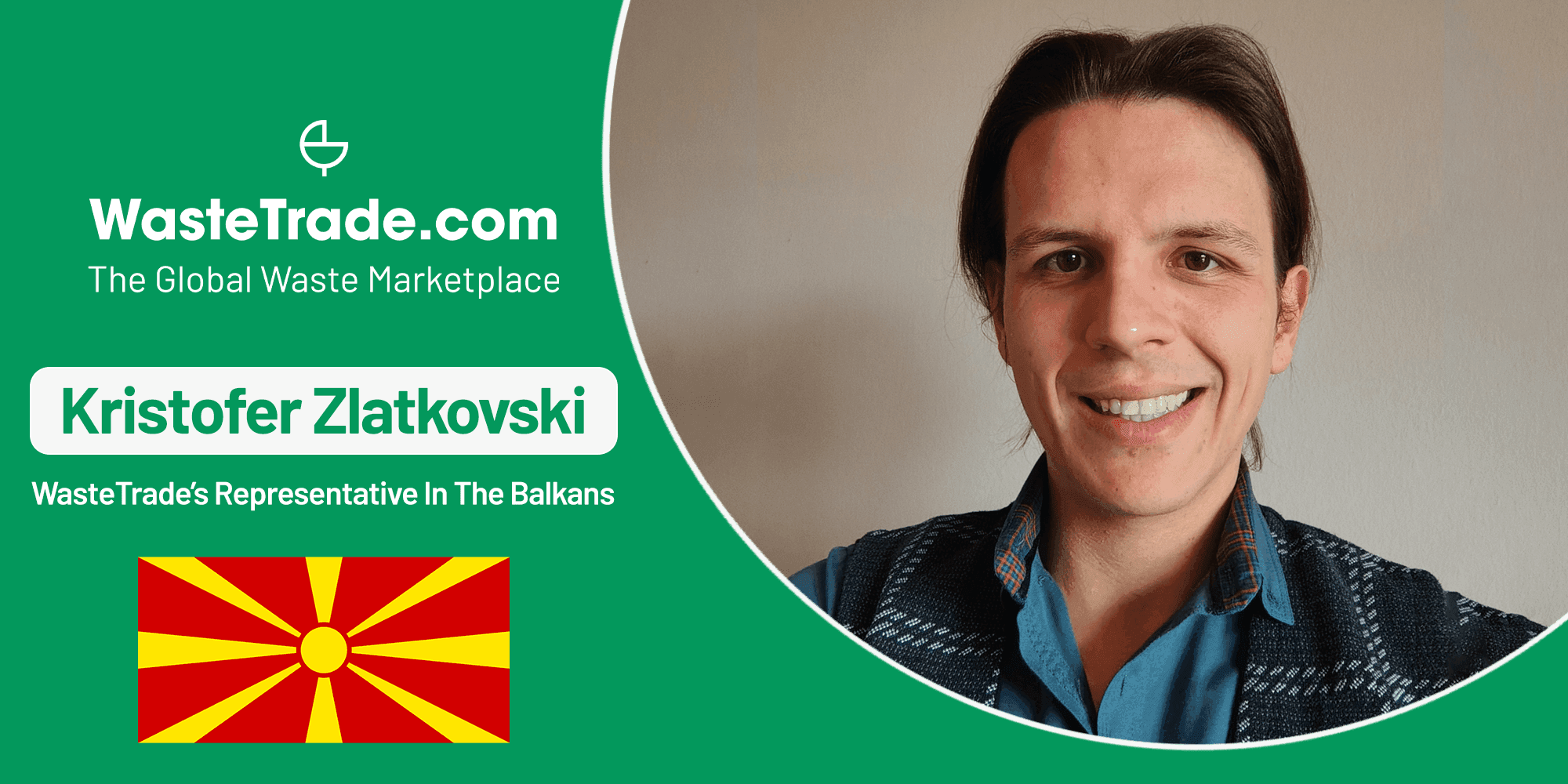
You are leading WasteTrade’s growth across North Macedonia and the wider Balkans. Can you start by telling us about your background and how you first got involved in the recycling or commodities sector?
My educational background is in law, but I do not have a single day of formal working experience in this sector. During my studies I started working in different sales roles to support myself and my education and got addicted to the adrenaline rush in the job, which made me realise this is my calling.
I got into the recycling sector by accident when I was looking for a new job that had to be in my hometown of Kumanovo and the first acceptable offer was for a de-facto General Manager in a recycling company. During my time there I fell in love with the industry and countless opportunities in it. I am still considered new in this sector, but I always strive to never overpromise, and always overdeliver.
You are working across a region with a mix of EU and non-EU markets. What has your experience been like operating in these environments, and what have you learned from it?
When you are driving for 3 hours in the more famous countries nothing much will change. In the Balkans, when you drive for 3 hours you will come across 2 timezones, 3 religions, 3 alphabets, and 10 dialects claiming to be separate languages.
This is very overwhelming for someone outside this region, but for us it is a strong part of our everyday life. EU countries such as Bulgaria, Greece, and Croatia still have to adhere to the laws of the EU but, in their hearts, they are very much Balkan. Over time I learned to take different approaches and understand the difference between what our partners want to hear and what can actually be done.
What attracted you to WasteTrade, and what made you feel it was the right move at this stage in your career?
I first heard of WasteTrade when I attended PRSE 2025 in Amsterdam and met Adam and Rasheed who gave me a very positive first impression of the company and the general principles that WasteTrade stands for.
After some time, some new regulations in the recycling industry affected Macedonia; due to her being economically weak and a non-EU country, it was apparent that my current role will not last very long. The positive impressions I received from WasteTrade, and thinking about how some opportunities could work if my company was a trader, got me to the conclusion that trading has 100 times more opportunities than production and I applied for a position within WasteTrade.
Since joining, what have been your first impressions of the company and how it approaches trading and building relationships in new markets?
At first it was very overwhelming with all the technology and multiple steps needed to get thing moving. Over time, I came to understand that WasteTrade has an approach where the advantages of new technologies, combined with the old school approach of in person communication gives us the perfect opportunity to stand out from the noise.
While everyone else is trying to be the loudest, WasteTrade does its own thing to stand out and so far it works.
The Balkans is a very fragmented region, with differences in regulation, infrastructure, and business culture. How would you describe the current state of the recycling and secondary materials market there?
If we open this discussion it could last for days, and I will still feel as if I have not shared anything. The business culture is more or less the same from Greece to Kosovo to Slovenia, where the traditional approach is preferred to build trust and everyone likes to get things moving immediately.
For the EU countries the same regulations apply everywhere. For Albania and Bosnia, it can be strict, but not that much; Macedonia and Serbia are very strict with their regulations, and Kosovo is a topic by itself. Waste collection is present a lot in the region and prices are very high for it, which makes the recycled materials very expensive as well – that gives us a great opportunity to challenge the current norms and enable WasteTrade to be the main supplier for multiple companies.
As we speak there are a lot of new companies opening in Albania, Serbia, and Bulgaria who have contacted WasteTrade to be their supplier even during the opening stages.
What are some of the biggest practical challenges you face when moving materials across borders in your region?
Most of the companies deal with their materials domestically only. Challenges appear when approvals are needed from certain government bodies to move the material. The process unfortunately takes time and when you receive an answer from the authorities, the market situation has changed multiple times. The deals you had lined up unfortunately often no longer work. At the same time, there is the inexperience of suppliers and dealing with custom procedures due to them selling domestically all the time.
You have visibility across markets like Greece, Bulgaria, and North Macedonia. Where are you currently seeing the strongest demand, and for which materials?
At this moment the biggest demands are in Greece and Bulgaria for PET flakes, as the local supply is very expensive and not workable at all. Bulgaria at the same time has a (quote unquote) “monopoly” on waste in the region, where the highest bidder gets everything
That leaves a lot of companies begging for materials. Most of these companies are small scale palletisers with smaller purchasing power than the top companies. Macedonia, unfortunately is very small, and the recycling sector is going downhill – but waste collection is constantly improving.
In some of these markets, relationships and trust are still very traditional. How important is that when building a trading network, and how does WasteTrade fit into that environment?
The first approach is the ability to speak the native language in the county you are in. A simple “Здраво” (“Hello”) immediately changes the way they see you and WasteTrade. If these same companies are approached by someone from the West, there are reservations on trust. Once they see the representative as one of their own, trust is easier to build.
But that still does not mean you don’t have to work for it; you will still have to prove to them that your “new age” way of doing business is the future. There is still some negative feedback, but once a few align with your views the rest will line-up like dominos. WasteTrade, especially for the smaller companies is their only way to get access to materials they could not on their own.
From your perspective, where are the biggest opportunities for WasteTrade in your region over the next 12 to 24 months?
In the current market situation, getting on good terms with the new companies is the best way WasteTrade can establish its presence in the region. Word of mouth is very present in the region and positive experiences with one company will bring another – again, like dominos.
Please keep in mind that the opposite also applies.
Other than that, the strong players are slowly agreeing to try working with WasteTrade. The way things here work is everyone asks first for a trial, and then, if everything works out, companies want a guarantee that they can rely on having this material supplied for the next few years ahead. It all comes down to finding the right material and keeping them happy as time goes by.
As WasteTrade continues to expand, how do you see the Balkans contributing to the company’s wider international growth?
The Balkans are small with much less purchasing power and consumption than the other regions, but companies here are willing to pay a lot more for material due to the aforementioned reasons – limited supply driving up demand. Two loads with margins of 100 euros/ton per month is better than 10 loads with 15 euros/ton per month – this is true both mathematically, and in that it leads to fewer migraines.
Looking ahead, what is your personal focus when it comes to building WasteTrade’s presence in your territory?
Getting the right contacts in the right companies to get things moving immediately.
All we need here is to do a few deals and new clients will be inquiring about materials by themselves without the need for chasing. It comes down to patience and understanding different business cultures.
Finally, outside of work, how do you like to spend your time? Do you have any hobbies or interests that help you switch off?
Martial Arts, old-school Role-Playing Games (RPGs), and swords are all a man needs to switch off in my opinion. I have a collection of multiple swords and homemade bows and crossbows that I also know how to use thanks to martial arts which makes me feel relaxed and safe.
Get in Touch
You can get in touch with Kristofer at: kristofer@wastetrade.com