A Recycling Industry Under Pressure
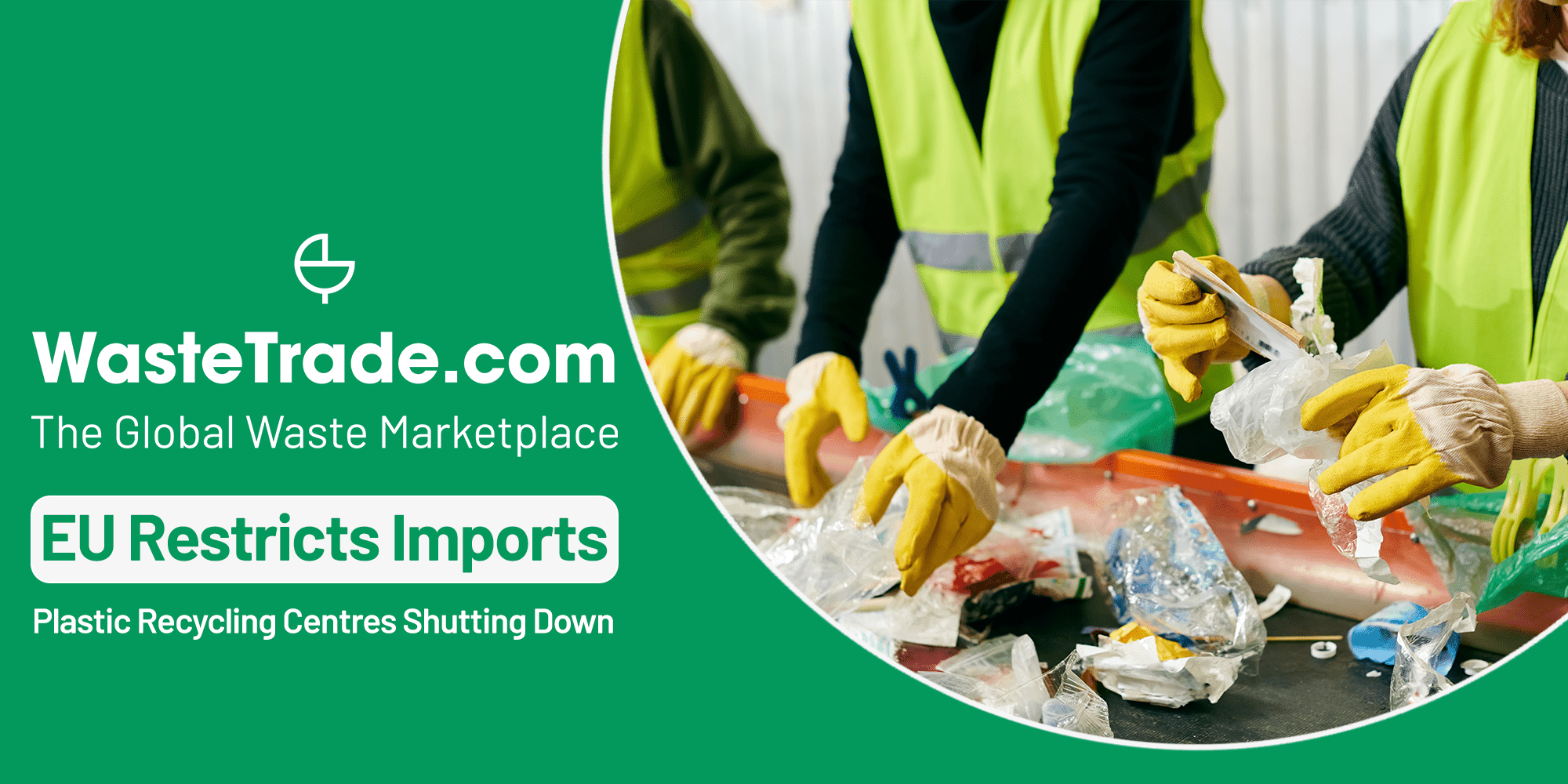
Across Europe, recycling plants are closing at a pace that would have seemed unthinkable only a few years ago. Around one million tonnes of plastics recycling capacity has disappeared in less than two years. In the Netherlands alone, ten plants have shut their doors. Across the EU, the loss is equivalent to France’s entire annual plastics recycling output.
This is happening at the same time as recycled content targets are increasing, sustainability claims are multiplying, and policymakers continue to speak about the circular economy as a core pillar of Europe’s industrial future. The contradiction is now impossible to ignore.
Recyclers are struggling not because demand for plastic has disappeared, but because recycled material is being undercut. Virgin polymer remains cheap. Imports are cheaper still. And in many cases, those imports arrive with far fewer questions asked.
The European Commission has now acknowledged what many in the industry have been saying quietly for some time – the market is no longer working as intended.
Cheap Imports And Distorted Prices
The flow of low-cost plastics into the EU has become a structural problem rather than a temporary imbalance. Even after anti-dumping duties were imposed on certain plastics from China in 2024, imports have continued to arrive in large volumes.
For EU recyclers, the challenge is twofold. First, they face higher operating costs driven by energy prices, labour, compliance, and carbon pricing. Second, they are competing against imported material that may not be playing by the same rules.
One of the most sensitive issues is recycled content itself. European authorities increasingly suspect that not all plastic entering the EU labelled as recycled genuinely is. In practice, virgin material can be cheaper to produce abroad than compliant recyclate produced within the EU. When that material is misclassified, it undermines both pricing and trust.
For recyclers operating in Europe, this is not an abstract policy concern. It is the difference between running a plant at capacity and shutting it down.
New Checks On Recycled Plastics
In response, the European Commission is preparing to introduce additional checks on imported plastics. Central to this is a new customs code that would distinguish recycled plastic from virgin material.
This may sound technical, but its implications are significant. For the first time, customs authorities would have a clear mechanism to challenge recycled claims at the border. Imports would no longer rely solely on declarations and paperwork that are difficult to verify after the fact.
The stated aim is a level playing field. If recycled content targets exist, then the material used to meet them must actually be recycled. Without that certainty, the targets lose credibility and domestic recyclers lose their market.
For traders and manufacturers importing material into the EU, this marks a shift. Proof, traceability, and consistency will matter more than ever. The era of recycled content being taken largely on trust is coming to an end.
End-Of-Waste Rules Under Scrutiny
Another fault line in the EU recycling market lies in how waste is classified. At present, the point at which recycled material stops being legally considered waste varies from one member state to another. What can be traded freely in one country may still be subject to waste shipment controls in another.
This fragmentation creates friction. Material that could be processed efficiently elsewhere in the EU can become stranded by regulation. Transport routes lengthen, costs rise, and plants operate below capacity.
The Commission now wants a single EU-wide criterion for when recycled material ceases to be waste. The intention is to create a genuine single market for recyclates, where material can move to where it is most efficiently processed.
If implemented properly, this could reduce unnecessary bureaucracy, improve utilisation rates, and make cross-border recycling more viable. For an industry built on scale and logistics, consistency matters as much as ambition.
Chemical Recycling Gets Clarity
For years, chemical recycling has sat in a regulatory grey area. Companies have been unsure whether the output would count towards recycled content targets, and investors have hesitated as a result.
That uncertainty is now being addressed. The Commission has confirmed that chemically recycled plastic will count towards recycled content obligations, including the current 25 percent target for PET drinks bottles, rising to 30 percent by 2030.
This does not settle every debate around chemical recycling. Questions about energy use, environmental impact, and feedstock remain. But from a regulatory perspective, the direction is clear. Chemical recycling is being recognised as part of the future mix, not excluded from it.
For the market, clarity is often more valuable than endorsement. Investment decisions depend on rules that are stable and predictable, not provisional.
Recycling As Strategic Infrastructure
What is emerging is a broader shift in how the EU views recycling. It is no longer treated solely as an environmental service. It is increasingly framed as industrial infrastructure that must be protected.
This mirrors developments in other sectors. Heavy industries such as steel, glass, ceramics, chemicals, and batteries are receiving greater state support due to high energy and carbon costs. With EU carbon prices exceeding 80 euros per tonne, the risk of production moving offshore is real.
Recycling sits within this same logic. If domestic capacity collapses, Europe becomes more dependent on imported material, often with weaker environmental oversight. Circular economy goals become harder to achieve, not easier.
Protecting recycling capacity is therefore not about shielding inefficiency. It is about maintaining the ability to process materials within Europe under European standards.
What This Means For The Market
For EU recyclers, tighter import checks could bring some relief, but only if quality and consistency are maintained. Scrutiny will increase across the board, not just at the border.
For traders and importers, the message is clear. Classification, documentation, and traceability will be examined more closely. Recycled material will need to stand up to inspection, not just satisfy a specification sheet.
For manufacturers, supply chains may start to shift. Verified EU-sourced recyclate may carry a premium, but it also carries certainty in a regulatory environment that is becoming less forgiving.
Transparency Becomes Unavoidable
As regulation tightens, the recycling market is being pushed towards greater transparency. This is not about technology for its own sake, but about information – who produced the material, how it was processed, and whether it genuinely meets the claims attached to it.
Marketplaces that bring buyers and sellers together with clear specifications, verified counterparties, and traceable material flows are increasingly aligned with this direction of travel. When rules tighten, opacity becomes a liability.
A Clear Change In Direction
The EU’s message is becoming more direct. Recycling targets alone are not enough if the market collapses underneath them. Cheap imports that undermine domestic capacity are no longer being treated as an acceptable side effect of global trade.
The focus is shifting towards fair competition, verifiable claims, and resilient European recycling infrastructure. For an industry that has long operated in the margins of policy, this represents a meaningful change.
Whether these measures arrive quickly enough to prevent further closures remains to be seen. But the direction is clear. Europe cannot build a circular economy if its recyclers cannot survive.