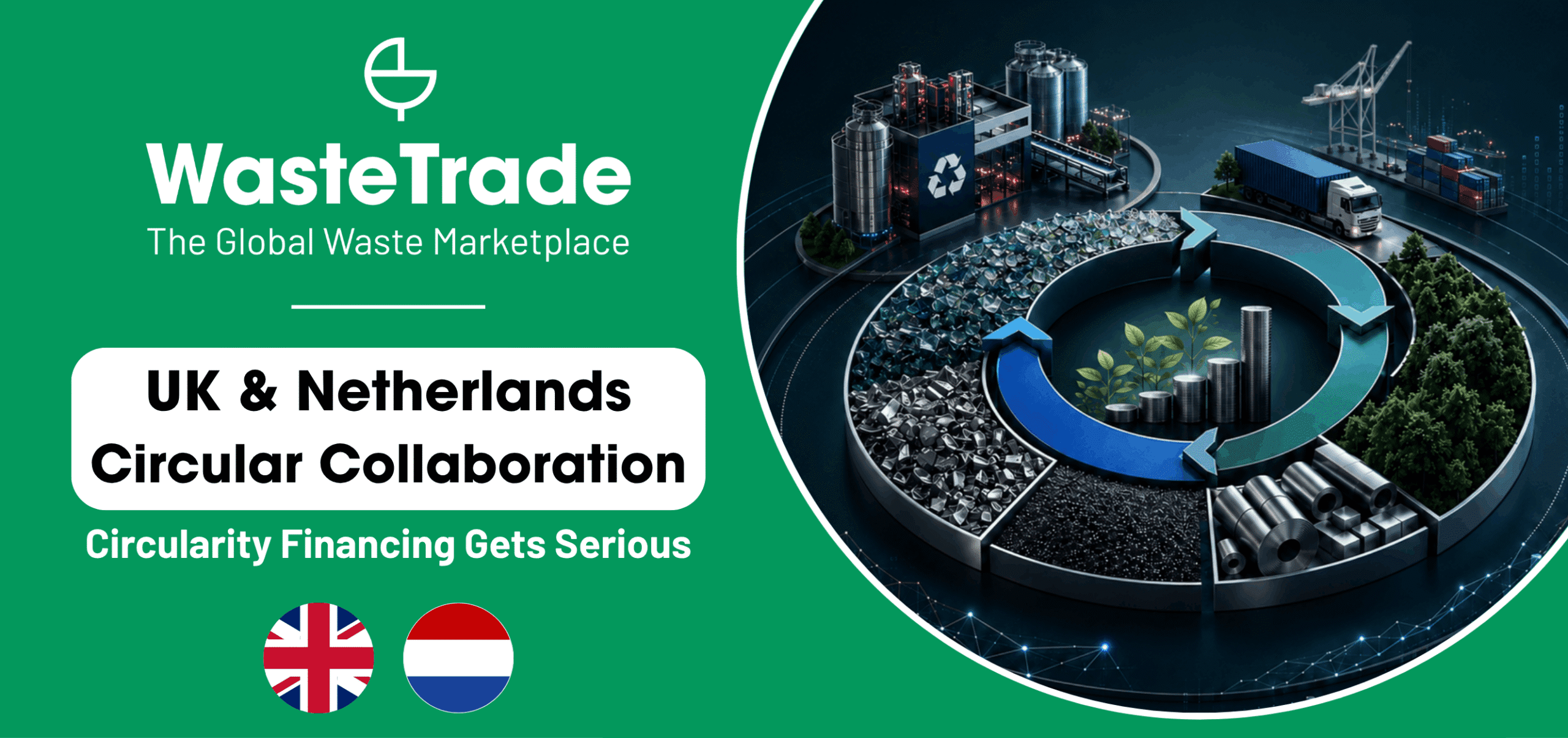
Circular economy finance is becoming one of the most important questions facing the waste, recycling and secondary materials sectors. In simple terms, it means directing money towards businesses, projects and systems that keep materials in use for longer, rather than allowing them to become waste. That includes recycling and reprocessing, but it also reaches into reuse, repair, remanufacturing, logistics, material traceability, digital marketplaces and circular product design.
The UK and Dutch governments have now signalled that this area needs more structure. Their agreement to collaborate on circular economy finance is not just another policy announcement. It reflects a growing understanding that the circular economy will not scale on ambition alone. It needs investment, and investment needs clarity.
For businesses working with recyclable materials, this matters. Capital will increasingly follow circular activity, but investors will expect companies to define it, measure it and prove it. That is where the future of the circular economy starts to become more practical, more commercial and more demanding.
Why Circular Economy Finance Matters
The circular economy has often been discussed through the language of recycling targets, waste reduction and environmental responsibility. Those ideas still matter, but they do not go far enough.
A functioning circular economy needs sorting facilities, reprocessing capacity, reverse logistics, transparent trading systems, reliable end markets and better data on material flows. It needs manufacturers that can use secondary raw materials with confidence. It needs waste producers to understand the value of what they generate before useful materials disappear into costly disposal routes.
All of this requires finance.
The difficulty is that circular business models do not always fit neatly into traditional lending or investment categories. Their value may sit in avoided disposal costs, retained material value, reduced dependence on virgin resources, lower carbon impact, better regulatory alignment or stronger supply chain resilience.
That makes circular economy finance more complex than simply funding “green” projects. Finance providers need to understand what circular activity looks like in practice, how to measure it and how to judge its risks.
The UK And Netherlands Circular Economy Finance Agreement
The UK and Netherlands have committed to working together on a shared understanding of circular economy finance. A central part of that work is a voluntary reference framework intended to support common definitions, measurement methods and indicators for lending, financing and investing in circular activities.
That may sound technical, but it addresses a real market problem.
The word “circular” covers a wide range of activity. A recycler processing plastic packaging, a manufacturer using recycled feedstock, a repair business extending product life and a digital platform trading secondary materials may all contribute to circularity. They do so in different ways, with different risks and different types of evidence.
Without clearer definitions, lenders and investors struggle to compare opportunities. Businesses also face inconsistent expectations when they try to prove their circular credentials.
A reference framework will not build infrastructure by itself. It will not create demand for recycled materials or solve every challenge in waste movement. But it can help create the shared language that finance needs before it can move with confidence.
Capital Needs Evidence, Not Slogans
The circular economy does not lack ambition. What it often lacks is proof.
For finance providers, the question is not whether a project sounds sustainable. The question is whether it can show credible circular outcomes. Does it reduce virgin material use? Does it keep resources in productive use? Does it create measurable commercial or environmental value? Can the company evidence its claims?
For secondary materials, those questions become very practical.
What is the material? Where did it come from? What condition is it in? Who is buying it? Where will it go? Does the movement comply with the relevant rules? Can the transaction support audit, reporting and due diligence?
These details matter because circularity depends on what actually happens to materials. A waste stream only becomes part of the circular economy when it finds a viable route back into use.
Secondary Raw Materials Need Stronger Markets
Secondary raw materials sit at the centre of the circular economy. They reduce reliance on virgin resources and help retain value already present in the economy. Yet the markets around them have often been fragmented.
Quality can vary. Supply can be inconsistent. Buyers and sellers may lack visibility over each other. Cross-border movement can involve complex documentation. Prices can move with commodity markets. Trust can become a limiting factor.
These barriers do not only affect recyclers and waste producers. They affect the investment case for circularity.
A lender assessing recycling infrastructure will care about feedstock security. A manufacturer considering recycled content will care about quality, consistency and availability. An investor looking at circular business models will care about whether material flows can support reliable revenue.
That is why circular economy finance depends on stronger secondary materials markets. It needs systems that make materials visible, comparable, traceable and tradeable.
WasteTrade And Circular Market Infrastructure
WasteTradeoperates in this practical space. The platform connects businesses generating recyclable materials with verified buyers, recyclers, reprocessors and end users. In doing so, it helps turn waste streams into secondary resources with clearer routes back into productive use.
Its role matters because circularity does not happen simply because a material has potential value. The right buyer needs to find it. The seller needs a credible route to market. The movement needs to make commercial and regulatory sense. The transaction needs enough trust for both sides to proceed.
WasteTrade helps bring structure to a market that can otherwise be difficult to navigate. For sellers, it can open access to a wider network of buyers and help recover value from materials that might otherwise be treated mainly as a cost. For buyers, it can improve access to recyclable commodities through a more transparent trading environment.
That is not only useful at transaction level. It also speaks directly to the direction of circular economy finance. As investors and lenders look for measurable circular activity, platforms that support visibility, documentation and trusted trading will become more important.
Compliance And Circular Economy Finance
Waste and recyclable materials do not move outside regulation. Cross-border shipments, material classifications, documentation requirements and environmental controls shape how circular markets operate.
As regulation becomes more digital and more closely monitored, compliance will form a larger part of financial risk. A transaction that lacks proper documentation does not only create an administrative problem. It can create legal, reputational and commercial exposure.
This matters especially for international recycling and secondary raw materials. Digital waste shipment systems and stronger traceability expectations point towards a market where businesses need clearer records of where materials come from, where they go and how they move.
Circular economy finance will reflect that reality. Banks and investors will ask whether circular activities can operate within the rules, generate reliable records and support credible reporting.
WasteTrade’s approach aligns with this shift. By supporting a more structuredtradingprocess and helping businesses navigate the movement of recyclable materials, the platform contributes to the confidence that circular markets need.
Material Traceability In The Circular Economy
Traceability is becoming central to circularity. In a linear economy, materials often lose their identity once they become waste. In a circular economy, that information becomes valuable.
Material origin, composition, quality, handling history and end destination can all influence price, compliance and buyer confidence. They can also influence whether a circular activity looks investable.
This is why digital systems, material records and Digital Product Passport-style thinking are becoming more significant. The more information a material carries, the easier it becomes to assess its value and risk. Better data can help buyers compare options, support sustainability reporting and give finance providers a clearer basis for assessing circular activity.
In this context, WasteTrade’s role in transparent material trading sits within a wider market shift.Circular economyfinance will increasingly favour businesses and systems that can evidence material flows, not just describe them.
The next stage of circularity will not only depend on how much material gets recovered. It will depend on how clearly that recovery can be documented and connected to real demand.
From Waste Cost To Resource Value
For many businesses, waste has traditionally appeared as a cost. It needed collection, treatment and disposal. Circular economy finance challenges that view.
When a material has a credible route back into use, it becomes more than a liability. It becomes a potential source of value. That value may come through resale, avoided disposal, improved sustainability performance, reduced exposure to virgin material markets or stronger alignment with customer expectations.
Not every waste stream has equal value. Quality, contamination, volume and location all matter. But businesses that understand their material streams will be better placed to benefit from circular markets.
They will know what they produce, in what quantities, to what specification and with what potential onward use. Platforms such as WasteTrade can then help connect that material intelligence with market demand.
This is where the circular economy becomes commercial. Not abstract, not distant, but rooted in the movement of materials from one business to another.
What Businesses Should Do Now
The UK and Netherlands agreement should encourage businesses to look closely at how prepared they are for a more finance-led circular economy.
Waste producers should improve how they classify and record materials.Recyclersand reprocessors should expect stronger questions around origin, specification and compliance. Manufacturers should assess where secondary raw materials can support procurement resilience and sustainability goals.
Finance providers should also widen their view. Circular economy finance should not focus only on largerecycling facilities. It should also recognise the enabling systems that allow circular markets to function, including digital marketplaces, logistics networks, traceability tools, compliance platforms and material data systems.
These systems may not always look like traditional infrastructure, but they increasingly perform an infrastructural role. They help materials move, help markets form and help circular value become visible.
Building A Finance-Ready Circular Economy
Circular economy finance is entering a more serious phase. The UK and Netherlands agreement reflects a wider recognition that circularity needs capital, and capital needs confidence.
Shared definitions and indicators will help. So will clearer policy, better reporting and stronger international guidance. But the success of circular economy finance will ultimately depend on what happens in the real economy. Materials must be recovered, identified, traded, transported and returned to productive use. Those processes must be transparent enough for businesses, regulators and finance providers to trust.
WasteTrade’s relevance lies in that practical ground between circular ambition andcircular delivery. By creating a more transparent marketplace for recyclable commodities, connecting credible counterparties and supporting the movement of secondary materials, WasteTrade is helping to build some of the foundations a finance-ready circular economy will require.
The future of circularity will belong to businesses that can prove value, not merely claim it. Circular economy finance will reward those that can show where materials come from, where they go and how they contribute to a more resilient use of resources.
That is the deeper significance of the UK and Netherlands agreement. It points towards a market where waste is not judged only by what it was, but by what it can become.