For much of 2024 and 2025, talk around plastic scrap imports into Turkey has been loud, confused, and often wrong. LinkedIn posts declaring HS codes “dead”. Rumours of blanket bans. Claims that mixed plastics are finished overnight.
The reality heading into 2026 is more subtle, and more serious.
Turkey is not closing its doors to recycled plastic. What it is doing is enforcing a framework that quietly removes low-grade, poorly defined, and trader-led material from the market. For exporters and buyers alike, this is not a legal technicality. It is an operational shift that will decide who can still trade and who cannot.
This matters well beyond Turkey. As one of the most important recycling and manufacturing hubs in the region, its approach is a signal of where compliance expectations are heading more broadly.
No Ban, Just A Higher Bar
There is no single regulation in force for 2026 that bans plastic waste imports outright. HS codes such as 19 12 04 remain valid. What has changed is how strictly the existing framework is applied, and how much proof is now required at every stage of a shipment.
The centre of gravity has moved away from tariff rates and customs declarations, and towards environmental compliance, facility capability, and material quality. In practice, that shift is far more disruptive than a headline ban.
Importers Must Be Processors
One of the clearest pillars of Turkey’s waste import regime is that imported waste must be processed by the importing facility itself. Importing as a paper exercise, with material sold on to a third party, is not the model the system is built to support.
This is not new language, but it is now actively enforced through inspections, registration requirements, and quotas. Importers are expected to demonstrate that they have the physical capacity to process what they bring in, and that the volumes imported align with that capacity.
For exporters, this changes the risk profile of the buyer. The question is no longer just price and payment terms, but whether the counterparty is a licensed processor with audited capability.
Facility Inspections And Import Quotas
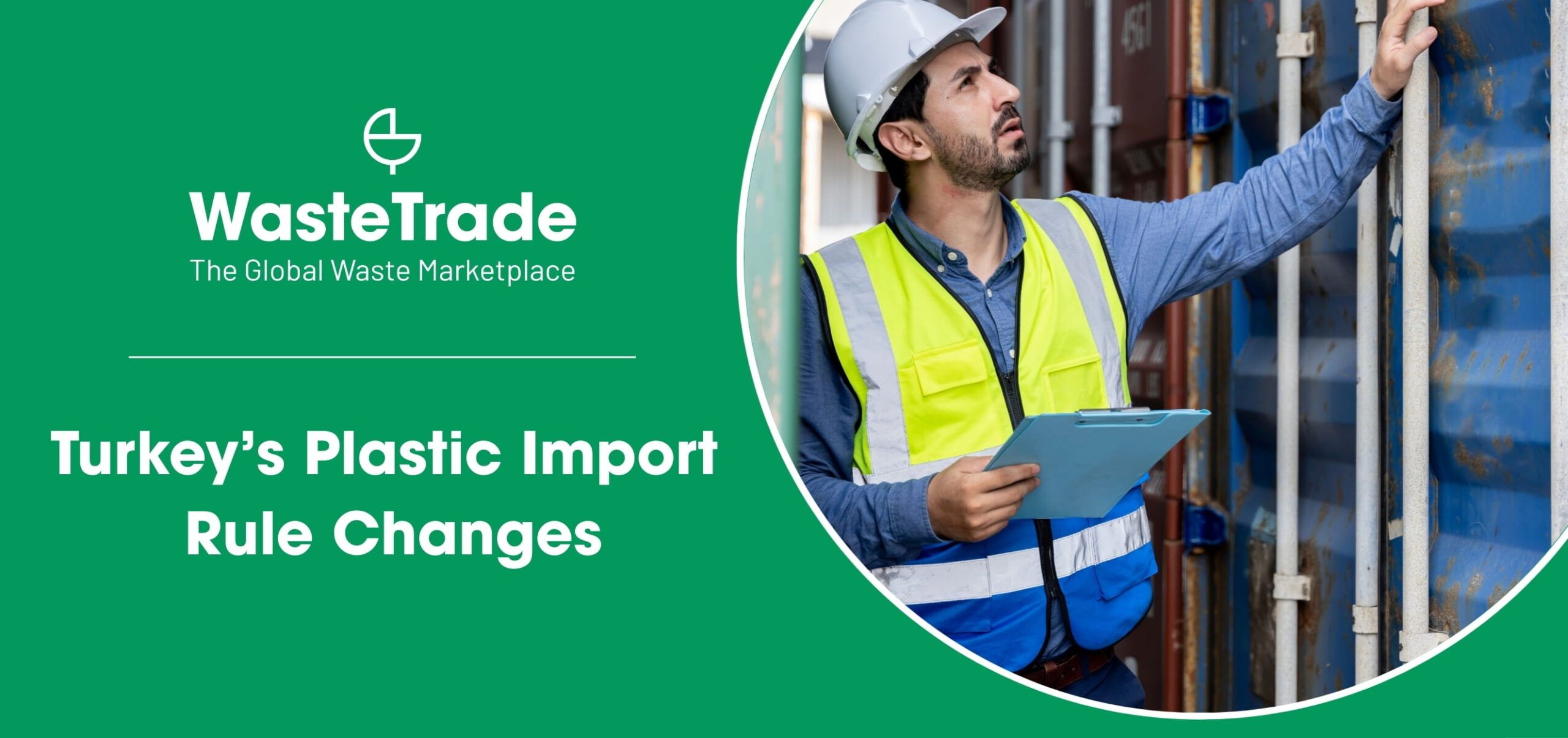
Imports of non-hazardous waste into Turkey are now firmly tied to facility-level controls. These include annual inspection reports, a Waste Importer Registration Certificate issued by the Ministry, and an import quota calculated based on processing capacity.
The quota element is particularly important. Even a fully licensed facility cannot import unlimited volumes. Importers must track their remaining quota through the system and plan shipments accordingly.
The message is clear. Waste imports are no longer about finding a customs clearance route. They are about proving, on paper and in practice, that the material can be processed responsibly.
The 1 Percent Contamination Rule
Perhaps the most commercially significant pressure point is the contamination threshold. The framework requires that imported waste contain no more than 1 percent foreign matter by weight.
This requirement has existed for some time, but enforcement has sharpened. For mixed or loosely specified material, especially manually sorted bales, meeting this threshold consistently is difficult.
This is where much of the confusion around “mixed plastics” originates. There is no sentence in the law that says mixed plastics are banned. Instead, mixed and poorly sorted material struggles to pass a contamination test that is now treated as a hard specification, not a guideline.
For exporters, this means quality control moves from a nice-to-have to a contractual necessity.
Form Matters As Much As Polymer
Another area where enforcement has tightened is material form. Bottles, films, flexibles, and bags are no longer interchangeable under broad descriptions.
Recent guidance and enforcement practice make this clear. Bottle-only streams are treated very differently from loads that include films or flexibles, even if the polymer family appears similar on paper. Shipments declared as bottles but containing bags or films are increasingly exposed to rejection and penalties.
The industry shorthand of “mixed bottles” is becoming risky. Material form must be explicit, consistent, and defensible.
Traceability Before The Shipment Moves
Turkey’s waste import process now expects shipments to be audit-ready before arrival. This includes photographs of the material taken in the country of origin, uploaded during conformity steps, and written declarations confirming correct classification, recyclability, and the absence of hazardous or out-of-scope material.
Transport tracking also plays a growing role, particularly around port entries and movements within customs-controlled areas. Environmental authorities are increasingly involved in what was once treated as a purely customs-led process.
For exporters used to resolving issues after arrival, this is a meaningful change. Problems identified late are less likely to be negotiated away.
What This Means For HS 19 12 04
HS code 19 12 04 has become a lightning rod for debate, but the practical reality is straightforward. There is no new 2026 regulation that singles out this code for prohibition. What has changed is the tolerance for ambiguity.
Material shipped under 19 12 04 that is clean, well-defined, and demonstrably recyclable can still move. Material that is mixed, contaminated, or inconsistently described is increasingly likely to fail under inspection, contamination thresholds, or importer capacity checks.
The risk is no longer theoretical. Enforcement activity, inspections, and penalties have increased, and classification decisions are being scrutinised more closely, particularly in light of Basel Convention amendments that clarify how mixed plastics should be treated.
In short, 19 12 04 is not disappearing. What’s disappearing is poorly defined material.
Virgin Plastics And The Cost Signal
Alongside recycled material controls, there has been renewed attention on virgin polymer imports. Much of the noise centres on a widely reported temporary safeguard-style charge applied to certain virgin PET resin imports.
This measure introduces an additional cost of around $100 per tonne for a limited period, pending investigation outcomes. It applies to specific PET resin classifications and should not be interpreted as a blanket charge across all virgin plastics.
Other polymers may face additional charges depending on HS code and country of origin, but these vary significantly. The important point is not the exact figure, but the direction of travel. Trade policy tools are increasingly used to manage material flows, and recycled content is not insulated from that context.
Why Turkey Is Tightening The Screws
These changes do not exist in a vacuum. Domestic scrutiny around imported waste has been intense, driven by media investigations, environmental groups, and public concern. At the same time, exporting regions, particularly in the EU, are tightening their own controls around plastic waste movements and documentation.
Basel amendments have added further clarity around classification and consent requirements, increasing the risk attached to mixed or poorly described material. For Turkey, enforcing higher standards is as much about credibility and control as it is about environmental outcomes.
What Exporters Need To Do Now
For exporters supplying recycled plastics into Turkey, preparation is no longer optional.
Contamination thresholds should be treated as hard specifications and reflected in contracts and inspection routines. Shipment evidence packs, including photographs and declarations, should be standard practice rather than reactive paperwork.
Equally important is buyer due diligence. Exporters need confidence that the importer is a licensed processor with valid registration, recent inspection reports, and sufficient quota headroom.
What Buyers And Importers Must Prepare For
For Turkish buyers, the environment rewards realism. Import volumes must align with actual processing capacity. Documentation, traceability, and internal controls need to stand up to inspection, not just satisfy a broker.
The days of absorbing poorly defined material and resolving issues later are fading. Compliance failures now carry real operational and financial consequences.
Why Market Structure Matters
As enforcement tightens, the way materials are listed, described, and matched becomes more important. Trading environments that rely on vague descriptions and informal assurances are increasingly exposed.
Clear definitions of polymer, form, cleanliness, and volume are no longer administrative details. They are the foundation of whether a trade will succeed.
This is the direction the market is moving, whether participants welcome it or not.
The Bottom Line For 2026
Turkey’s approach to plastic imports in 2026 is not about closing the market. It is about narrowing it to those who can demonstrate quality, traceability, and genuine processing capability.
For the recycled plastics trade, the era of ambiguity is ending. Not with a ban, but with enforcement that rewards clarity and quietly removes everything else.
WasteTrade is here to support your business through navigating these changes. Between, our vast network, our logistics specialists, and our compliance experts, we are perfectly position to help your business when dealing with moving material under Turkey’s new rules.
To reach out to our team for support, please contact WasteTrade Turkey at: turkey@wastetrade.com.