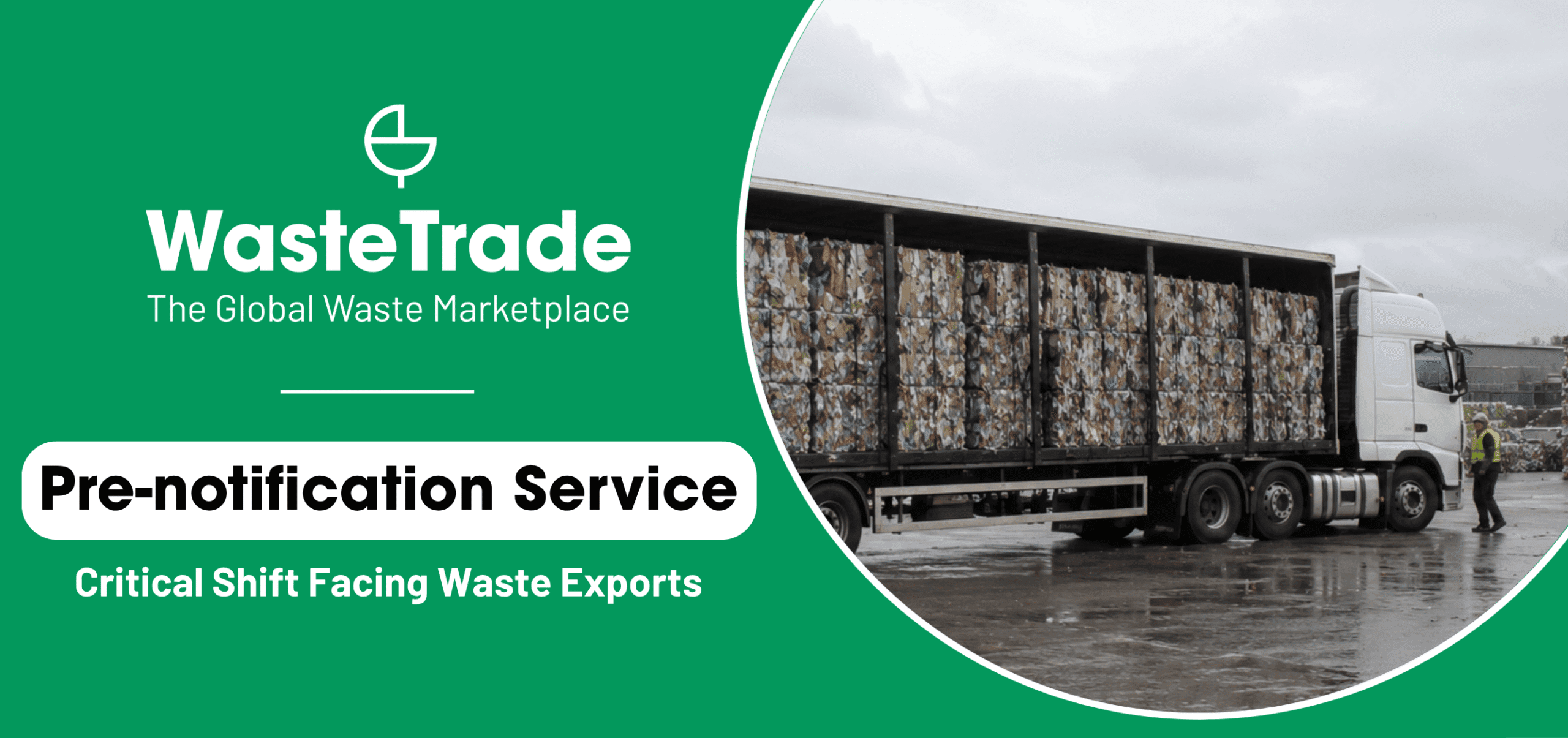
Pre-notification service requirements are rapidly becoming one of the most important issues facing plastic waste exports across the UK and Europe.
Thousands of tonnes of mixed and lower-grade plastics currently moving under Green List procedures may soon require formal notification approval before export, particularly material commonly traded under code 19 12 04. For many exporters, the real issue is no longer whether material can move internationally. It is whether it can continue moving without disruption, delay or regulatory challenge.
Across Europe, authorities are tightening their interpretation of plastic waste classifications. Loads that moved routinely eighteen months ago are now attracting additional scrutiny around contamination, polymer mix, downstream recovery and shipment documentation. In some cases, exporters are only discovering the problem once buyers request further evidence or authorities intervene at transit stage.
For businesses trading lower-grade film, mixed rigid plastics or MRF-derived material, the market is entering a very different phase.
WasteTrade has developed its pre-notification service specifically for this changing environment, helping suppliers maintain compliant export routes as enforcement standards tighten across international waste exports.
Why Waste Export Controls Are Tightening
The direction of travel has been building for years.
Changes under the Basel Convention, combined with the revised EU Waste Shipment Regulation, are steadily reshaping how plastic waste exports move internationally. Regulators are drawing a much firmer distinction between clean, traceable recyclable material and mixed or contaminated waste streams that require closer control.
Historically, many plastic waste exports moved under simplified Green List procedures with relatively limited intervention. In practice, however, contamination thresholds often varied significantly between exporters, recovery facilities and competent authorities.
That gap is narrowing quickly.
Authorities across Europe are now applying far stricter interpretations around:
- contamination levels
- mixed polymer content
- downstream recovery routes
- evidence of environmentally sound recycling
- shipment traceability
The result is a growing shift towards formal notification procedures for material that may previously have moved under Article 18 controls.
DIWASS And The Future Of Waste Exports
From May 2026, the European Union’s Digital Waste Shipment System, known as DIWASS, will begin changing how notification procedures are managed across Member States.
While the practical rollout will evolve in stages, the wider significance is already clear. Waste exports are moving into a far more transparent and centralised regulatory environment.
Digitisation gives authorities greater visibility over:
- shipment movements
- notification records
- recovery destinations
- carrier information
- downstream facilities
For exporters, this represents more than an administrative update. It signals a permanent shift towards tighter evidential standards across international waste exports.
Businesses relying on vague classifications, inconsistent paperwork or weak downstream verification are likely to face increasing pressure over the coming years.
Which Plastic Waste Streams Face The Highest Risk?
Not all plastic waste exports face the same level of exposure.
Clean, single-polymer material with low contamination levels generally continues to move through compliant Green List procedures without major difficulty.
The greatest pressure sits around mixed and lower-grade fractions, particularly:
- low-grade LDPE film
- construction and demolition film
- MRF film streams
- mixed 3D plastics
- pots, tubs and trays
- mixed bottle bales
- bottle bales containing tray contamination
- lower-grade PP Big Bags
Film waste remains one of the clearest examples. Agricultural film, heavily printed LDPE and mixed post-commercial film often contain inconsistent contamination levels that can alter the classification profile of a shipment very quickly.
MRF-derived plastics present similar challenges. Variability between loads, cross-contamination and inconsistent sorting standards create obvious concerns for authorities assessing whether a shipment genuinely qualifies for simplified procedures.
Mixed rigid plastics continue attracting increasing attention across export markets as well. Pots, tubs and trays often contain layered materials, labels, residues and mixed polymers, all of which complicate classification and downstream recovery assessment.
None of these materials are inherently prohibited from export. The issue is whether the classification, quality and recovery route genuinely support movement under simplified controls.
That distinction is becoming increasingly important across international waste exports.
Green List Vs Notification Controls
One of the biggest misunderstandings in the market is the assumption that Green List procedures automatically apply to all non-hazardous plastic waste exports.
They do not.
Green List controls were designed for clean, well-sorted recyclable material moving to legitimate recovery operations. They were never intended to cover poorly sorted, heavily contaminated or operationally ambiguous waste streams.
This is where many exporters now face difficulty.
A load classified internally as recyclable plastic may still trigger notification requirements once authorities assess:
- contamination
- mixed polymer content
- moisture levels
- downstream processing routes
- recovery facility approvals
In practical terms, the difference between Green List movement and formal notification increasingly comes down to material quality and evidential confidence.
That creates a major commercial divide between exporters operating with strong compliance infrastructure and those relying on historic market assumptions.
The Commercial Cost Of Shipment Rejection
The financial consequences of non-compliant waste exports can escalate quickly.
A single rejected container can erase the margin across several successful shipments.
Once authorities challenge a load, exporters may face:
- demurrage charges
- port storage fees
- return-to-origin costs
- delayed vessel bookings
- disrupted buyer relationships
- additional sampling requirements
- increased carrier scrutiny
For businesses operating on tight export margins, even short delays can become commercially damaging.
Buyers are also becoming more selective. Recovery facilities increasingly want reassurance around material quality, classification and downstream traceability before accepting shipments.
As compliance expectations rise, exporters with established notification routes are likely to hold a significant operational advantage over competitors still relying on uncertain classification positions.
What A Pre-Notification Service Actually Involves
Many businesses understand the phrase pre-notification service but have limited visibility into the operational detail behind it.
In reality, successful notification procedures involve far more than paperwork alone.
Waste Classification And Recovery Verification
Every notification process begins with classification assessment.
Exporters must review:
- material composition
- contamination levels
- polymer mix
- recovery routes
- destination facility approvals
For mixed plastics and lower-grade film, this stage can become highly technical very quickly.
Authorities increasingly expect exporters to demonstrate that receiving facilities hold the appropriate permits, carry out legitimate recovery operations and can process material compliantly.
Weak downstream verification is becoming one of the most common pressure points within plastic waste exports.
Notification Documentation And Authority Liaison
Formal notification procedures also involve extensive documentation.
Depending on the shipment route, exporters may need:
- notification applications
- financial guarantees
- contractual documentation
- carrier information
- recovery facility approvals
- transit authority consent
Where multiple jurisdictions are involved, approval may also be required from dispatch, destination and transit authorities before movement can begin.
As application volumes increase across Europe, timelines may also become more difficult to predict.
That operational complexity is precisely why more exporters are now looking for dedicated pre-notification service support rather than attempting to manage notification procedures internally.
Why WasteTrade Developed Its Pre-Notification Service
WasteTrade operates directly within international recycling and secondary commodity markets, giving the company practical exposure to the operational realities behind plastic waste exports.
Over the past year, the company has seen a clear increase in:
- buyer caution
- facility verification requirements
- contamination scrutiny
- classification challenges
- export route pressure
In response, WasteTrade developed a dedicated pre-notification service designed to support suppliers moving plastic waste exports across the UK and Europe.
The service includes:
- waste classification review
- recovery facility verification
- notification preparation
- competent authority liaison
- shipment monitoring
- compliance documentation management
More importantly, the objective is not simply regulatory compliance in isolation.
The wider aim is to maintain commercially workable export routes in an environment where oversight, documentation standards and recovery verification are all becoming significantly more demanding.
That distinction matters.
Exporters do not simply need forms completed. They need logistics routes that continue functioning commercially as market conditions tighten.
The Future Of Plastic Waste Exports
The international trade in recyclable plastics is not disappearing.
Demand for secondary raw materials remains substantial across global manufacturing markets, particularly as recycled content targets continue increasing across packaging and industrial sectors.
What is changing is the level of control surrounding how those materials move internationally.
Cleaner material will become more commercially valuable. Consistent sorting standards will matter more. Recovery facilities with strong compliance records are likely to attract increasing demand from exporters seeking stable long-term routes.
At the same time, lower-grade and mixed plastics may become increasingly concentrated among operators capable of managing notification procedures, downstream verification and complex recovery documentation at scale.
For exporters prepared to adapt early, that shift may create opportunity as much as difficulty.
The businesses best positioned for the next phase of international waste exports will not necessarily be those chasing the cheapest route. They will be the operators capable of combining commercial reach, material quality and credible compliance infrastructure in equal measure.