EU Plastic Waste Export Ban 2026: What Is Actually Changing?
From late 2026, a structural shift will hit global plastic recycling flows. Under the new EU Waste Shipment Regulation (EU) 2024/1157, the European Union will prohibit exports of plastic waste to non-OECD countries from 21 November 2026, for at least two and a half years, with the possibility of later derogations.
Between May 2026 and November 2026, shipments of certain “clean” plastic wastes (Basel code B3011) to non-OECD destinations will still be possible, but only under prior written notification and consent, adding time, cost and administrative risk. After 21 November 2026, these flows are essentially turned off until at least May 2029.
This is layered on top of:
- Existing bans on hazardous waste exports to non-OECD countries.
- Stricter oversight of exports even to OECD destinations, with closer scrutiny of how plastic waste is managed at the receiving end.
For non-OECD processors who built their business on European LDPE film, HDPE bottles and drums, PET bottles, PP and mixed rigids, this is not a marginal rule change. It is the scheduled closure of a major supply line.
EU Waste Shipment Regulation 2024/1157 and Global Plastic Scrap Trade
The new regulation aims to stop the EU from exporting its environmental burden and to push more plastic recycling and treatment inside Europe. The effect, however, will ripple far beyond the EU’s borders.
In recent years, analyses show:
- OECD countries still export significant quantities of plastic waste to non-OECD destinations, even though volumes have declined since the height of China’s imports.
- Several South-East Asian non-OECD countries remain major destinations for plastic waste and scrap.
From 2026 onwards, however, the EU’s plastic flows to non-OECD economies will fall to effectively zero for at least 2.5 years. That material must either be managed within Europe or diverted to other OECD partners. For non-OECD processors who depended on those bales, the question becomes simple and uncomfortable:
What replaces Europe?
Countries Most Affected by the EU Plastic Waste Export Ban
The ban will touch a wide range of non-OECD processors across Africa, Asia and the Middle East. Among the most exposed are:
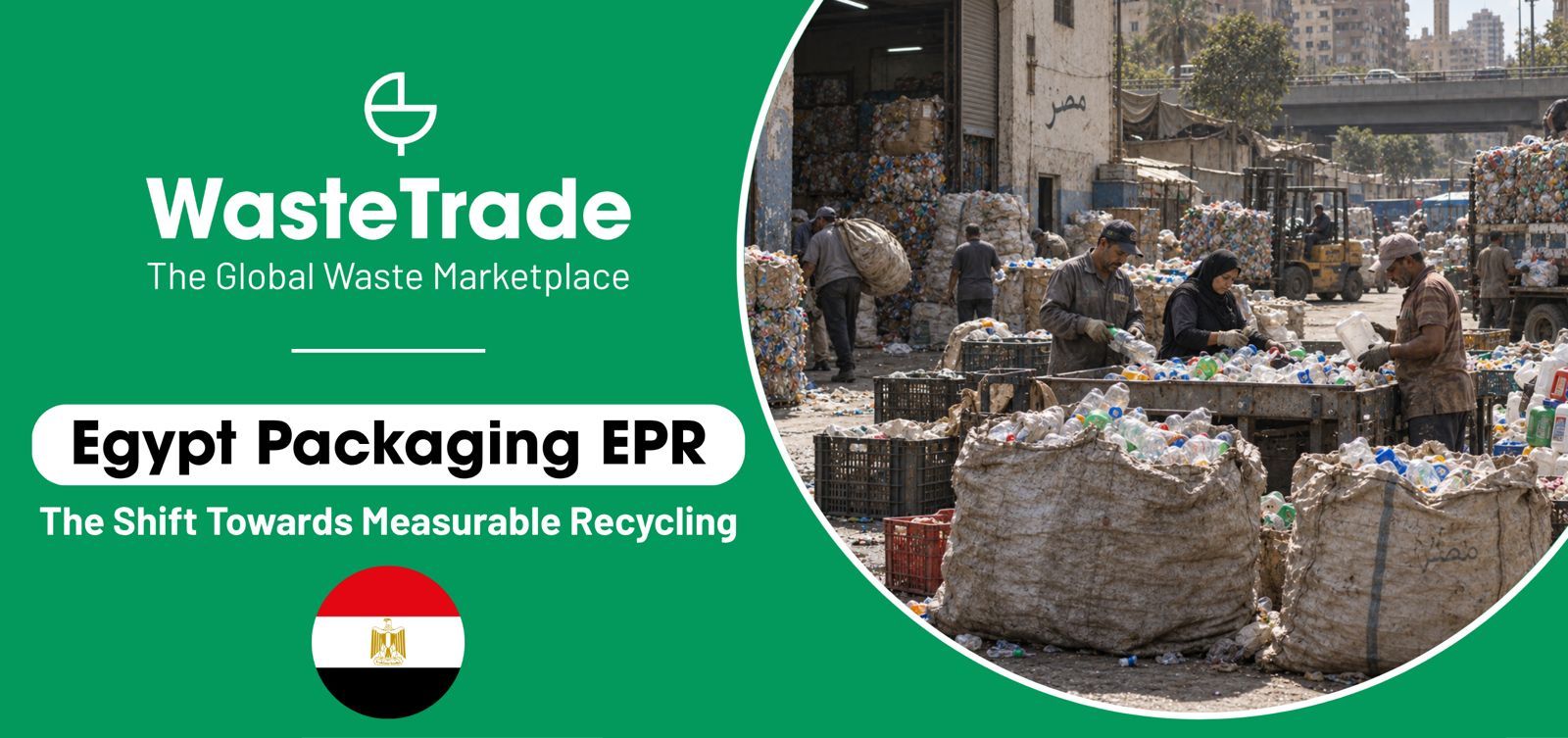
- Egypt and other North African processors that import European plastics as a core feedstock.
- India, Vietnam, Malaysia, Indonesia and other Asian recyclers, many of which continue to receive plastic scrap from OECD exporters.
- East African and West African recyclers, from Kenya to Ghana, who process imported LDPE, HDPE, PET and mixed rigids to serve domestic and regional markets.
Many of these plants invested in lines, labour and downstream contracts on the assumption that European supply would remain available, even if more tightly controlled. The upcoming ban removes that assumption.
Plants that rely heavily on EU-origin bales face a cascade of risks: reduced utilisation, erratic operating schedules, pressure on margins and, in extreme cases, mothballed capacity.
West Africa Plastic Recycling Feedstock Gap
Nowhere is the tension between risk and opportunity clearer than in West Africa.
On the demand side, the region is moving quickly:
- Consumption of packaged goods continues to rise as cities grow and incomes increase.
- Governments, including Ghana’s, are positioning the region as a hub for waste management and circular economy policy, with Ghana formally designated the West Africa Regional Hub for policy support on waste and resource circularity.
- New and upgraded facilities for PET, HDPE, LDPE and PP recycling are being built to reduce reliance on imported virgin resin.
On the supply side, however, domestic collection systems are still catching up. Imported European scrap has been a critical complement: medium- to high-quality bales that allow plants to run steadily while local feedstock systems mature.
When EU plastic exports to non-OECD countries stop in November 2026, a feedstock gap opens. Unless processors move quickly to secure new origins and strengthen domestic supply, some will find themselves competing over a shrinking pool of suitable material.
WasteTrade Ghana Plastic Recycling Hub and West Africa
This is the context in which WasteTrade’s expansion into Ghana matters.
WasteTrade is a global online marketplace that connects waste generators and recyclers for plastics, metals, cardboard and other waste commodities, with verified participants and structured listing, bidding, contracting and logistics tools.
Over the past year, WasteTrade has:
- Launched a dedicated Ghana office, giving the company a formal base in Tema and a direct presence in the West African recycling ecosystem.
- Built relationships with local recyclers, aggregators and manufacturers, as well as informal sector actors who are essential to feedstock mobilisation.
- Positioned Tema as the starting point for a West Africa network, serving exporters and processors in countries such as Ivory Coast, Senegal and Nigeria.
Ghana’s own policy trajectory amplifies this. As the region’s designated hub for waste-management and circular-economy policy support, Ghana is likely to see further regulatory moves on collection, segregation and producer responsibility in the coming years.
For non-OECD processors in West Africa, this means WasteTrade is not a distant digital platform but an actor already embedded locally, with an on-the-ground understanding of permits, environmental requirements and the realities of moving containers through West African ports.
Challenges for Non-OECD Plastic Recyclers After the EU Export Ban
As the 2026 deadline approaches, non-OECD processors can expect a cluster of pressures:
- Loss of European feedstock: a complete halt to EU plastic waste exports to non-OECD countries from 21 November 2026 to at least May 2029.
- Price volatility as more buyers chase fewer suitable bales, especially for PET and higher-grade PE and PP streams.
- Reduced availability of mixed plastics: lower-grade, mixed and contaminated loads that previously moved under more lenient regimes will be harder to source.
- Supply uncertainty – shipping slots, documentation and changing rules create execution risk, making it harder to plan plant utilisation.
- Competition for high-quality scrap: EU recyclers and manufacturers will retain more material within Europe, increasing competition at origin.
- Greater reliance on domestic waste streams, which may be more inconsistent, more contaminated and harder to standardise.
- Operational pressure: plants will face growing expectations on environmental performance, traceability and quality control from any OECD supplier willing to ship.
These challenges are real, but they are not evenly distributed. Operators who prepare now will experience the same policy as a catalyst rather than a constraint.
How Non-OECD Plastic Recyclers Can Diversify Plastic Scrap Supply
Diversifying Plastic Scrap Origins Beyond the EU
The first principle is straightforward: no single-region dependence.
In practice, that means:
- Looking to OECD Asian exporters such as Japan or South Korea, where regulatory regimes and quality standards are already stringent.
- Expanding regional African trade in recyclables, for example between West African neighbours, to balance domestic flows.
- Gradually deepening ties with local collection systems – municipalities, informal networks, cooperatives and NGOs – so that domestic and regional feedstock becomes less erratic over time.
Above all, it means engaging with the United States, which remains one of the largest generators and exporters of plastic scrap worldwide.
Improving Compliance Standards to Attract OECD Suppliers
The tightened EU regime is part of a wider pattern: exporters are under growing pressure to prove that their plastics are treated responsibly abroad.
For processors in Africa and Asia, this is not just a paperwork issue; it is a commercial signal. Plants that can demonstrate:
- Valid and up-to-date environmental permits.
- Documented downstream routes for their outputs.
- Basic health, safety and environmental procedures.
are more likely to be trusted by OECD suppliers and marketplaces. Over time, those operational standards become part of the plant’s competitive advantage.
Strengthening Sorting, Washing and Quality Control
As origin portfolios diversify, quality variability increases. Processors will need to tighten:
- Inbound inspection – bale checks, contamination thresholds and clear rejection criteria.
- Washing and flake cleaning – to handle wider ranges of contamination and label types.
- Laboratory testing – for melt flow index, moisture and contamination to reassure downstream buyers.
Even modest investments in better sorting, washing and testing can make a plant a more attractive destination for high-quality scrap and help secure longer-term contracts.
Securing Medium-Term Feedstock Contracts
The era of relying solely on spot shipments is ending.
Non-OECD processors should aim, wherever possible, to:
- Negotiate 6–24 month contracts with minimum tonnages and agreed quality specs.
- Use indexed or banded pricing mechanisms to manage volatility.
- Combine contracted volumes with a smaller spot exposure rather than relying on spot alone.
Digital platforms that aggregate multiple suppliers – rather than a handful of personal contacts – can make it easier to secure and manage these agreements.
Using Verified Marketplaces for Plastic Scrap Procurement
This is where marketplaces such as WasteTrade are increasingly important.
WasteTrade’s platform offers:
- A global pool of verified suppliers and buyers for plastics, metals, cardboard and other recyclables.
- Structured listings with filters for polymer, grade, location, volume and other technical parameters.
- Integrated tools for logistics coordination, documentation and digital contracting, all within a single environment.
For non-OECD processors, this reduces the risk of relying on informal broker networks while still allowing them to discover new supply origins and partners.
US Plastic Scrap Exports to Africa and Asia After 2026
With EU flows restricted, the United States becomes even more significant for non-OECD processors.
The US:
- Is one of the largest plastic scrap exporters globally.
- Exported around 400,000 tonnes of recycled plastics in 2024, out of 32 million tonnes of recycled materials overall.
- Ships significant volumes of plastic scrap to countries such as India, Malaysia, Indonesia and Vietnam, with a meaningful share going to non-OECD destinations.
At the same time, the US has an extensive network of material recovery facilities and recycling infrastructure, capable of producing reasonably consistent PET, HDPE and mixed-plastic streams.
As European supply tightens, US exporters will be looking for reliable offshore partners who can manage material in a compliant and technically capable way. Processors who are ready – in terms of permits, quality control and logistics – are in a good position to capture some of that redirected tonnage.
WasteTrade’s expanding presence in the US and its global marketplace infrastructure place it in a natural mediating role between American suppliers and African and Asian buyers.
West Africa Plastic Recycling Opportunities 2026–2028
The years from 2026 to 2028 are likely to be turbulent – but also unusually rich in opportunity for West African recyclers and investors.
On the demand side:
- Packaging and FMCG sectors will continue to require plastics, and policy pressure for recycled content is unlikely to diminish.
- Ghana’s status as a regional policy hub for waste management and circular economy suggests further reforms to support structured waste collection and recycling markets.
On the supply and infrastructure side:
- There is room for investment in collection, aggregation, sorting and washing capacity.
- Technology upgrades – from optical sorters to better washing and flake-handling – can unlock higher-value applications and export options.
- Logistics networks can be improved to move material efficiently between coastal hubs such as Tema and inland cities.
In this setting, WasteTrade Ghana acts as both a physical and digital anchor: a hub that can coordinate material from US and other OECD origins into West Africa, while also helping local players find stable outlets for their own recycled outputs.
WasteTrade Marketplace for Plastic Scrap Supply Security
As non-OECD processors adjust to the new regime, WasteTrade’s role can be framed in very practical terms. The platform helps plants:
- Access verified supply from the USA, from Europe where exports remain lawful, and from other OECD trading partners.
- Receive transparent documentation, including shipping records and compliance paperwork aligned with the new regulatory environment.
- Obtain pre-shipment images and, where needed, video of loads to reduce disputes and surprises on arrival.
- Rely on licence checks and counterpart verification, reducing the risk of dealing with non-compliant operators.
- Use digital contracts and payment flows that create a clear record of each transaction.
- Benefit from logistics support, including coordination with carriers and ports, especially through hubs such as Tema in Ghana.
The result is not a promise to remove volatility, but a way of reducing avoidable uncertainty and building more predictable feedstock arrangements in a less forgiving regulatory climate.
Non-OECD Plastic Processors 2026 Outlook: A Forward-Looking View
The 2026 EU export restrictions mark a decisive moment. They will close off established routes, compress margins and expose plants that have left their supply chains to habit and hope.
Yet the same measures are also forcing a more honest reckoning with where plastic is generated, where it is processed, and on what terms. Non-OECD processors that diversify supply, lift their operational standards and build robust relationships with credible platforms and partners will not simply survive this period; they will become more central to the next phase of global recycling.
For West Africa – and especially Ghana – the coming years are an opportunity to pair policy ambition with real industrial capability, backed by serious partners.
WasteTrade, with its global marketplace, US and European presence, and Ghana hub, is already orienting its network around this new reality. The task now is to ensure that processors across Africa and Asia take full advantage of that infrastructure before the 2026 deadline arrives.
If you operate a plant in a non-OECD country and want to stabilise your feedstock ahead of the EU ban, this is the moment to start those conversations – not after the last European container has sailed.