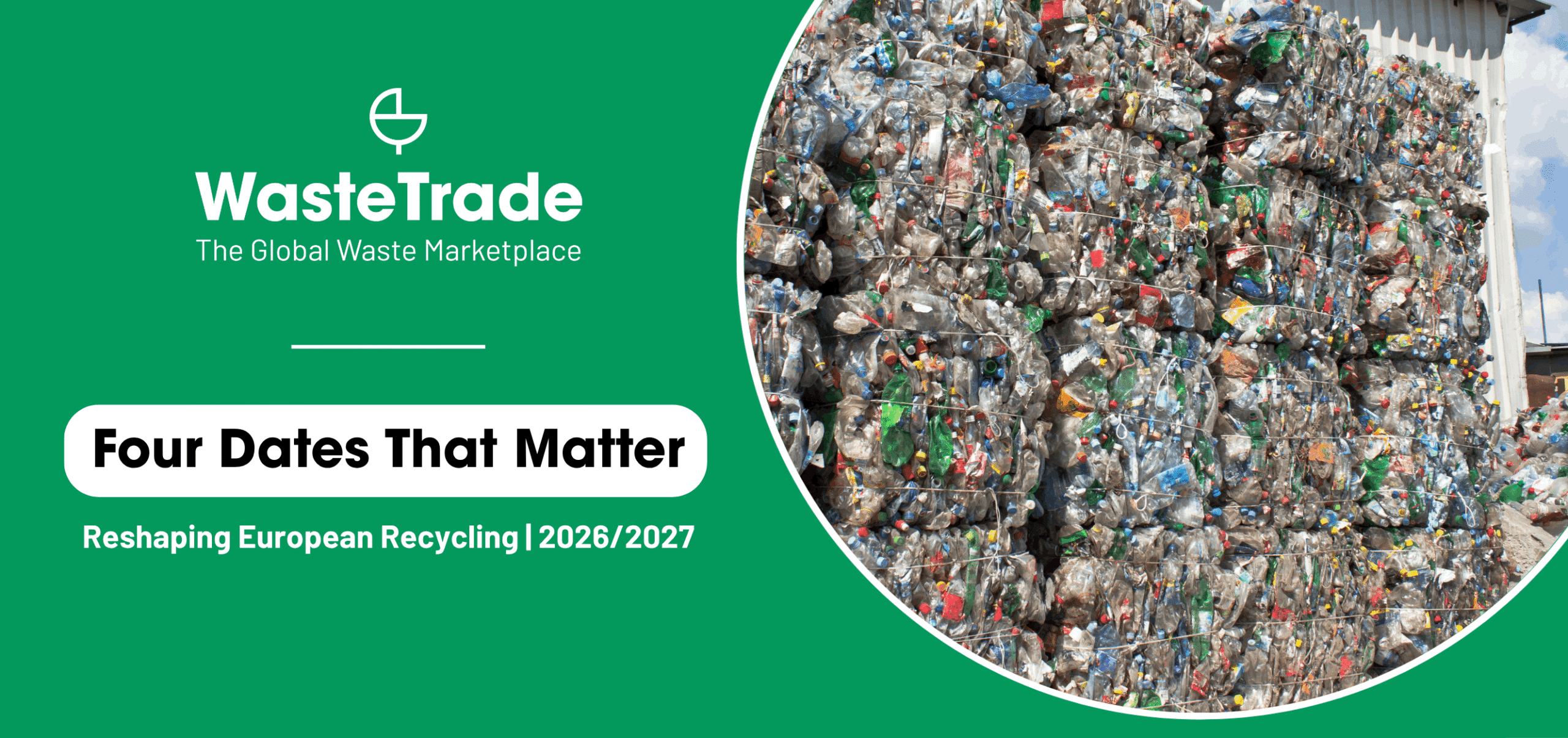
Why 2026 Marks A Turning Point For European Recycling
For years, the European recycling industry has operated within a relatively stable framework of export routes, compliance expectations and market dynamics. That stability is now ending. The regulatory changes landing across 2026 and into 2027 are not incremental adjustments. They represent a structural tightening of how waste is moved, traded and ultimately valued.
Two forces are converging at the same time. The revised EU Waste Shipment Regulation is placing far greater control on where waste can go and under what conditions. At the same time, the Packaging and Packaging Waste Regulation is increasing demand for high-quality recycled material by reshaping how packaging must be designed and recovered.
Taken together, these changes will alter pricing, restrict certain trade flows and reward those who can operate within a more complex compliance environment. For recyclers, traders and manufacturers, the question is no longer whether to adapt, but how quickly.
EU Waste Shipment Regulation And PPWR Explained
It is important to separate the two regulatory tracks driving this shift. The EU Waste Shipment Regulation governs the movement of waste across borders. It determines which materials can be exported, to which countries and under what level of scrutiny. The direction is clear. Fewer open routes, more documentation and tighter enforcement.
The Packaging and Packaging Waste Regulation, by contrast, operates upstream. It governs how packaging is produced, used and recovered within the European market. Its impact is less about movement and more about composition. It will drive higher demand for recycled content, stricter recyclability standards and greater accountability across the value chain.
The result is a squeeze from both sides. Supply routes become more restricted at the same time as demand for compliant recycled material increases. This is where the market begins to shift. Those who can still move material efficiently, and prove its compliance, will hold the advantage.
Platforms such as WasteTrade sit directly within this pressure point. As regulatory friction increases, the value of structured, compliant trade execution becomes more apparent.
21 May 2026 Plastic Waste Export Rules Tighten
The first major date arrives on 21 May 2026. From this point, all plastic waste exports from the EU, including non-hazardous streams previously traded with relative ease, will fall under the prior notification and consent procedure.
This is not a minor administrative change. It introduces formal approval requirements from competent authorities in both exporting and importing countries. It also brings plastic waste into a more controlled regulatory category, regardless of quality.
At the same time, the EU’s digital waste shipment system becomes operational. In theory, this should streamline processes. In practice, it will expose any weaknesses in documentation, classification or process discipline.
For operators on the ground, the consequences are immediate. Deal timelines lengthen. Transactions become more dependent on accurate paperwork. The margin for error narrows. Shipments that might once have moved quickly can now be delayed or rejected outright.
This is where operational capability begins to separate participants in the market. Companies that rely on fragmented processes or informal networks will find it harder to execute. Those using structured systems, with clear documentation and vetted counterparties, will be able to maintain flow.
WasteTrade plays a practical role here. By embedding compliance into the transaction process and working with verified buyers and processors, it reduces the risk of failed shipments and shortens the path from listing to execution.
12 August 2026 PPWR Compliance Deadline Begins
On 12 August 2026, the Packaging and Packaging Waste Regulation begins to apply. This marks the point at which packaging compliance moves from planning into operational reality.
It is worth being precise. Not every obligation within the PPWR takes effect immediately. Many targets, particularly around recycled content and reuse, are phased in over time. However, from August 2026, businesses are expected to have their compliance strategies in place and actively functioning.
This has direct consequences for procurement and material sourcing. Packaging producers and brands will need reliable access to recycled materials that meet both quality and traceability requirements. Lower-grade or poorly sorted material becomes harder to place. Higher-quality recyclate becomes more valuable.
The effect is a shift in demand. It is no longer sufficient to produce recycled material. It must be demonstrably suitable for compliant packaging applications.
This is where access becomes critical. WasteTrade provides visibility across available material streams, allowing buyers to source compliant recyclate and compare supply options across different markets. In a tightening environment, that visibility has real commercial value.
21 November 2026 Plastic Waste Export Ban To Non OECD Countries
The most disruptive date in the timeline arrives on 21 November 2026. From this point, all exports of plastic waste from the EU to non OECD countries are banned.
This removes a significant outlet that has historically absorbed large volumes of European plastic waste. Even for cleaner, non-hazardous streams, the route is effectively closed during the ban period.
The immediate impact is displacement. Material that would have been exported must find alternative destinations. In the short term, this creates pressure within European and OECD markets. Prices may soften in some segments, while competition for compliant buyers intensifies.
Over time, the market is likely to rebalance. Domestic and regional processing capacity may expand. Material quality will become more important as buyers become more selective.
For exporters and traders, speed of adjustment is critical. Those able to quickly identify alternative buyers and secure new offtake arrangements will limit disruption. Those who cannot may face stock build-up, reduced pricing and operational strain.
WasteTrade offers a route through this disruption by providing access to a broader network of OECD buyers and facilitating faster reallocation of material. When a major export channel closes, the ability to pivot quickly becomes a defining advantage.
21 May 2027 New EU Waste Export Rules And Authorised Countries
The final date in this sequence, 21 May 2027, marks the point at which the new export architecture is fully in place.
From this stage, exports of non-hazardous waste to non OECD countries are generally prohibited unless the destination country has been authorised and placed on the European Commission’s list. In addition, exporters must rely on independent audits to demonstrate that receiving facilities manage waste in an environmentally sound manner.
It is important to be precise here. These rules do not apply uniformly to all waste streams in the same way. Plastic waste follows its own timeline, including the earlier ban. Other materials are subject to the authorised country framework.
What is consistent is the direction of travel. Exporting waste is no longer a straightforward logistical exercise. It becomes a regulated transaction requiring verification, documentation and ongoing oversight.
This increases both cost and complexity. It also reinforces the role of structured trading environments. Platforms that can verify counterparties, manage documentation and provide transparency across the transaction become more valuable.
WasteTrade is positioned within this shift. By integrating compliance checks, logistics coordination and payment security into a single platform, it allows companies to continue trading in a more restricted environment with greater certainty.
What These EU Recycling Regulations Mean For The Market
Taken together, these four dates point to a market that is becoming more controlled, more localised and more quality-driven.
Export routes are narrowing. The ability to send material to distant, less regulated markets is being reduced. This places greater emphasis on regional trade within Europe and across OECD countries.
Material quality is becoming decisive. As regulatory scrutiny increases, contamination and misclassification carry greater risk. Buyers are likely to favour consistent, well-specified material that can move through compliance processes without issue.
Compliance itself is becoming a commercial factor. It is no longer just a legal requirement. It directly affects deal speed, buyer confidence and ultimately pricing.
There will be volatility, particularly in the early stages of these changes. Some segments may experience oversupply. Others may see tighter availability. Over time, the market is likely to stabilise around more structured and transparent trade flows.
How WasteTrade Helps Businesses Adapt To EU Waste Rules
In this environment, the traditional approach to waste trading becomes harder to sustain. Informal networks, manual processes and fragmented logistics struggle under increased regulatory pressure.
WasteTrade provides an alternative model built around structure and visibility. It connects verified buyers and sellers, supports compliance processes and integrates logistics and payment into the transaction.
For exporters, this reduces the risk of delays and rejected shipments. For buyers, it improves access to reliable material streams. For both, it shortens the distance between listing and completed deal.
As regulations tighten, the ability to execute becomes as important as the material itself. Platforms that reduce friction and increase certainty will play a larger role in how the market operates.
The Real Shift Behind The 2026 Recycling Timeline
The significance of these dates goes beyond compliance. They signal a broader shift in how the European recycling market functions.
Control over material flows is increasing. Access to compliant buyers is becoming more limited. The ability to move material quickly and reliably is no longer guaranteed.
In that context, the companies that perform well will not necessarily be those with the largest volumes. They will be those with the strongest systems, the clearest visibility and the ability to operate within a more demanding regulatory framework.
The market is not closing. It is becoming more selective. And in a more selective market, execution is everything.