Chemical recycling in Europe is entering a more serious phase.
For years, the conversation centred on capacity announcements. New plants. New technologies. New partnerships between petrochemical producers and waste operators. The narrative was one of scale on the horizon.
Now the mood has shifted.
Procurement teams are under pressure to secure reliable feedstock. Investors are asking harder questions about supply risk. Brands are scrutinising recycled content claims. Regulators are tightening expectations around traceability, documentation and cross-border waste movements.
In that environment, availability is no longer enough.
Certainty is becoming decisive.
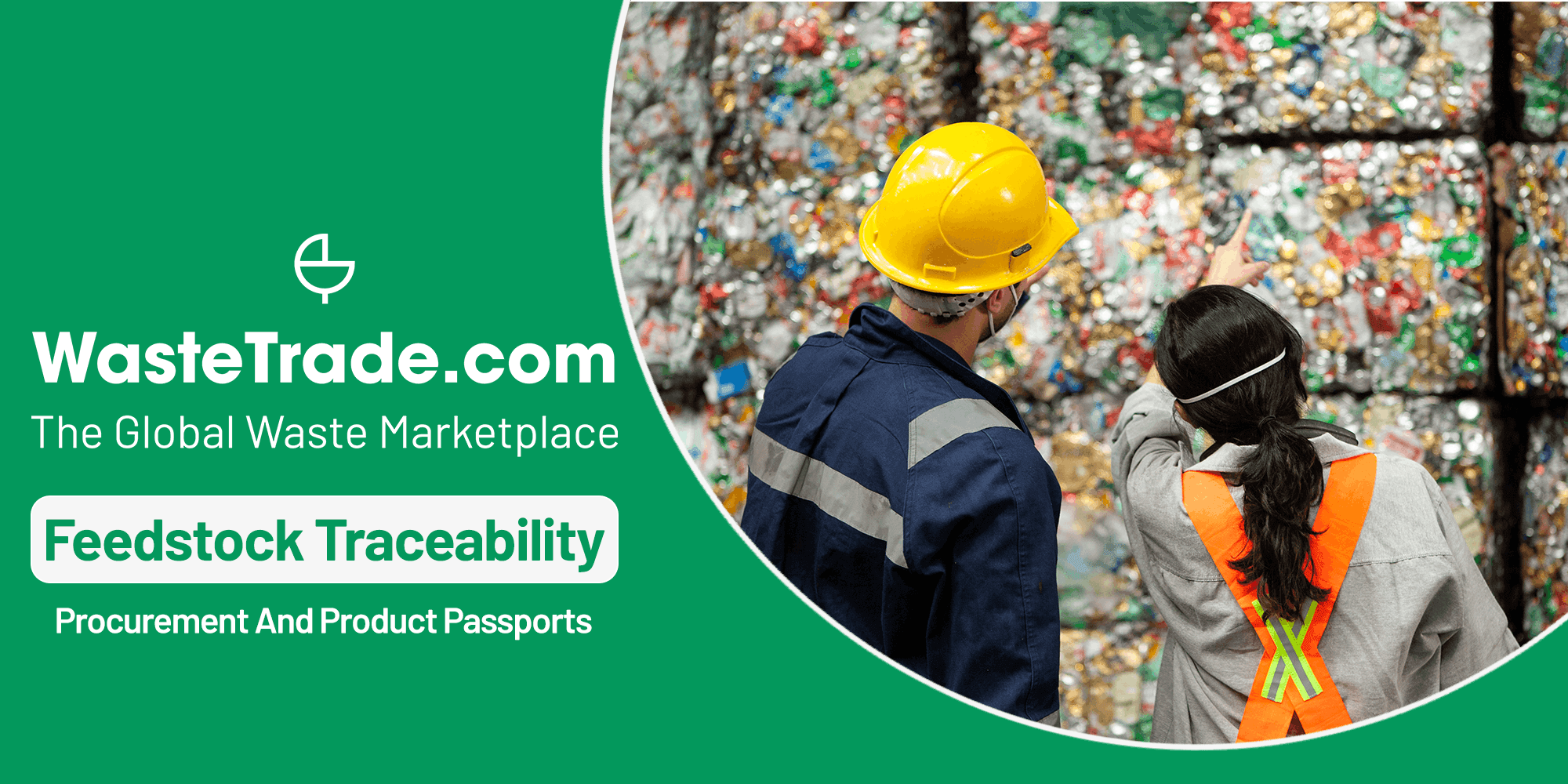
The next stage of chemical recycling will not be defined by how much material exists. It will be defined by how well that material is described, verified and contractually structured. That is where feedstock traceability and digital product passports enter the picture.
WasteTrade’s forthcoming Product Passport sits directly in this space. It is not a marketing label. It is an attempt to solve one of the least visible but most persistent bottlenecks in advanced recycling markets: fragmented material data.
Chemical Recycling Feedstock Procurement Is Getting Harder
Talk privately to chemical recyclers and the same themes emerge.
Securing feedstock is not simply about volume. It is about:
- Defined polymer type and grade
- Moisture content within agreed limits
- Known contamination thresholds for PVC, metals and fines
- Additive load and degradation indicators
- Clear waste classification and shipment controls
- Handling and storage history
- Confidence in regulatory alignment
None of this is new. Mechanical recyclers have wrestled with these questions for decades. What has changed is the scale of scrutiny.
Chemical recycling plants are capital-intensive. Feedstock inconsistency can undermine yields, contaminate outputs or create compliance exposure further down the value chain. When investors and brand customers are watching closely, tolerance for uncertainty narrows.
Yet much of the underlying information still lives in familiar places: email chains, spreadsheets, ad hoc PDF specifications recreated for each transaction. A description written for one counterparty is copied, amended and resent to another. Sampling methods differ. Terminology drifts. Historical data is hard to retrieve.
Every new deal feels like a first deal.
That friction slows scale more than most people admit.
Re Qualification Friction In Chemical Recycling Markets
One of the hidden costs in chemical recycling feedstock procurement is repeated qualification.
A recycler may approve a stream of coloured PET or mixed polyolefin once. The material performs within expected ranges. A contract is signed. But when the same stream is offered to another plant, or when the contract is renewed months later, the qualification process often begins again.
Questions are asked again. Documents are shared again. Clarifications are repeated.
Multiply that across dozens of streams and multiple counterparties and the inefficiency compounds.
This is not a failure of goodwill. It is a structural weakness in how material identity is handled. There is rarely a persistent digital identity for a feedstock stream. There is only a description attached to a transaction.
Scale does not fail because feedstock does not exist. It fails because feedstock cannot be trusted quickly enough.
EU Digital Product Passport Regulation And Recycling Traceability
The regulatory direction of travel in Europe is clear. Structured, machine-readable product data is moving from concept to legal framework.
The Ecodesign for Sustainable Products Regulation establishes the basis for Digital Product Passports across product groups. Delegated acts will define how information is structured, accessed and verified. The principle is straightforward: product information should not be informal or opaque. It should be standardised and accessible.
At the same time, the new Packaging and Packaging Waste Regulation tightens expectations around recyclability, recycled content and harmonised compliance. Claims will need to withstand scrutiny. Data will need to be defensible.
The revised Waste Shipment Regulation increases traceability requirements for cross-border movements and pushes further towards digital documentation systems.
These frameworks do not yet dictate exactly how chemical recycling feedstock must be documented in every case. But they establish a direction. Information flows, regulatory compliance and material identity are converging.
It is increasingly difficult to imagine a future where finished goods are subject to structured digital passports while upstream feedstock continues to be described in inconsistent, transaction-specific documents.
Feedstock data is being pulled into the same gravity field.
Mass Balance Certification And Feedstock Data Integrity
Chemical recycling often relies on mass balance accounting to attribute recycled content to final polymer outputs. When recycled feedstock is processed alongside virgin inputs, bookkeeping becomes critical.
Certification schemes such as ISCC PLUS and others require clear documentation of input characteristics, sustainability claims and chain of custody. The credibility of recycled content claims depends on robust input data.
If the feedstock narrative is weak, the mass balance narrative is exposed.
Persistent, structured data at feedstock level does not replace certification. But it supports it. It reduces ambiguity. It creates a more reliable foundation for allocation and audit.
For chemical recyclers scaling capacity and engaging with brand customers, that distinction matters.
Introducing The WasteTrade Product Passport
Against this backdrop, WasteTrade is preparing to launch its Product Passport.
The concept is simple but overdue.
Instead of attaching a fresh description to every transaction, the Product Passport creates a structured, persistent digital profile for a recyclable material stream traded on the platform.
It is not a marketing badge. It is operational data embedded directly into trading workflows.
Each Product Passport will consolidate key information, including:
- Polymer type and grade
- Intended recycling route mechanical or chemical
- Defined quality parameters and agreed ranges
- Known limitations and contamination thresholds
- Waste code and regulatory classification indicators
- Shipment and permit references where relevant
- Trade and logistics metadata
- Sampling references and update history
The passport becomes the single source of truth for that stream. It can be version-controlled. It can be reused across contracts. It can be referenced in offtake agreements without rewriting the underlying specification each time.
Material identity becomes persistent rather than transactional.
PET Chemical Recycling Feedstock Qualification
PET is often cited as a relatively straightforward polymer. In practice, the picture is more nuanced.
Food-grade clear PET commands established markets in mechanical recycling. But as demand grows for coloured, degraded or non-food-grade PET, chemical recycling becomes more relevant.
For these lower-grade streams, contamination and consistency become critical. Brands relying on recycled content claims need confidence in traceability. Chemical recyclers need clarity around input variability.
A Product Passport allows a PET feedstock stream to be evaluated once in detail and then referenced consistently across multiple offtake discussions. If moisture ranges, PVC thresholds and contamination flags are clearly defined and version-locked, deal flow accelerates. Re-qualification effort reduces.
It does not eliminate risk. It makes risk visible.
Polyolefin Chemical Recycling Feedstock Specification
Polyolefins, particularly PE and PP, present a different challenge.
Additive loads vary. Odour can be problematic. Multilayer fragments and incompatible polymers introduce uncertainty. Chemical recycling demand for these streams is selective, not indiscriminate.
In this context, the Product Passport functions as a pre-filter.
By clearly defining acceptable ranges and flagging variability upfront, it reduces speculative engagement. Material that falls outside defined parameters is identified early. Material within range can move more quickly towards structured supply.
For chemical recyclers seeking multi-month or multi-year feedstock contracts, clarity at the outset protects both sides.
Mixed Plastic Feedstock Data For Advanced Recycling
Mixed plastics and complex packaging remain under active evaluation in many advanced recycling projects.
Here, the Product Passport serves another purpose: tracking improvement.
Pre-treatment steps, contamination reduction measures and sorting enhancements can be recorded over time. A stream that begins as pilot material can evolve towards commercial viability, with data to support that transition.
Instead of relying on anecdotal progress, the passport provides a structured record.
That continuity is essential when moving from trial batches to contracted supply.
Structured Offtake Agreements In Chemical Recycling
As chemical recycling matures, spot trading becomes less attractive.
Plants with high fixed costs require predictable input. Procurement teams increasingly seek six to twenty-four month contracts with defined specification bands, agreed sampling cadence and clear dispute mechanisms.
The WasteTrade Product Passport is designed to integrate with these offtake structures.
A contract can reference a specific passport version. Quality ranges can be pre-agreed. Adjustments for contamination drift can be defined in advance. When a contract renews, both parties can assess changes against a documented baseline.
This reduces ambiguity. It shortens negotiation cycles. It strengthens audit narratives.
Data and contract structure reinforce each other.
Feedstock Data Infrastructure For Recycling Markets
WasteTrade has always positioned itself as more than a listing site. The platform connects waste generators, recyclers and hauliers in a structured trading environment, with compliance and documentation embedded in the process.
The Product Passport extends that logic.
It recognises that the next phase of market development is not about simply matching buyers and sellers. It is about embedding traceability, regulatory awareness and reusable data into the core of transactions.
Increased regulatory scrutiny, whether through digital product passport frameworks, packaging rules or waste shipment controls, will not wait for markets to tidy themselves up.
Markets that treat data as secondary will find themselves reactive. Markets that build structured data into trade will adapt more easily.
Data Will Determine Who Scales In Chemical Recycling
The next twelve months in European chemical recycling will be shaped by several forces at once.
Feedstock competition will intensify as more plants come online. Contractual certainty will become a differentiator. Regulatory pressure will continue to build. Brand expectations around transparency will sharpen.
In that environment, materials backed by clear, trusted and reusable data will outperform those described only in emails and spreadsheets.
Chemical recycling will not scale on ambition alone. It will scale where feedstock certainty meets contractual structure.
WasteTrade’s Product Passport is a step towards that certainty. As it launches in the coming weeks, chemical recyclers and recyclers are invited to engage early and help shape how feedstock data, traceability and offtake agreements work together in practice.
The direction of travel is clear. The question is who prepares for it.