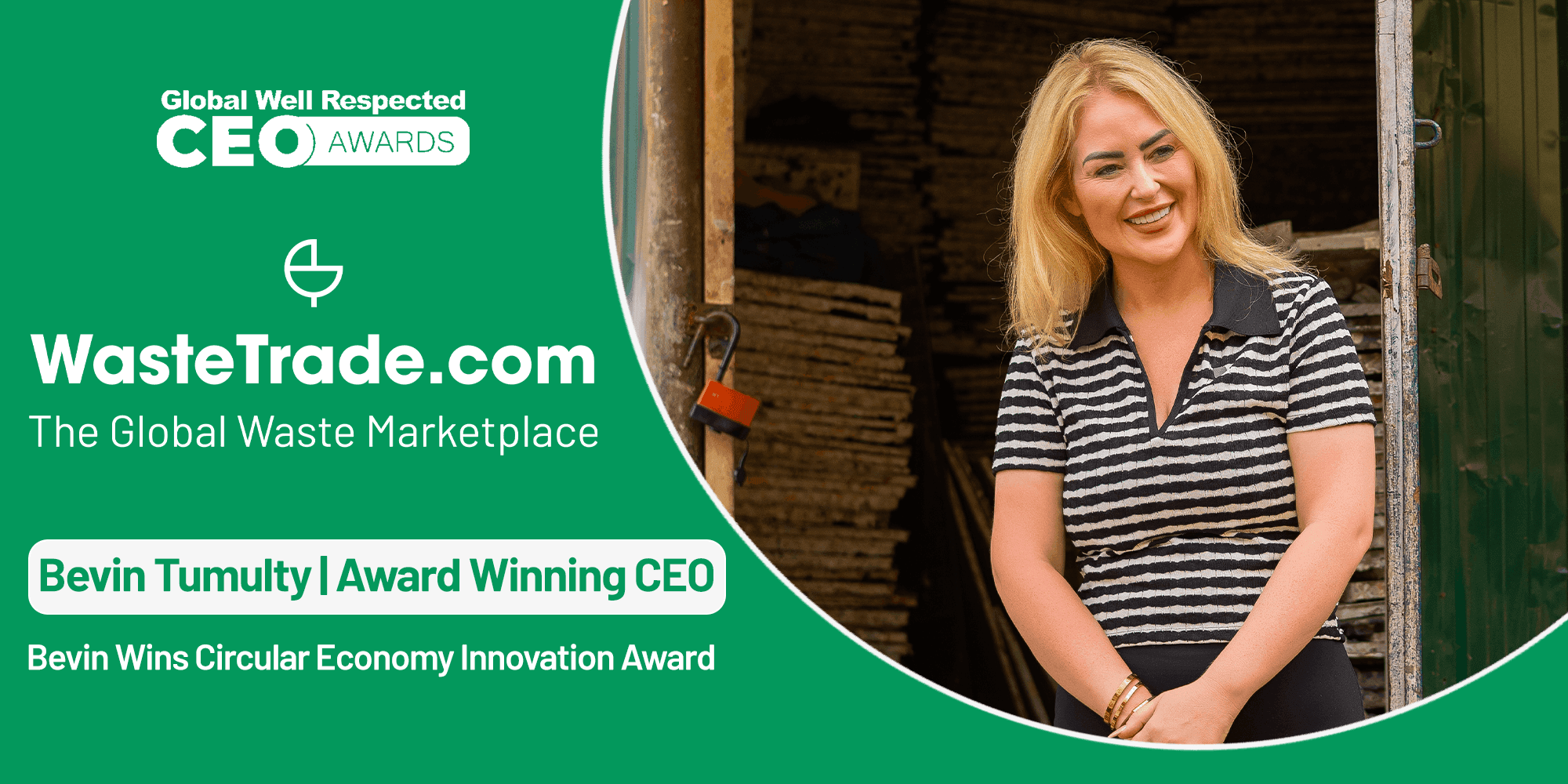
You have recently been recognised with the Circular Economy Innovation Award at the Global Well Respected CEO Awards in Rwanda, Africa. What was your reaction when you first received the news?
To be honest, I was genuinely humbled by it, I really didn’t expect it.
There are so many people doing important work across the continent, so to be recognised in this way was a real honour. But for me, it’s not just a personal moment, it also represents the journey we’ve started with WasteTrade.com and the belief that Africa can become a global hub for sustainability and circular economy innovation.
As a young woman stepping into this space, and actively working to help reshape how materials move, how value is created, and how systems are built across Africa, it means a lot to have that recognised at this level.
At the same time, it reinforces the responsibility that comes with it. We’re still at the early stages, and there’s a huge amount of work ahead. This award isn’t a finish line, it’s motivation to keep pushing forward, building partnerships, and delivering real, scalable impact across the region.
The award focuses on “Transforming waste into value, transparency into impact”. How closely does that reflect what you set out to build with WasteTrade?
It reflects it exactly! This is precisely what we built WasteTrade to do.
We’re turning waste into a tradable commodity by connecting supply to real end markets, and the key to that is transparency. In many African Regions this waste is stagnant in landfills and the open environment. When people understand value, compliance, and where their material is going, it builds trust and unlocks movement.
Once materials start moving efficiently, that’s where the real impact happens for us all. Both the sector and region have more recycling, stronger supply chains, and real value being created.
The awarding body itself is based in Kigali, Rwanda, with a strong emphasis on building a global future through inclusive leadership. How significant is it for you, and for WasteTrade, that this recognition is coming from Africa?
It’s extremely significant, and arguably more meaningful given that it comes from within Africa. Rwanda has positioned itself as a leader in circular economy development on the continent, taking a highly structured and progressive approach, particularly in areas such as e-waste. It demonstrates what can be achieved when policy, infrastructure, and execution are aligned.
For WasteTrade, Africa is a strategic priority. The region represents a critical component of future global supply chains, with substantial volumes of recyclable material and increasing demand for compliant, transparent routes to market.
Recognition from within the region validates both the relevance of our model and the direction of travel. As we scale, Africa will play a central role in the WasteTrade’s growth, both as a source of high-quality material and as a market where circular economy systems can be developed in a more efficient and forward-thinking way from the outset.
WasteTrade opened its Ghana office in 2025, marking a major step into West Africa. What made that region a priority, and what have you seen so far since establishing a presence there?
Ghana was a very deliberate choice for us. From a regulatory perspective, it is one of the countries in the region most aligned with Basel Convention frameworks, which is critical when you’re building compliant, cross-border material flows. In addition to that, we already had a strong underlying data set in the country, which gave us clear visibility on material availability, market gaps, and potential end users. That allowed us to enter the market with a structured approach rather than starting from zero.
We also received early support from local government and key stakeholders, which has been instrumental. That level of engagement creates the right environment to build something sustainable and scalable.
Since establishing a presence, what we’ve seen is a highly active and entrepreneurial ecosystem which needs help in producing the volumes of recyclable materials. The infrastructure is fragmented and we hope with a strong demand from both local and international buyers, the motivation will increase to sort and produce. We have also seen a clear inefficiency in how those materials are currently traded and this is where our process will become invaluable for the local market – both formal and informal sections. That combination is exactly where WasteTrade operates best – bringing structure, transparency, and access to market to unlock value across the supply chain.
More broadly, WasteTrade is now expanding across Europe, West Africa, North Africa, the Middle East, the Far East, and beyond. How would you describe the company’s growth over the past 12–24 months?
The past 12–24 months have been a period of significant growth, but also considerable challenge. We’ve seen increasing pressure across the recycling sector, particularly in Europe, with plant closures, margin compression, and instability in end markets. That environment has made it clear that the traditional way of trading materials is no longer sufficient.
For us, the growth of the platform has meant we’ve had to double down, there’s been no option but to lean into the data, strengthen our global network, and continue building out compliant routes to market across multiple regions.
At the same time, that expansion across Europe, West Africa, North Africa, the Middle East, and the Far East has been driven by necessity as much as opportunity. Supply and demand are no longer regional, they are global, and the platform has had to evolve accordingly.
What underpins all of this is a clear objective to protect recyclers and ensure the long-term viability of the sector. That means creating transparency, securing end users, and building resilient supply chains with affordable feedstock that can withstand market volatility.
So, while the journey has been challenging, it has also reinforced the importance of what we’re building, and why it needs to exist.
As WasteTrade enters new regions, how important is it to have people on the ground versus relying on the digital platform?
It’s critical to have people on the ground, especially in this fragile turn of the market.
While WasteTrade is a digital platform, this industry has always been built on a personal, relationship-driven approach. We’re dealing with waste, and that comes with inherent risks around quality, compliance, and logistics, so having local presence is essential to mitigate those risks.
That’s why we’ve made a deliberate decision to position employees across key regions globally. It allows us to physically attend loadings, verify material, and manage documentation, particularly around pre-notifications and evolving regulatory requirements, directly within the territory.
The platform enables scale and transparency, but it’s the people on the ground that ensure execution, compliance, and trust. Both are equally important, and together they create a much more robust and reliable system.
You have spoken previously about the importance of traceability and transparency in recycling. How are these principles shaping the way WasteTrade is developing as it scales globally?
Traceability and transparency are fundamental to how WasteTrade is being built; they’re not optional, they’re core to the model. As we scale globally, the complexity of material movement increases, particularly across jurisdictions with tightening regulation. Without full visibility, you introduce both commercial and compliance risk.
That’s why we’re continuing to invest heavily in data capture and verification across the platform, tracking material from origin through to end destination. This year, that evolves further with the introduction of product passport functionality, which will allow materials to carry a structured digital identity, improving traceability, quality assurance, and auditability across the chain.
Alongside that, we’re integrating systems such as DIWASS to ensure that movements – particularly those requiring notification – are managed in line with regulatory requirements directly through the platform.
From your perspective, how is the role of a platform like WasteTrade changing as the recycling industry becomes more regulated and more commercially driven?
The role of a platform like WasteTrade is becoming increasingly central as the industry evolves. As regulation tightens and the sector becomes more commercially driven, the margin for error reduces. Businesses can no longer rely on informal networks or fragmented processes – there’s a growing need for structure, compliance, and real-time visibility.
That’s where a platform like WasteTrade comes in. We’re moving beyond being just a marketplace and becoming an infrastructure layer; one that connects supply and demand, but also embeds compliance, documentation, pricing transparency, and logistics into a single environment.
As the industry matures, the expectation is not just to trade materials, but to prove where they’ve come from, how they’ve moved, and where they’ve ended up. A platform that can deliver that level of accountability, while still enabling efficient commercial transactions, will play a critical role in the future of the sector.
Looking at the industry more broadly, what do you think are the biggest challenges businesses will face over the next few years when it comes to sourcing and managing recyclable materials?
Over the next few years, the biggest challenge will be aligning material flows with increasingly complex compliance frameworks while still maintaining viable commercial routes to market.
We’re already seeing a tightening of regulations around transboundary movement, and businesses will need to navigate multiple layers of compliance when moving material from one country to another. Identifying the correct, fully compliant end markets will become more difficult, particularly as enforcement increases.
At the same time, there’s still a structural imbalance, many regions generating significant volumes of waste simply don’t have the domestic recycling capacity to process it. That creates pressure on export markets, which are themselves becoming more restricted and controlled.
Systems like DIWASS are a step in the right direction, but adoption will take time, and in the interim, that transition period will create additional complexity for operators.
Finally, there remains a fundamental issue around harder-to-recycle materials such as mixed plastics, lower-grade films, and contaminated streams, where consistent, scalable end markets are still limited.
So overall, the challenge is not just collecting material, it’s really down to ensuring it can be moved, processed, and monetised in a fully compliant and commercially sustainable way.
On the opportunity side, where do you see the biggest areas of growth, whether that is geographically or in terms of specific material streams?
The biggest areas of growth sit at the intersection of geography, regulation, and material demand, and increasingly, regulation is driving that demand.
One of the most significant opportunities comes from minimum recycled content requirements. As governments and brands push toward mandated recycled content in packaging and products, there is a growing need for consistent, high-quality, and fully traceable recycled material. That is fundamentally changing the market, shifting recyclates from a secondary option to a required input.
From our perspective, WasteTrade’s global dataset gives us a very clear view of where that demand is building. We have registrations from virtually every country, with buyers and sellers bidding across the platform globally, which allows us to identify where supply exists, where demand is strongest, and where gaps are forming.
Geographically, regions such as Africa, the Middle East, and parts of Asia present major opportunities, both as sources of material and as locations where new processing capacity can be developed to meet this rising demand.
At the same time, while high-quality polymers like PET, HDPE, and PP will continue to see strong growth, there is also a significant opportunity to unlock value from more challenging streams, particularly as technology and compliance frameworks evolve.
What’s critical is that minimum recycled content targets cannot be achieved without structured, transparent supply chains. That’s where platforms like WasteTrade play a key role – not just facilitating trade, but enabling the data, traceability, and market connectivity required to support this next phase of the circular economy.
WasteTrade has grown from an idea into a global platform with teams across multiple regions. What has been the most important lesson for you as a founder through that journey?
The biggest lesson has been resilience, understanding that building something at this scale, particularly in a traditionally fragmented and often unsupportive market, requires a level of grit that you can’t fully prepare for.
There have been moments where the environment, the market conditions, and even people around you suggest that you should slow down or stop. But as a founder, you have to stay anchored to the vision and continue pushing forward, even when the path isn’t clear.
For me, that’s meant really tapping into an entrepreneurial mindset, being comfortable with uncertainty, making decisions with imperfect information, and continuously adapting as the business evolves.
At the same time, I’ve learned that you can’t do it alone. Building a strong team and support of my co-founder John McKenna has allowed me to draw motivation from the people around me.
Ultimately, founding and scaling a business like WasteTrade isn’t easy, it really demands a lot, both mentally and professionally. But if we can stay focused, keep learning, and keep moving forward, even in challenging conditions, that’s where real progress is made.
Finally, looking ahead, what is your vision for WasteTrade over the next few years as it continues to expand globally?
We’re building something that goes beyond a marketplace, integrating data, product passports, compliance systems, and global logistics into a single environment that underpins how materials are traded worldwide.
There will be a clear leader in this space as the industry consolidates and matures. It’s a highly competitive environment, but based on the scale of our dataset, our global presence, and the foundations we’ve already built, I’m confident that WasteTrade is that platform.
Ultimately, the goal is simple but ambitious, to redefine how the world moves waste, turning it into a fully transparent, data-driven, and globally connected resource system.
Watch this space!