A 45,000-tonne signal
Indorama Ventures’ decision to build a 45,000 tonne per year food-grade rPET facility in Lagos is one of the clearest signals yet that Africa’s PET bottle recycling market is entering a new phase.
This is not a pilot. It is not a small-scale investment. It is a large industrial commitment tied to real demand from the beverage sector, backed by global expertise and local market access. By 2027, the plant is expected to convert post-consumer PET bottles into high-quality recycled resin for packaging.
The headline is straightforward. Africa is building capacity to process its own plastic waste at scale.
The more important question sits just beneath it.
Where will the material come from?
Africa’s PET supply gap
On paper, the answer seems obvious. Africa generates significant volumes of PET bottle waste. Urban populations are rising, consumption is increasing, and collection networks already exist across cities like Lagos, Accra and Abidjan.
Walk through any major urban area in West Africa and you will see it. PET bottles are collected, sorted and traded every day. The material is there.
Yet the reality is more complicated.
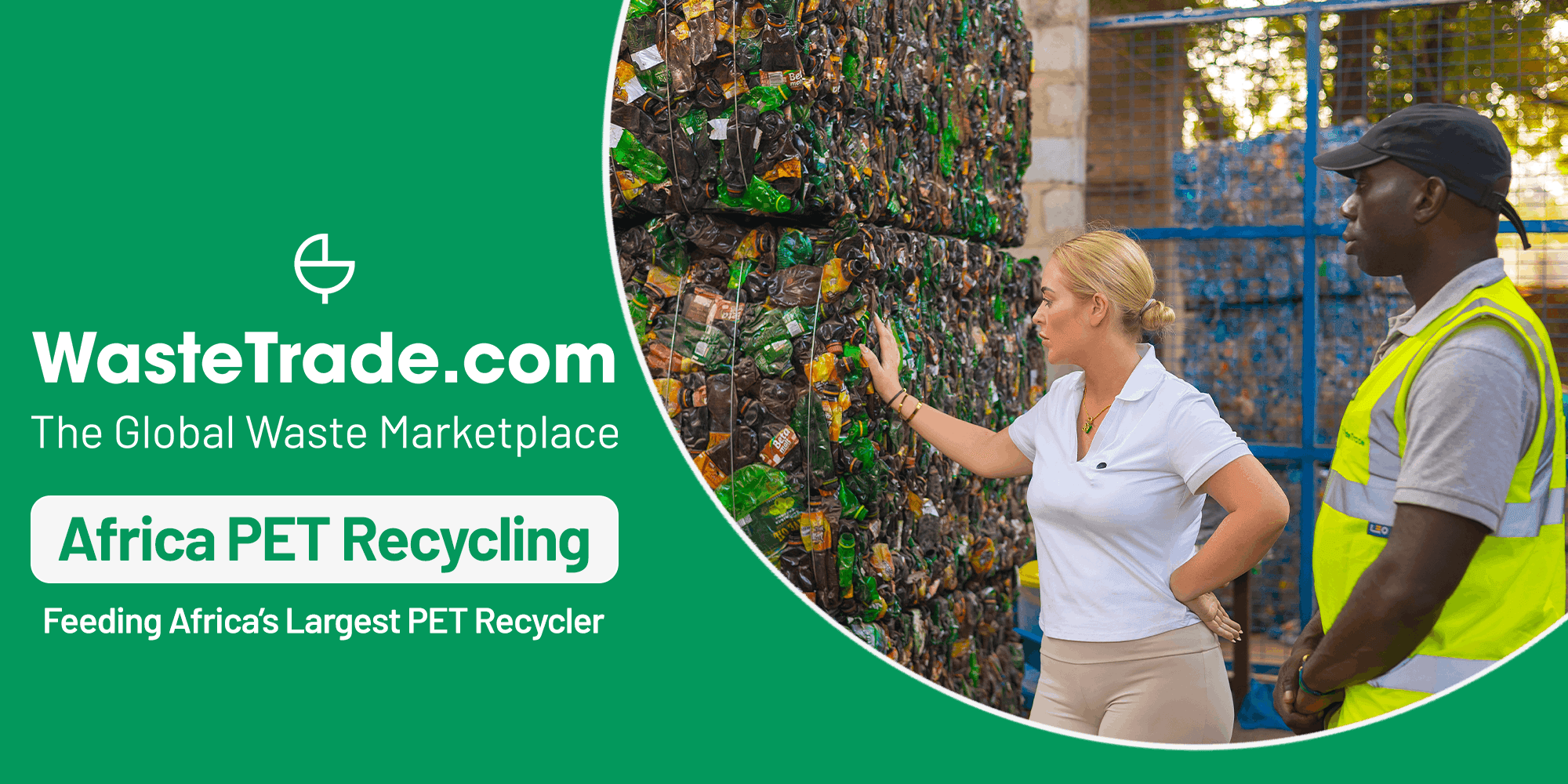
Supply chains remain fragmented. Material moves through multiple hands. Quality varies. Documentation is often incomplete. What begins as a bale of PET bottles in Ghana or Nigeria does not always arrive at a processor in a condition that meets international standards.
This is the gap.
Africa does not lack PET bottles. It lacks a consistent, structured way to turn those bottles into reliable feedstock for large-scale recycling.
Informal strength, structural limits
The informal recycling sector is the backbone of PET bottle recovery across West Africa. Individual collectors and small enterprises recover vast quantities of material that would otherwise be lost.
They are efficient, adaptive and deeply embedded in local systems.
But they operate within constraints.
Pricing is inconsistent. Visibility is limited. Material often passes through several intermediaries before reaching a recycler. By the time it approaches export markets, traceability is weak and documentation is rarely robust enough to satisfy international buyers.
This is not a failure of effort. It is a failure of structure.
For a facility that needs 45,000 tonnes of PET feedstock each year, inconsistency is not a minor issue. It is a fundamental risk.
PET recycling compliance pressure
Food-grade rPET raises the bar.
It is not enough to collect PET bottles. The material must be clean, controlled and traceable. Buyers need to know where it came from, how it was handled and whether it meets regulatory standards.
For exports, this extends further.
Basel compliance, documentation, audit trails and quality verification all become essential. Without them, material may never leave the country or may be rejected on arrival.
In many African markets, this is where value is lost.
Material exists, but it cannot be proven.
Logistics friction in Africa
Even when PET bottles are collected and prepared, logistics can stall the process.
Transport is inconsistent. Freight costs fluctuate. Containers often return empty. Timing breaks down between collection, aggregation and export.
These are not theoretical issues. They are the everyday reasons why trades fail.
For a large recycling plant in Lagos, this matters just as much as feedstock supply. Material must move reliably, not occasionally.
Without structured logistics, scale becomes difficult to sustain.
Building a functioning PET system
To supply a facility of this size, Africa does not need more PET bottles. It needs a system that can handle them properly.
That system requires several things working together:
- Aggregated and visible supply of PET bottles
- Verified material quality and grading
- Documented compliance for export and processing
- Predictable logistics and shipping routes
- Trusted relationships between buyers and sellers
This is not just infrastructure. It is market organisation.
And this is where a different kind of platform begins to matter.
WasteTrade’s role in Africa
WasteTrade has positioned itself as a global marketplace for recyclable materials, but its activity in West Africa points to something more specific.
It is building a structured layer around existing recycling activity.
Through its platform, recyclers and waste producers can list PET bottles, flakes and other materials with clear specifications. Buyers can search, compare and engage directly. Transactions are supported with documentation, logistics coordination and compliance handling.
The aim is not to replace local systems, but to connect them to global demand in a way that is visible and reliable.
In the context of Africa’s PET bottle recycling market, that shift is significant.
Finding the 45,000 tonnes
The first challenge for any large recycling facility is discovery.
Material exists across Ghana, Nigeria and neighbouring countries, but it is often hidden within local networks. WasteTrade brings that material into view.
A recycler in Accra listing baled PET can reach buyers beyond immediate contacts. Aggregators in Nigeria can present consistent volumes with defined specifications. Supply becomes searchable rather than assumed.
For a facility requiring tens of thousands of tonnes, visibility is the starting point.
Structuring PET supply
Visibility alone is not enough. Supply must be structured.
WasteTrade introduces standardisation through listings, specifications and transaction frameworks. Material is described clearly, quantities are defined and availability is communicated.
This reduces reliance on informal negotiation and creates a more predictable flow of PET bottles and recycled material.
Fragmented supply begins to take on a shape that large processors can work with.
Compliance and documentation
One of the strongest constraints in African recycling trade is documentation.
WasteTrade embeds compliance into the transaction process. EPA permits, site audits, export documentation and digital records are linked to each movement of material.
In Ghana, this is already operational.
With an EPA export permit in place, WasteTrade Ghana coordinates Basel-compliant exports of plastics and rubber from Accra and Tema. Every shipment is backed by documentation stored within the platform, creating a traceable record from origin to destination.
For buyers sourcing PET feedstock, this reduces uncertainty. For suppliers, it opens access to markets that were previously out of reach.
PET logistics and reverse shipping
Logistics is where many recycling trades collapse. WasteTrade addresses this directly.
Through its operations in Tema, the platform supports a reverse-shipping model. Containers that arrive full of goods do not return empty. They leave carrying verified recycled materials, including PET flakes, regrind and granules.
This approach reduces freight costs, improves efficiency and creates repeatable shipping routes between West Africa and global markets.
It turns logistics from a barrier into a working part of the system.
Traceability and buyer trust
For global buyers, trust is built on evidence.
WasteTrade’s model centres on traceability. Each shipment carries a digital record that includes supplier credentials, testing data, documentation and transport details.
In Ghana, the development of the Material Testing and Circularity Hub strengthens this further. PET materials can be tested for contamination, moisture and quality before export, with results integrated into the platform.
This shifts confidence upstream. Buyers do not have to wait until arrival to assess quality. They can make decisions based on verified data.
Ghana’s PET gateway
Ghana has become the first fully operational example of this system in practice.
From its base in Accra and operations through Tema Port, WasteTrade has begun coordinating verified exports of PET, HDPE, LDPE and rubber to international buyers. Early shipments have already reached European end users with full documentation and compliance.
The Ghana 2026 targets reflect a structured build-out:
- 10,000 tonnes of verified material traded
- Over 50 EPA-permitted suppliers
- Five active shipping routes linking Tema to Europe
- Full digital traceability across exports
These are not abstract goals. They are the foundations of a functioning PET recycling network.
Feeding Nigeria and beyond
As Nigeria develops large-scale processing capacity, including the new Lagos rPET facility, the need for structured supply will increase.
Ghana’s role becomes clearer in that context.
It is not just an exporter. It is a controlled, verified gateway for materials that can move across borders and into industrial demand centres.
WasteTrade’s wider West Africa hub extends this further, connecting Ghana, Nigeria, Ivory Coast and beyond into a single network of recyclers, aggregators and buyers.
This creates the possibility of regional balancing.
If supply in one country falls short, material can be sourced from another. If demand rises, the network can respond.
Integrating the informal sector
None of this replaces the informal recycling sector. It depends on it.
Collectors, small recyclers and local aggregators remain the first link in the chain. What changes is how their material moves beyond local markets.
WasteTrade introduces visibility, pricing clarity and compliance pathways that allow informal recovery to connect with formal global trade.
This is not a transition from informal to formal. It is an integration of the two.
Africa’s PET future
The Lagos rPET facility is a clear marker of intent. Africa is moving towards processing more of its own plastic waste and supplying global packaging markets with recycled material.
But capacity alone is not enough.
The success of that shift will depend on whether systems exist to support it. Systems that can aggregate PET bottles, verify quality, manage compliance and move material reliably across borders.
WasteTrade’s work in Ghana and across West Africa points towards one way of building that structure.
The material is already there. The collectors are already doing the work.
The challenge now is to connect that effort to global demand in a way that is consistent, transparent and scalable.
The question is no longer whether Africa can supply 45,000 tonnes of PET.
It is whether the systems are in place to deliver it.