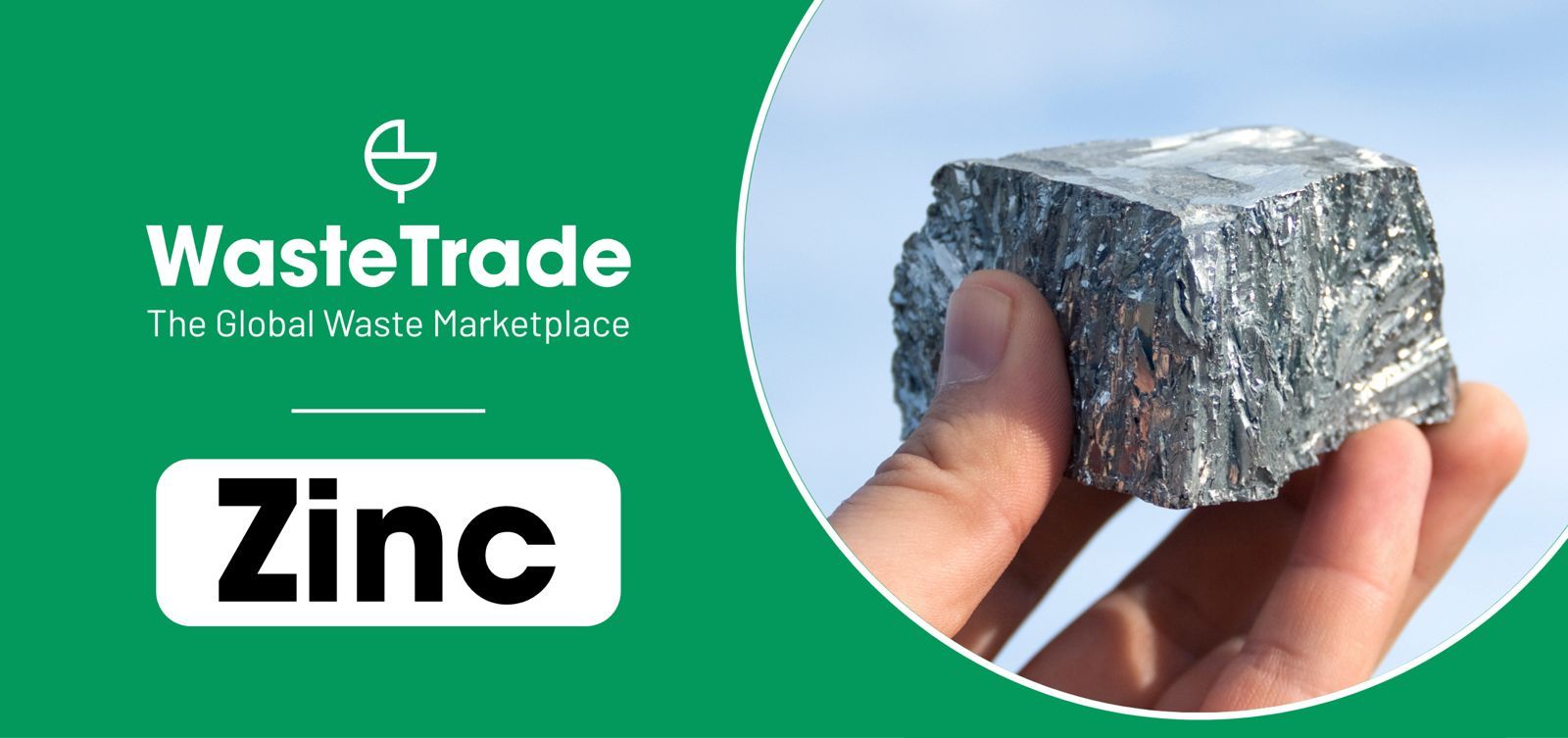
Zinc Metal | Key Information
- Zinc metal is a non-ferrous metal with the chemical symbol Zn and atomic number 30.
- Zinc is used mainly for corrosion protection, die casting, zinc alloys, rolled sheet, sacrificial anodes and as an alloying element in metals such as brass.
- Zinc scrap can include clean production offcuts, zinc sheet, ZAMAK and other zinc alloy castings, spent anodes, dross, ash and other zinc-bearing industrial residues.
- Galvanised steel is not the same as zinc scrap. It is primarily steel with a zinc coating and follows a different pricing and recycling route.
- Refined zinc is commonly benchmarked against London Metal Exchange prices, but the LME zinc price is not the same as the price paid for zinc scrap.
- Zinc scrap value depends on grade, zinc content, recoverable metal, contamination, quantity, location, processing requirements and transport. WasteTrade helps businesses present zinc material to suitable buyers and establish a competitive market price.
Zinc Metal
Zinc metal is a widely traded non-ferrous metal used across construction, manufacturing, engineering and corrosion protection. Identified by the chemical symbol Zn and atomic number 30, zinc combines useful physical properties with an established global recycling market.
For businesses, the important question is often less about zinc as an element and more about the material in front of them. Clean zinc metal, zinc alloy castings, sheet zinc, galvanised steel, spent anodes, zinc dross and zinc ash can all contain zinc, but they are separate commercial streams with different buyers and recovery routes.
WasteTrade gives businesses a route to buy and sell zinc and zinc-bearing materials through a marketplace built around verified counterparties, compliant movements, logistics and secure payments. Sellers can present material to the market with the information buyers need, while buyers can search available material or register demand for the grades and feedstocks they want.
If you already know what material you have, you do not need to read the whole page before taking action. List zinc material on WasteTrade, search current supply, or use the price and scrap sections below to understand how the market assesses your material.
Zinc Metal Buying and Selling on WasteTrade
Zinc metal trading works best when a load is presented as a defined commodity rather than simply as "scrap". A buyer wants to know what the material is, how much is available, its composition and condition, where it is located and whether the supply is one-off or recurring.
For sellers, useful evidence can include an alloy grade, assay, production source, photographs, weight, packaging and details of contamination or attachments. For buyers, it means setting clear limits for zinc content, physical form, tolerances, load size and delivery.
On WasteTrade, that information helps the right counterparties assess the material before a load moves. The aim is not to create a theoretical "WasteTrade price", but to expose a properly specified zinc stream to verified buyer demand and reach a competitive commercial outcome.
Zinc Alloy
Zinc alloy refers to a metallic material in which zinc is combined with other elements to achieve particular strength, hardness, castability, dimensional stability or corrosion behaviour. In industrial use, the term usually refers to zinc-base alloys rather than every alloy that happens to contain zinc.
The two principal zinc casting-alloy families are conventional ZAMAK alloys and higher-aluminium ZA alloys. ZAMAK grades typically contain about 4% aluminium with smaller controlled additions of magnesium and, in some grades, copper. ZA-8, ZA-12 and ZA-27 contain progressively more aluminium and are used where higher strength or bearing performance is required.
Brass is also a zinc-containing alloy, but it is commercially treated as a copper-zinc stream. The distinction matters because a buyer of zinc-base die-casting scrap is buying a very different feedstock from a brass recycler.
For secondary zinc, grade control is valuable. Segregated zinc alloy production returns can often be assessed against a known specification, while mixed castings of uncertain composition may need analysis before they can be routed confidently.
Zamak
Zamak is a family of zinc-base die-casting alloys built around zinc and aluminium, with controlled additions of magnesium and, depending on the grade, copper. ZAMAK 2, ZAMAK 3, ZAMAK 5 and ZAMAK 7 are the best-known conventional grades.
• ZAMAK 3 is the general-purpose reference grade, valued for castability, dimensional stability and finishing characteristics.
• ZAMAK 5 contains roughly 1% copper and is slightly stronger and harder than ZAMAK 3, although with lower ductility. It is especially widely used in Europe.
• ZAMAK 7 is a high-fluidity modification of ZAMAK 3 with tighter impurity control, suited to thin sections and fine surface finish.
• ZA-8, ZA-12 and ZA-27 are related zinc-aluminium casting alloys, but they sit outside the conventional ZAMAK family because of their higher aluminium content.
For recyclers and manufacturers, keeping known grades separate protects their value as a controlled secondary feedstock. A WasteTrade listing for ZAMAK scrap should state the grade where known and identify plated parts, iron inserts, swarf, skimmings or other material that changes the load.
Zinc Melting Point
Zinc melting point is approximately 419.5°C for pure zinc metal, equivalent to about 787°F.
This relatively low melting temperature is one reason zinc is well suited to casting and remelting. Zinc alloys do not necessarily melt and solidify exactly like pure zinc, however, because aluminium, copper and other alloying elements alter their thermal behaviour.
In recycling, clean known-alloy material may be suitable for direct remelting, while oxidised, mixed or contaminated feedstock can require separation or refining first.
Zinc Density
Zinc density is approximately 7.13 g/cm³, or around 7,130 kg/m³, for pure zinc at room temperature.
Zinc is therefore considerably denser than aluminium and feels relatively heavy for its size. Density can provide a useful identification clue, but it cannot confirm an alloy grade or distinguish a zinc coating from the substrate underneath it.
For commercial loads, verified weight remains more important than visual volume. Density also influences storage, load planning and the amount of metal that can be moved within transport limits.
Is Zinc Magnetic?
Is zinc magnetic? Pure zinc is not ferromagnetic, so an ordinary magnet will not stick to zinc metal in the way it sticks to iron or most carbon steels. Zinc is weakly diamagnetic.
A magnet test is useful as a quick sorting check, particularly when distinguishing solid zinc from something that is only zinc-coated. If a zinc-coloured component attracts a magnet strongly, it may be galvanised or zinc-plated steel rather than solid zinc.
For a commercial load, origin, specification and analysis are more reliable than a magnet test where identification is uncertain.
Zinc Uses
Zinc uses are dominated by industrial applications that exploit the metal's corrosion behaviour, alloying properties and castability.
Its largest role is corrosion protection for steel through galvanising and other zinc coatings. Zinc-base alloys are widely used for precision die-cast components, rolled zinc is used in sheet, roofing and cladding, and sacrificial zinc anodes protect steel in marine and other corrosive environments. Zinc is also an important constituent of brass and a raw material for a wide range of zinc compounds.
Each of those applications creates a different end-of-life material. The sections below explain the form the zinc takes in use, rather than repeating the recycling process for each one.
Zinc Properties
Zinc properties include a combination of moderate density, a relatively low melting point, useful corrosion behaviour and temperature-dependent mechanical characteristics. Pure zinc is a metallic element with atomic number 30 and an atomic weight of about 65.38.
• Appearance: freshly exposed zinc is bluish-white and metallic, although the surface changes as corrosion products form.
• Crystal structure: zinc has a hexagonal close-packed crystal structure.
• Boiling point: pure zinc boils at about 907°C.
• Mechanical behaviour: zinc is relatively brittle at ordinary temperatures but becomes more malleable when heated into an intermediate temperature range.
• Corrosion behaviour: zinc forms protective corrosion products and can also corrode preferentially to steel, which is the basis of galvanic protection.
Melting point, density and magnetism are covered separately above because they are common identification and engineering questions in their own right.
Zinc Coating
Zinc coating is an umbrella term for several methods of applying zinc to another material, most commonly steel, to improve corrosion resistance.
Hot-dip galvanising immerses fabricated steel in molten zinc. Continuous galvanising applies zinc to moving steel sheet or coil. Electrogalvanising and zinc plating deposit zinc electrochemically, while thermal spraying, mechanical plating, sherardizing and zinc-rich coating systems use different application methods.
The method matters because it changes the thickness, structure and intended use of the coating. The finished product may contain only a relatively small proportion of zinc by weight even though zinc is critical to its performance.
Galvanised Steel
Galvanised steel is steel protected by a layer of zinc, most commonly applied through hot-dip or continuous galvanising. The coating acts as a barrier and also provides sacrificial electrochemical protection if the underlying steel becomes exposed.
Galvanised steel is widely used in construction, structural products, automotive components, sheet, ductwork, fencing and outdoor equipment because it combines steel's mechanical properties with improved corrosion resistance.
Commercially, a tonne of galvanised steel is primarily a steel commodity, not a tonne of zinc metal. At end of life it normally enters the steel recycling system, while zinc can later be recovered from zinc-bearing steelmaking residues. Galvanising dross and ash are separate process streams and should be listed separately from galvanised steel scrap.
Zinc Plating
Zinc plating applies a relatively thin zinc coating to a conductive surface by electrodeposition. It is commonly used on steel fasteners, fixings, brackets and engineered components where corrosion protection is needed with a controlled coating thickness.
Electrical current drives zinc deposition onto the component surface, after which passivation or other finishing treatments may be used to improve corrosion performance or appearance. Zinc plating differs from hot-dip galvanising in both application method and typical coating thickness.
A zinc-plated steel component remains predominantly steel for scrap purposes. Plating-line sludges, solutions and other zinc-bearing process residues are different again and can require specialist analysis, treatment and waste classification.
Zinc Die Casting
Zinc die casting is a high-volume manufacturing process in which molten zinc alloy is forced into a precision steel die to produce complex components with consistent dimensions and good surface finish.
Zinc alloys are particularly well suited to hot-chamber die casting. Typical applications include housings, handles, fittings, locks, automotive components, electrical hardware and detailed parts where close tolerances or good finishing characteristics are valuable.
The process can generate commercially attractive secondary material. Runners, sprues, flash, rejected castings and some machining returns can form clean recurring streams when the alloy is kept segregated. A manufacturer able to state the grade, physical form and typical monthly tonnage gives zinc buyers a much clearer basis for a bid.
Zinc Sheet
Zinc sheet is rolled zinc or zinc alloy supplied as sheet or coil for fabrication and architectural use. It is different from galvanised sheet, which is steel carrying a zinc coating.
Rolled zinc is widely used for roofing, facades, cladding, gutters, flashing and architectural details. Exposed architectural zinc develops a protective patina, which is one reason the material can achieve a long service life in suitable environments.
Secondary zinc sheet commonly appears as clean fabrication offcuts or as old architectural material recovered during refurbishment and demolition. New offcuts can be relatively straightforward to market, while older sheet may contain solder, fixings, sealants or attached building products that need to be declared to buyers.
Zinc Anode
Zinc anode most commonly refers, in industrial corrosion protection, to a sacrificial zinc component designed to corrode in preference to the metal it protects. The term is also used in battery chemistry, but batteries are a separate material stream.
Sacrificial zinc anodes are used on marine structures, vessels and other steel assets exposed to corrosive environments. As the anode performs its function, zinc is deliberately consumed.
A spent anode therefore needs to be assessed by its remaining metal rather than its original nominal weight. For commercial quantities, buyers may need the remaining gross weight, material specification, photographs and details of steel cores, straps or other attachments.
Zinc Price
Zinc prices determined by market value of refined zinc rather than the amount paid for zinc scrap. International trading commonly uses London Metal Exchange pricing for Special High Grade zinc as a benchmark.
The benchmark provides a current reference for the metal market. Zinc prices move with mine supply, smelter output, industrial demand, galvanised steel production, inventories, energy costs, regional availability and wider economic conditions.
For WasteTrade users, the useful role of the benchmark is context. It shows what refined exchange-grade zinc is doing in the market before the quality, recovery and transaction economics of a particular secondary load are considered.
Zinc Price Per Pound
Zinc price per pound can be calculated from a zinc price quoted in US dollars per metric tonne by dividing the tonne price by approximately 2,204.62.
The converted figure is simply the refined zinc benchmark expressed in pounds. It is not a zinc scrap quotation.
Zinc Ingot
Zinc ingot is zinc metal cast into a standard physical form for handling, storage, sale or subsequent manufacturing. Ingots can be produced from primary refined zinc, secondary zinc or a controlled zinc alloy.
Specification matters more than appearance. Special High Grade refined zinc, a secondary zinc ingot and a ZAMAK alloy ingot are different products even if all are supplied as cast metal blocks.
A buyer may require zinc purity, alloy chemistry, analysis, ingot size, total tonnage, origin and consistency between batches. Where zinc ingot or secondary zinc is offered on WasteTrade, the listing should state the actual specification rather than relying on the word "ingot" alone.
Zinc Scrap Price
Zinc scrap price is the executable value of a specific secondary material, not the refined zinc benchmark multiplied by gross weight.
A buyer may start with the relevant metal or alloy value, then adjust for contained zinc, expected recovery yield, alloy grade, oxidation, contamination, steel attachments, moisture, treatment costs, freight, compliance and the processing route available to that buyer. The result is a commercial bid for that load.
This is why clean segregated zinc sheet, known ZAMAK production scrap, zinc ash and mixed zinc-bearing material can trade at very different levels even on the same day.
WasteTrade allows a seller to put a properly described load in front of relevant verified buyers and compare real market interest, rather than relying on a generic internet scrap price that may refer to a different grade, region or quantity.
How Much Is Zinc Worth?
How much is zinc worth? For secondary zinc, the fastest route to a useful answer is to define the load well enough for buyers to price it.
• Material: zinc sheet, ZAMAK, die-cast scrap, anodes, dross, ash or another zinc-bearing stream.
• Quantity: total tonnes available and whether supply is one-off or recurring.
• Composition: known alloy grade, zinc content or assay where available.
• Condition: clean solids, mixed material, oxidised residue, swarf, moisture, coatings or attachments.
• Location and logistics: collection point, packaging, loading method and any movement constraints.
Those details can be used to present the material on WasteTrade and obtain buyer bids against current market conditions. For recurring industrial streams, consistency of specification and volume can be just as important as the headline zinc benchmark.
Zinc Scrap
Zinc scrap includes zinc metal, zinc-base alloys and certain zinc-bearing materials recovered from manufacturing or from products that have reached the end of their useful life.
Clean new zinc scrap includes fabrication offcuts, sheet trim and other segregated production material. Zinc alloy scrap includes ZAMAK castings, process returns and rejected components. Old zinc scrap can include architectural sheet, roofing, gutters and other recovered products. Spent anodes, dross, ash and skimmings form further specialist streams.
A strong WasteTrade recyclable zinc scrap listing should tell a buyer what the material is, how it was generated, the grade or assay where known, quantity, supply frequency, physical form, packaging, contamination and current location. Photographs and analysis are especially useful for material that cannot be identified confidently from its description.
International movements may also be subject to waste shipment controls. Clean metallic zinc and zinc-bearing residues can fall into different classifications, so the correct regulatory route needs to be established before material moves.
The commercial objective is to match a defined zinc feedstock with a buyer whose process and specification fit the load. That is where a marketplace is more useful than simply finding the nearest operator willing to accept "metal scrap".
Zinc Recycling
Zinc recycling does not follow one universal process. The recovery route depends on whether the feedstock is clean zinc metal, a controlled zinc alloy, an oxidised process residue or zinc associated with another metal.
Clean sheet and segregated die-casting returns can often be prepared and remelted, with chemistry checked or adjusted before the metal returns to production. This route preserves the value of well-controlled metallic scrap.
Zinc dross, ash, skimmings and other oxidised residues may require mechanical separation, pyrometallurgical treatment, hydrometallurgical processing or further refining. In these materials, gross weight and recoverable metallic zinc are not the same thing, so assay and process compatibility can determine the economics.
Galvanised steel follows a different loop. The steel is recycled as steel, while zinc can become concentrated in steelmaking dust and recovered through specialist processes before re-entering zinc production.
WasteTrade helps connect those technically different streams with appropriate buyers and recyclers. A producer can describe the material, reach verified counterparties, compare commercial interest and arrange the transaction with logistics and compliance built into the process.
FAQs
Zinc FAQs
What is zinc dross?
Zinc dross is a zinc-rich metallic or intermetallic residue formed during molten-zinc processes such as galvanising and die casting. Its composition varies with the process and with whether it forms at the top or bottom of a zinc bath.
What is zinc ash?
Zinc ash is the oxidised material that forms at the surface of a molten zinc bath and can contain zinc metal, zinc oxide and other compounds. Its zinc content should be established before a recycling route or commercial value is assumed.
Is zinc a metal?
Yes. Zinc metal is a non-ferrous metallic element with the chemical symbol Zn and atomic number 30.
How do I identify zinc scrap?
Start with the material's source, appearance and a magnet test: pure zinc and most zinc-base alloys are not strongly magnetic, while galvanised steel is. For commercial quantities or mixed alloys, XRF or laboratory analysis is the reliable way to confirm composition.
Is galvanised steel the same as zinc scrap?
No. Galvanised steel is primarily steel with a zinc coating, so it is normally traded and recycled as steel rather than valued at its gross weight as zinc.
What types of zinc scrap are most valuable?
Clean, segregated material with known composition and low contamination is usually easiest for buyers to value and often attracts stronger bids than mixed or oxidised material. The actual price still depends on zinc or alloy content, market conditions, quantity, processing costs and location.
Do I need an assay to sell zinc scrap?
Not always: known-grade clean sheet or segregated production returns may be sold from specification and process history. An assay becomes much more important for dross, ash, skimmings, mixed residues or any load whose recoverable zinc content is uncertain.
What information do zinc scrap buyers need before quoting?
Recyclers typically need the material type or grade, available tonnage, location, physical form, contamination, packaging and whether supply is one-off or recurring. For residues or uncertain alloys, photographs, certificates or assay data may also be needed.
Where can I sell zinc scrap?
Businesses can list zinc scrap on WasteTrade to reach verified buyers looking for defined secondary materials. A clear listing with the grade, quantity, location, condition and supporting analysis where relevant gives buyers the information needed to assess the load.
Can zinc scrap be sold internationally?
Yes, but cross-border movements of zinc scrap and zinc-bearing residues can be subject to different waste shipment controls depending on composition, classification, origin and destination. The material should be correctly classified before transport is arranged.


