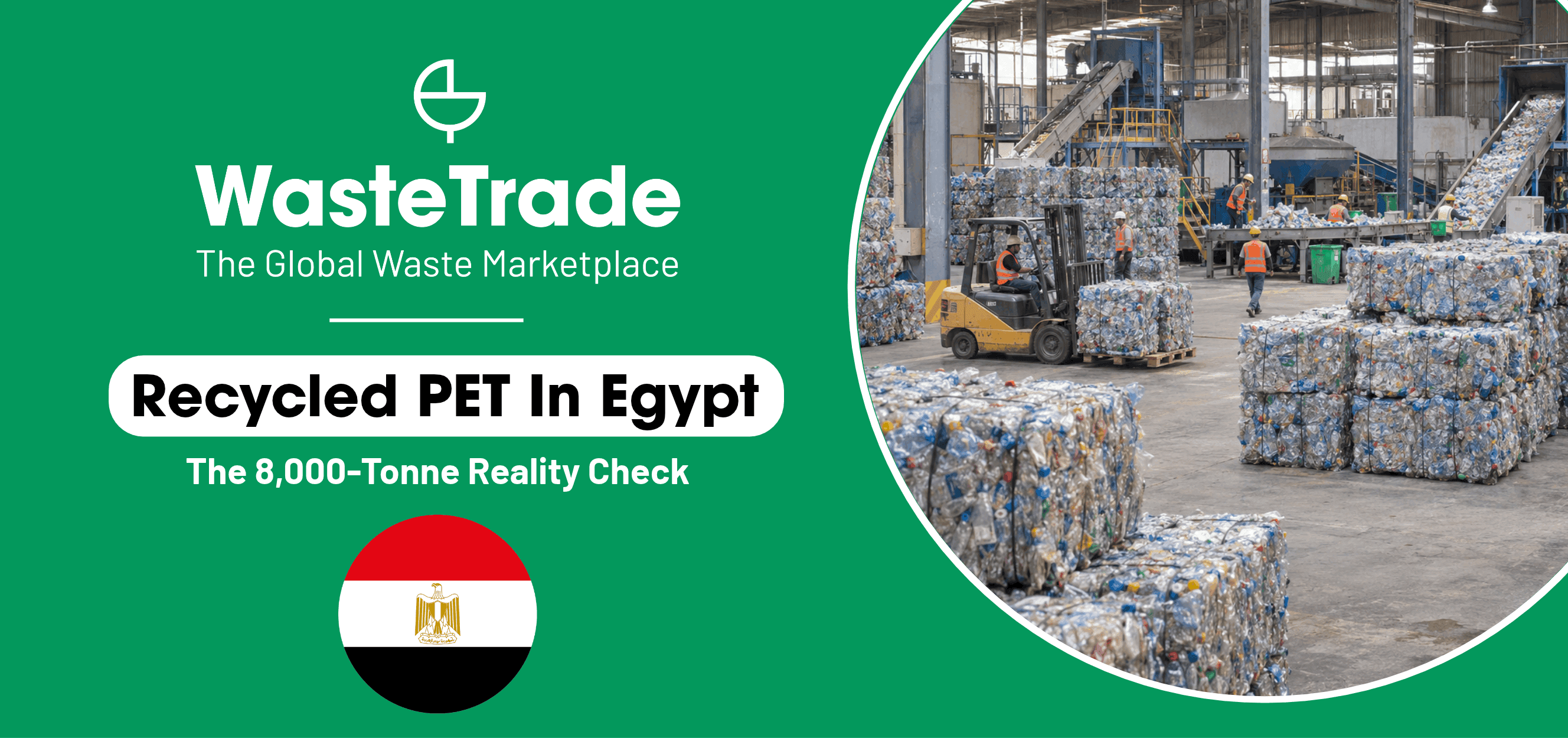
Recycled PET in Egypt has reached the factory floor: packaging manufacturer Delta El Nile reports converting approximately 8,000 tonnes of customer-supplied, food-grade recycled PET (rPET) in 2025. PET, or polyethylene terephthalate, is the plastic widely used in drinks bottles; its recycled form can enter new food packaging only when the material and process meet the required standards. That is a meaningful production signal. It is not a purchase order. [1]
Recycled PET in Egypt: Key Information
- Delta El Nile reports using approximately 8,000 tonnes of customer-supplied rPET within 92,000 tonnes of PET resin throughput in 2025, roughly 9%. Its figures have not been externally assured. [1]
- This represents reported factory use, not an 8,000-tonne purchasing tender from Delta El Nile.
- Food-grade rPET requires controlled recycling processes, technical validation and evidence of origin, not just a clean-looking bottle stream. [2][7]
- EU rules now make the location of recycling relevant to whether material counts towards specific beverage-bottle recycled-content targets. [8][9]
- Suppliers' commercial advantage rests on repeatable quality, approved specifications and reliable delivery rather than nominal recycled tonnage.
What Delta El Nile's 8,000 Tonnes Actually Show
The company reports that its New Salhiya City plant processed 92,000 tonnes of PET resin during 2025. Around 8,000 tonnes consisted of post-consumer food-grade rPET supplied by its customers. Delta has not obtained external assurance for these figures, and they describe one factory, not Egypt's entire packaging market. [1]
Delta manufactures PET preforms, the moulded starting pieces later blown into bottles, and supplies packaging customers in more than 25 export markets. It says its recycled-content programmes began in 2023. The important development is that recycled resin is passing through an established converter's production lines, not merely appearing in future targets. [2][3]
Who Actually Buys Food-Grade rPET?
The disclosure contains an unusually useful commercial distinction. Delta converted resin that its customers supplied. That does not establish that Delta purchased those 8,000 tonnes, has an unfilled order, or intends to procure a similar volume in 2026. [1]
In customer-directed production, a beverage brand or packaging customer may determine the resin supplier while the converter manages processing and quality. A recycler approaching the factory with a price for pellets could therefore be speaking to the wrong purchasing decision-maker. The party that approves the material may be as important as the party that melts it.
PET Bottle Waste Versus Food-Grade rPET
PET bottles can move through several distinct markets: sorted bales, washed flakes, decontaminated recycled resin and finally preforms or bottles. Each stage adds processing, losses, cost and specifications. WasteTrade's PET recycling guidance distinguishes these forms because a tonne of bottle waste is not commercially interchangeable with a tonne of qualified food-contact pellets. [4][5]
For food-contact uses, buyers must assess input provenance, decontamination, contamination levels and the intended application. EU rules govern recycled plastics intended to touch food; calling a shipment 'food-grade' does not, by itself, establish compliance in every destination market. [7]
PET Recycling in Egypt Has an Industrial Base
Recycled PET in Egypt is not dependent on one packaging factory. Egyptian recycler Bariq describes established bottle-to-bottle operations and production of food-grade rPET pellets. Delta names Bariq among its strategic suppliers, but neither company identifies it as the source of the 8,000 tonnes of customer-supplied rPET. [3][6]
Egypt also has other outlets for PET, including recycled polyester fibre. Different end uses can compete for suitable recovered bottles, but they do not necessarily require identical grades. For collectors, the question is which downstream process can extract the greatest reliable value from their particular stream. [12]
Why rPET Supplier Qualification Takes Weeks
Delta says qualifying an alternative rPET source can take eight to twelve weeks. That is a company estimate, not an industry-wide lead time, but it exposes a cost often absent from spot-price comparisons. [2]
A production buyer may need consistent colour, intrinsic viscosity, moisture and contamination results, plus food-contact evidence and trial performance. A technically acceptable sample is only the beginning. If later loads fail to match it, a low resin quotation can become an expensive interruption.
For serious suppliers, the most valuable offer is often not the cheapest tonne, but the tonne that has already passed the customer's qualification process.
What PET Recyclers and Waste Generators Can Sell
Collectors can strengthen their position by separating clear PET from mixed colours, controlling PVC and other contamination, and documenting sources and volumes. Reprocessors can convert that discipline into predictable flake or pellet specifications. Neither should assume that an end manufacturer's food-grade resin demand translates directly into demand for untreated waste.
On WasteTrade'savailable PET material listings, suppliers and buyers encounter material described by grade, form, location and quantity. That is a more useful commercial starting point than treating all recovered PET as a single commodity. A repeatable 100-tonne monthly specification may be worth more to a qualified buyer than an uncertain one-off volume several times larger.
EU Recycled Content Rules Complicate Export Demand
For recycled PET in Egypt, export destination and recycling origin can change the value of the same resin. The EU has required 25% recycled plastic in PET beverage bottles from 2025, calculated across national markets under its rules. Its Packaging and Packaging Waste Regulation also sets wider recycled-content requirements from 2030, with implementation details still evolving. [8][13]
But Commission Implementing Decision 2026/1425 currently counts recycled plastic from specified European jurisdictions for its single-use PET beverage-bottle calculations. From 21 November 2027, additional third-country material may qualify under defined conditions. Egyptian-recycled material is not currently on the Commission's eligible-country list for that calculation. This is not a blanket ban on selling Egyptian packaging into Europe. It is a consequential distinction for businesses making recycled-content compliance claims. [9]
Egypt's Packaging EPR Plans Add Another Variable
Egypt's waste authority has an extended producer responsibility, or EPR, registration facility within its Waste Information Management System. The government has outlined plans for producer reporting and future packaging obligations, while important implementation details still require confirmation. [10][11]
Better reporting could support more predictable collection and material provenance. It cannot, on its own, ensure that collected bottles emerge as qualified food-grade resin or that a converter will buy them. The manufacturing signal comes first; policy may influence the supply response.
International rPET Trade Depends on Landed Cost
A pellet price alone cannot settle a cross-border purchase. Freight, shipment classification, testing, rejected loads, currency exposure and the cost of holding stock can reverse an apparently attractive quotation. WasteTrade'scross-border logistics networkaddresses one practical part of that problem. Itsdigital product passportsare designed to make batch provenance and supporting records easier to assess. Neither transport coordination nor a digital record replaces technical approval.
This is where aninternational recyclable-materials marketplacecan add value without pretending that all PET is readily substitutable. The commercial task is to match a specified grade with an actual buyer, on terms that work after transport and compliance costs.
What Recycled PET in Egypt Means for Suppliers
The most useful reading of Delta's disclosure is neither a speculative boom nor an empty sustainability claim. It is reported evidence that customer-approved recycled resin already has a place in Egyptian packaging production.
Recycled PET in Egypt will generate durable commercial opportunities only where collection, resin qualification and genuine procurement decisions meet. The 8,000 tonnes should prompt suppliers to ask better questions: who controls the specification, where was the resin recycled, what evidence travels with it, and who has authority to place the next order?
參考文獻
[1] Delta El Nile for Industry. Sustainability: rPET, Lightweighting and 2025 ESG Disclosures.
https://www.deltaelnile.com/en/sustainability.html
[2] Delta El Nile for Industry. rPET Packaging: Validated Recycled PET Blends and Supplier Qualification.
https://www.deltaelnile.com/en/rpet-packaging.html
[3] Delta El Nile for Industry. About Delta El Nile: Manufacturing, Export Markets and Supply Chain.
https://www.deltaelnile.com/en/about.html
[4] WasteTrade. PET Recycling: Buy and Sell PET Plastic.
https://www.wastetrade.com/materials/pet-recycling
[5] WasteTrade. Polyethylene Terephthalate (PET): Properties, Applications and Recycling.
https://www.wastetrade.com/resources/plastics/polyethylene-terephthalate
[6] Bariq. About Bariq: Food-Grade PET Bottle-to-Bottle Recycling in Egypt.
https://www.bariq-eg.com/about-bariq/
[7] European Commission. Food-Contact Materials: EU Legislation.
https://food.ec.europa.eu/food-safety/chemical-safety/food-contact-materials/legislation_en
[8] European Commission. Single-Use Plastics: Recycled Content Requirements for Beverage Bottles.
https://environment.ec.europa.eu/topics/plastics/single-use-plastics_en
[9] European Commission. Commission Implementing Decision (EU) 2026/1425 on the Calculation, Verification and Reporting of Recycled Plastic Content in Single-Use Beverage Bottles. 30 June 2026.
https://eur-lex.europa.eu/eli/dec_impl/2026/1425/oj
[10] Egyptian Waste Management Regulatory Authority. Extended Producer Responsibility: National Waste Information and Data Management System.
https://wims.wmra.gov.eg/en/epr/
[11] WasteTrade. Egypt Packaging EPR 2026.
https://www.wastetrade.com/news/egypt-packaging-epr-2026
[12] WasteTrade. Recycled Polyester Fibre in Egypt: Bottles in Cairo to Duvets in Europe. 6 August 2026.
https://www.wastetrade.com/news/recycled-polyester-fibre-in-egypt
[13] European Commission. New EU Packaging Rules Start to Apply, Including Restrictions on PFAS in Food-Contact Packaging. 11 August 2026.
https://environment.ec.europa.eu/news/new-eu-rules-packaging-enter-application-2026-08-11_en