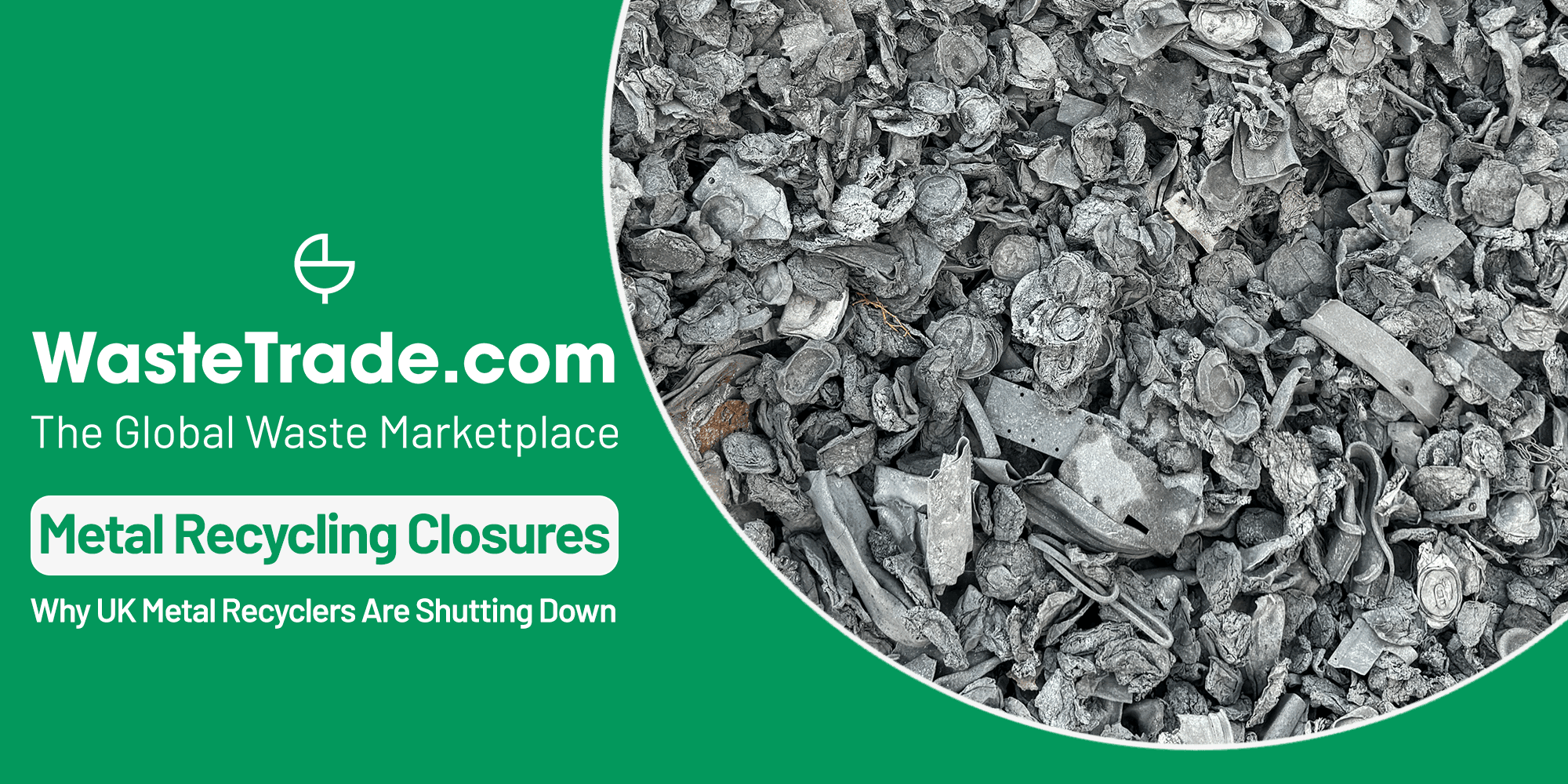
The UK metals recycling sector has entered one of the most difficult periods in its modern history.
In the space of months, long established operators have entered administration or liquidation. Regional yards have been sold off in parts. Groups built through rapid consolidation have faltered under debt and falling margins. Industry leaders are openly warning that more closures are likely.
This is not a routine downturn.
It is the result of a structural break in the domestic steel market, combined with rising costs, fragile export economics and policy uncertainty that has made lenders nervous and operators cautious.
And while no digital platform can fix UK steel policy, the recyclers that survive this period will be those who tighten commercial discipline, widen their buyer base and remove operational friction wherever they can.
UK Steel Production Collapse And Scrap Oversupply
The core issue is simple. Scrap arisings have not surged. Domestic absorption has fallen sharply.
The closure of blast furnaces and the pause in traditional steelmaking has removed a critical domestic outlet for ferrous scrap. Blast furnaces typically consume 15 to 25 percent scrap in the mix. Electric arc furnaces can use close to 100 percent scrap, but the replacement capacity is not yet operational at scale.
The result is a timing gap.
Scrap that would previously have flowed into UK furnaces is now competing for export markets. Domestic steel output has fallen to historic lows, and the UK is increasingly reliant on imports. Meanwhile, the electric arc furnace projects that promise higher future scrap demand are not expected to be fully operational until later in the decade.
For recyclers, that gap is brutal. Fixed costs remain. Volumes soften. Margins narrow. The balance shifts against them.
Rising Energy Costs And Compliance Pressure
Energy intensive industries across the UK have faced elevated electricity costs for years. Metals recycling is no exception. Shredders, balers, shear lines and separation systems are not light users of power.
Add to that increases in the National Living Wage, tighter environmental compliance, higher insurance premiums and more assertive health and safety enforcement, and the cost base thickens.
When trading volumes are strong, these pressures can be absorbed. When domestic demand contracts, they become acute.
Administrators’ statements from recent insolvencies have repeatedly cited energy costs, commodity price volatility and regulatory pressures as contributing factors. That combination erodes working capital quickly.
Scrap Export Restrictions And Policy Uncertainty
Export markets have become the pressure valve. But they are not a comfortable one.
Selling into overseas markets often means longer payment cycles, higher counterparty risk and more complex documentation. Freight rates remain volatile. Quality disputes can take weeks to resolve. Currency exposure adds another layer of unpredictability.
On top of that sits policy uncertainty.
There has been growing debate about restricting scrap exports in order to prioritise domestic steelmaking. Even the possibility of quotas or limits has unsettled parts of the market. Capital dislikes uncertainty. Lenders price it in. Investment decisions are delayed.
For processors operating on tight margins, uncertainty is not abstract. It influences credit lines, insurance terms and appetite for expansion.
Consolidation And Leverage Risk
The past decade saw consolidation across the UK metals sector. Smaller family owned yards were acquired. Groups expanded geographically. Fixed costs rose. Debt levels increased.
In buoyant markets, scale brings purchasing power and operational efficiencies. In contracting markets, leverage magnifies downside risk.
When margins compress and working capital stretches, debt servicing becomes harder. A cluster of insolvencies is not surprising under those conditions.
But structural pressures tell only part of the story.
Where Recyclers Are Losing Margin Quietly
Beyond steel output and energy bills lies a quieter issue. Commercial inefficiency.
Many yards still trade largely by phone and long standing relationship. A handful of regular buyers. Known brokers. Familiar hauliers. That system works in stable markets.
It works less well when domestic demand collapses and every pound per tonne matters.
Limited Buyer Pools And Price Visibility
If scrap that once moved to a local furnace now needs to compete internationally, access to a wider buyer base becomes critical.
Relying on two or three regular outlets reduces price tension. It also limits optionality when one buyer steps back.
Digital marketplaces such as WasteTrade have introduced structured buyer and seller visibility into the sector. Verified global buyers, searchable listings and demand signals through wanted listings allow recyclers to benchmark prices more effectively and test alternative outlets without building an international trading desk from scratch.
In oversupplied conditions, optionality is leverage.
Slow Payment Cycles And Cashflow Strain
Export deals often mean waiting weeks or months for settlement. During that period, processors have already paid for scrap intake, labour and haulage.
Cashflow becomes the constraint.
Structured contracting, centralised documentation and clearer counterparty verification can reduce friction and disputes. When transactions are managed through a formalised platform with transparent terms and documented communications, delays caused by paperwork errors or unclear specifications are reduced.
WasteTrade’s model of acting as the transactional counterparty and handling documentation does not eliminate market risk, but it can reduce administrative drag and uncertainty around compliance and payment processes.
In tight markets, speed matters as much as headline price.
Haulage Costs And Route Inefficiency
Transport is a significant line item. Yet many operators still procure haulage reactively, often with limited competitive tension.
When load opportunities are made visible to multiple approved carriers and bids are structured through a portal, price discovery improves. Backhaul opportunities increase. Routes are optimised more effectively.
WasteTrade’s haulier network approach introduces that structure. Hauliers can view loads, review details and bid accordingly. For recyclers, this can mean more competitive freight rates and reduced administrative burden compared with manual coordination.
Every pound saved per tonne transported flows straight to margin.
Compliance And Administrative Overhead
Environmental compliance, duty of care documentation and transfrontier shipment paperwork are increasingly complex.
Administrative errors create delay. Delay creates cost.
A centralised digital record of listings, contracts, messages and transaction history reduces the risk of missing documentation and improves audit readiness. When counterparties are vetted and verified before trading, the risk of inadvertently dealing with non compliant operators is reduced.
These are not dramatic changes. They are incremental efficiencies. But incremental efficiencies accumulate.
The Electric Arc Furnace Transition Window
The UK’s transition to electric arc furnace steelmaking is framed as part of a greener industrial future. EAFs rely heavily on high quality scrap.
That future demand is real. But it is not immediate.
There is a window between the closure of blast furnaces and the full ramp up of EAF capacity. During that window, domestic scrap demand remains subdued.
The risk is clear. If too much processing capacity disappears before EAF demand returns, the UK could find itself with insufficient domestic infrastructure to supply its own steel sector. Scrap may flow elsewhere. Processing expertise may be lost.
Maintaining a viable scrap processing base through this gap is therefore not only a commercial concern but a strategic one.
How Recyclers Can Improve Survival Odds
No single measure will shield operators from macro forces. But several practical steps can materially improve resilience.
Broaden Market Access
Expanding beyond traditional buyer networks spreads risk. Platforms that provide access to verified international buyers without the overhead of building overseas trading teams can support that diversification.
Tighten Working Capital Management
Faster deal cycles, clearer terms and reduced administrative delay improve cashflow. Structured digital transactions can shorten time between agreement and settlement.
Introduce Competitive Tension In Logistics
Making haulage visible to multiple approved carriers for each load can reduce freight costs and improve reliability.
Use Data Rather Than Habit
Monitoring grade spreads, export differentials and regional pricing trends helps inform when to hold, when to move and where to sell. Digital marketplaces generate transaction data that supports better decision making than informal phone based pricing alone.
WasteTrade does not replace relationships. It supplements them with transparency and structure.
A Structural Reset Not A Terminal Decline
Metals recycling is not obsolete. Scrap remains fundamental to steel production, particularly in a lower carbon model.
The current wave of closures reflects a mismatch between supply and domestic demand, amplified by cost inflation, export complexity and policy uncertainty.
The operators that emerge intact from this period are likely to be those who treat commercial efficiency as a defensive tool. Widening buyer access. Reducing transaction friction. Making logistics competitive. Strengthening compliance processes.
In volatile markets, transparency and optionality are not luxuries. They are safeguards.
WasteTrade was built to introduce structure, visibility and efficiency into the trading of recyclable materials. In a stable market, that is helpful. In a distorted one, it can be decisive.
The steel transition will eventually restore domestic scrap demand. The question is how much processing capacity will remain when it does.
For many recyclers, the next two years are about survival. And survival increasingly depends on running a tighter, more transparent and more efficient commercial operation than ever before.


