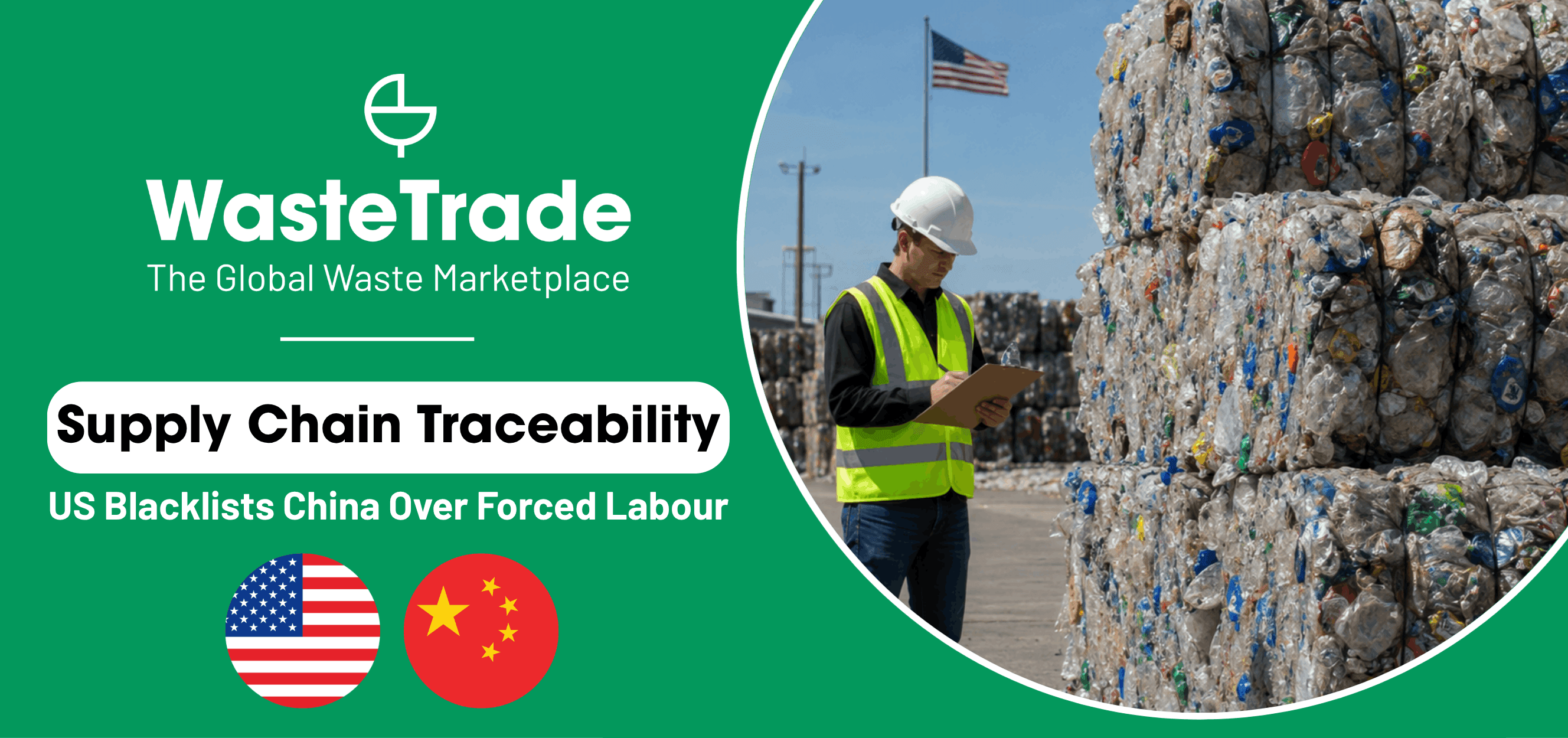
Supply chain traceability has become the dividing line between material that can move through regulated markets and material that can be stopped at the border. In practical terms, it means being able to show where a product or raw material came from, who handled it, how it changed and which records belong to the physical batch being traded.
That requirement moved sharply into focus on 31 July 2026, when the US Department of Homeland Security added 43 Chinese companies to the Uyghur Forced Labor Prevention Act Entity List. Effective from 3 August, the additions increased the list from 144 entities to 187 in its largest single expansion.
The consequences reach far beyond the named companies.
Why Supply Chain Traceability Now Matters
The Uyghur Forced Labor Prevention Act, or UFLPA, starts from a presumption that covered goods were made with forced labour and cannot enter the United States. The importer may challenge that position, but it must produce clear and convincing evidence supported by detailed records from across the upstream chain.
An importer can hold a finished product, a valid invoice and a supplier declaration, yet still lack the evidence required to release the shipment.
More than 24,300 shipments, worth close to $1 billion, have been denied entry under UFLPA enforcement, according to US Customs and Border Protection data. Each detention turns an abstract issue into a problem involving stock, customers and working capital.
The Largest UFLPA Expansion Yet
The latest additions cover businesses connected with cotton and textiles, metals, food, pharmaceuticals and materials used in batteries and advanced manufacturing.
Several operate outside Xinjiang, undermining screening processes that treat the issue chiefly as a question of supplier geography.
The enforcement logic is wider. Risk may follow an upstream input, a related company, a labour-transfer programme or another participant that never appears on the importer’s invoice. The material carries its history across provincial and national borders.
The Importer Must Prove the Chain
In commercial terms, the burden has moved to the buyer. Legally, the formal burden falls on the US importer or importer of record. Commercially, however, that demand travels upstream.
The importer carries the formal burden under US law, but the commercial demand does not stop there. Importers ask manufacturers for evidence, manufacturers ask processors, and processors turn to traders, collectors and suppliers. A business several transactions removed from the border may depend on information it never collected.
Customs officials may seek records identifying raw-material sources, production stages, counterparties, payments, transport movements and physical transfers. A declaration can support that evidence. It cannot replace the chain itself.
Risk Travels With the Material
The July notice also updated the official names of two entities already on the list. That detail may appear administrative, but it exposes another weakness in conventional compliance.
A spreadsheet treats a company name as a fixed string. A business may change its registered name, use several trading names or operate through different sites.
Effective supply chain traceability therefore requires persistent identity. A counterparty needs to exist as an entity with an address history, aliases, credentials and relationships, rather than as one line of text checked against another.
Recycled Content Does Not Reset Origin
Recovered materials pose a particular challenge because their commercial value often comes from transformation.
Textile cuttings become fibre, then yarn. Scrap cable becomes copper granulate. Plastic packaging becomes flake, pellet and compound. Loads are split, combined and blended as they move through collectors, traders and processors.
Each step can improve the material. It can also weaken the link to its origin.
Recycled status does not automatically remove provenance risk. A buyer may be able to prove that a product contains recycled content while remaining unable to identify the source of that content or the parties that handled it.
For material traders, supply chain traceability must cover both custody and lineage. It must show not only who held a batch, but how one batch became another.
Europe Is Building Its Own Enforcement System
The European Union is approaching forced labour through a different legal mechanism. Regulation (EU) 2024/3015 will apply from 14 December 2027 and will prohibit products made with forced labour from being placed on, made available in or exported from the EU market.
European authorities retain responsibility for investigating and establishing a breach. The regulation does not simply reproduce the US rebuttable presumption. Operators will nevertheless need to provide reliable supply-chain and due-diligence information when authorities ask for it.
The direction is reinforced by the Ecodesign for Sustainable Products Regulation and the emerging Digital Product Passport framework. Europe is building systems in which product identity, origin, composition and supporting information can be accessed in a standardised form.
The legal routes differ, but the commercial demand is converging: show the chain in a form another party can inspect.
Why Conventional Trade Records Fail
Most trade documentation describes individual transactions. It does not preserve the continuous life of the material.
An invoice may show that a trader sold a load of polymer flake. A transport document may show that the load moved between two sites. A laboratory report may describe its quality. None of those records necessarily connects the flake to its original inputs, earlier custodians or later outputs.
The evidence often sits in fragments across inboxes, portals and spreadsheets, assembled only when a customer raises a question or a shipment reaches a port.
By then, the batch may have been split, blended or processed beyond recognition.
Supply Chain Traceability Must Survive Transformation
A useful traceability system must follow the material through change. Recording a sale is not enough if the trail ends when a bale becomes fibre or scrap becomes ingot.
A material-level passport differs from a folder of certificates by giving each batch a persistent digital identity. Custody events, movements, documents and processing records remain connected to it. When a material transforms, parent and child records can preserve the link between input and output.
WasteTrade’s work in recovered-material markets addresses this practical gap. Its marketplace already brings verified participants, material listings, logistics, movement documentation and payment into the same transaction environment. Its Digital Product Passport extends that structure beyond one sale, allowing the record to continue with the material.
How WasteTrade’s Digital Product Passport Helps
The value of WasteTrade’s Digital Product Passport lies less in any single document than in continuity.
Each custodian can create a record while the material is in its possession. A transfer records who passed the material to whom. A processing event can show that an incoming batch became several outputs, or that several inputs were combined into one new product.
That creates a forward-built account of origin, custody and transformation. It reduces dependence on a retrospective reconstruction carried out after customs, a customer or a regulator has already raised a concern.
For forced labour compliance, the passport can provide a coherent evidence trail before the question is asked.
Identity and Disclosure Need Control
Visibility does not mean publishing every commercial relationship to every participant.
Traders may need to prove that a chain has been verified without disclosing their complete sourcing network to a customer. Authorities may require more detailed access than a routine buyer. Different users need different views.
WasteTrade’s passport model addresses that tension through controlled disclosure. It can connect materials to registered entities and supporting records while allowing access to reflect the role of the viewer.
A persistent entity record can retain former names, locations and credentials, making screening more reliable than occasional name matching.
What a Digital Product Passport Cannot Do
No platform can certify an event it was never shown. A Digital Product Passport cannot make false information accurate, replace a labour inspection or guarantee that forced labour played no part in a supply chain.
The importer or responsible operator remains accountable for the evidence and the conclusions drawn from it.
The passport performs a narrower, more credible task. It preserves the information needed to examine origin, custody, identity and transformation. Digital records do not remove the need for due diligence. They make serious due diligence possible.
Documentation Is Becoming Part of the Product
Price, quality and availability will continue to determine whether materials attract buyers. In regulated markets, they may no longer determine whether those materials can complete the journey.
The latest UFLPA expansion shows how quickly an accepted supply chain can become an evidential liability. It also shows why supply chain traceability can no longer sit behind the trade as administrative paperwork.
For WasteTrade and the wider recovered-materials sector, the strategic issue is straightforward. Material that arrives with its history attached gives an importer something it can test, present and defend. Material that arrives with a declaration and a collection of disconnected files may leave the buyer carrying a burden it cannot meet.