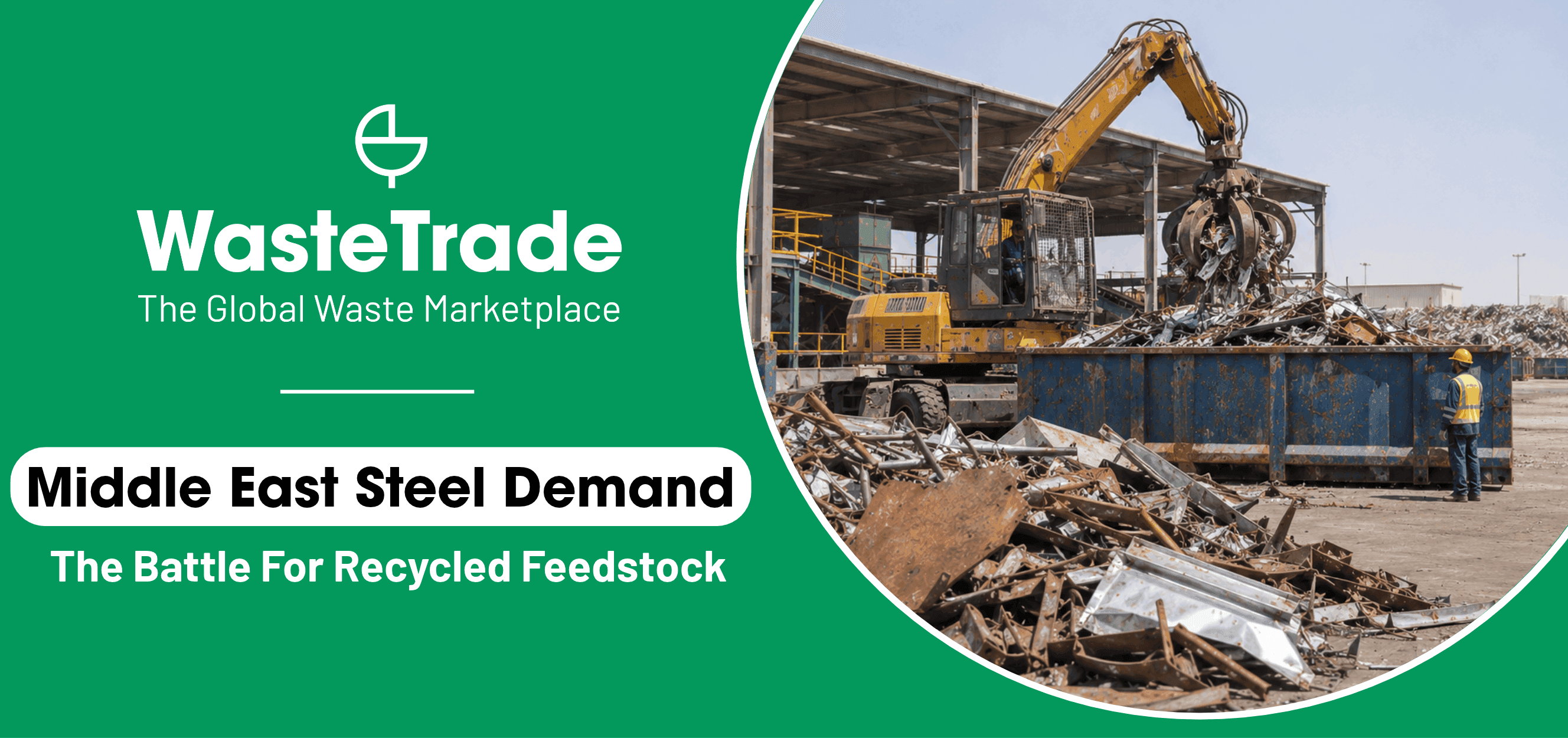
Middle East steel scrap demand is facing a decisive commercial test as the Gulf's steel industry confronts weaker construction activity, disrupted supply chains and changing restrictions on recyclable metal exports. Scrap recovered from factories, demolished buildings and redundant machinery can return to steelmaking as valuable raw material. But its commercial worth depends increasingly on whether manufacturers can obtain the right grades, in reliable quantities, at an economically viable delivered price.
For industrial waste generators, recyclers and international traders, this creates a more complicated market than headline scrap prices might suggest.
Middle East Steel Scrap Demand: Key Information
- Middle East steel scrap demand is influenced by manufacturing activity, electric arc furnace production, scrap quality and access to suitable suppliers.
- The World Steel Association forecasts GCC steel demand falling by approximately 11% in 2026, followed by an 11.3% recovery in 2027.
- Electric arc furnaces can operate with up to 100% steel scrap, although requirements vary by manufacturer and product.
- Dubai introduced export restrictions covering specified ferrous, copper and aluminium scrap classifications in June 2026.
- Scrap value depends on grade, contamination, processing requirements, delivery reliability and regulatory accessibility.
- Better material segregation and documentation can improve commercial opportunities for waste generators and recyclers.
Middle East Steel Scrap Demand Faces a Sharp Reversal
The Gulf's steel market has entered a period of considerable uncertainty.
In October 2026, the World Steel Association forecast an approximately 11% contraction in GCC steel demand during 2026, following growth of 17.7% in 2025. It anticipates a recovery of 11.3% in 2027, conditional on improving regional stability and the normalisation of disrupted supply chains. [1]
The outlook contrasts with earlier expectations. The OECD's June 2026 assessment projected Middle Eastern steel demand reaching 66.90 million tonnes in 2026, compared with 65.82 million tonnes in 2025. [2]
These forecasts cover different geographical groupings and neither directly measures scrap consumption.
Nevertheless, their divergence illustrates the uncertainty confronting manufacturers and suppliers. The immediate question is not simply how much steel the region might consume, but how industrial businesses can maintain resilient, commercially competitive material supply arrangements.
Recycled Steel Manufacturing Raises the Stakes
Steelmakers can produce new steel using recovered ferrous scrap, reducing their dependence on virgin metallic inputs.
Electric arc furnaces use electricity to melt combinations of steel scrap, direct reduced iron and other metallic feedstocks. According to worldsteel, these furnaces can operate with up to 100% scrap, depending on the intended product and available material. [3]
The manufacturing process creates an important distinction between recovered metal and steelmaking feedstock.
Factories, construction sites and demolition projects generate substantial varieties of scrap. Yet manufacturers cannot necessarily use every grade interchangeably.
Steelmaking requires specific chemical compositions, physical characteristics and consistent delivery arrangements. Material that fails to meet these requirements may need further processing or a different industrial destination.
UAE Steel Scrap Demand and Domestic Manufacturing
The UAE demonstrates how scrap recycling can contribute directly to domestic industrial production.
Publicly documented steelmaking operations in the country already use locally recovered scrap to manufacture products for construction and infrastructure. This establishes the practical role of secondary raw materials in regional manufacturing, without implying any particular purchasing opportunity.
The wider Middle East, however, remains commercially diverse. Manufacturing capacity, collection systems, material availability and trade requirements differ between jurisdictions.
For suppliers, the relevant opportunity depends on identifying suitable processing and manufacturing destinations rather than assuming that regional steel consumption automatically translates into demand for every scrap grade.
Ferrous Scrap Supply Has a Hidden Constraint
A recycler may hold thousands of tonnes of ferrous scrap while a manufacturer still struggles to obtain sufficient acceptable feedstock.
Some material contains unwanted alloys, coatings or non-metallic contamination. Other loads lack reliable grading information or require costly preparation before entering production.
There is also a structural constraint on availability. Steel frequently remains in buildings, vehicles and industrial equipment for decades before recovery becomes possible. Worldsteel consequently identifies insufficient scrap availability as a continuing limitation on meeting global steel demand through recycling alone. [3]
This creates a critical distinction for Middle East steel scrap demand: collected tonnage does not necessarily represent technically acceptable, legally accessible or economically deliverable supply.
Ferrous Scrap Grades Determine Commercial Value
Scrap quality begins at the point of generation.
Clean manufacturing offcuts generally offer greater consistency than mixed demolition waste, although their suitability still depends on composition and preparation.
Copper and tin contamination can be particularly problematic for certain steel products. Residual elements may restrict how much of a particular scrap grade a steelmaker can incorporate without compromising product specifications. [4]
Poor segregation therefore carries commercial consequences beyond the cost of sorting.
Processors that establish reliable grades, control contamination and provide accurate material descriptions can make recovered steel more attractive to industrial buyers.
For waste generators, maintaining separate material streams and basic quality records can preserve value before scrap reaches a recycling facility.
Steel Scrap Procurement Is About More Than Price
Steelmakers cannot base procurement decisions solely on the lowest quotation.
Buyers must consider chemical composition, preparation standards, load consistency, available volumes, delivery frequency and inspection arrangements.
A cheaper shipment may become more expensive if contamination increases processing costs, reduces recoverable yield or delays production.
This makes reliable information commercially valuable.
WasteTrade operates within this wider materials market, connecting recyclable commodity suppliers with potential buyers and supporting transactions through marketplace services.
Its relevance extends beyond finding a counterparty. Well-described materials, realistic quantities and clearly established delivery requirements help businesses assess whether a proposed transaction is commercially workable.
Steel Scrap Export Restrictions Complicate Market Access
Trade policy introduces another significant variable.
Dubai Customs Notice No. 13/2026 introduced restrictions on exports of specified industrial scrap classifications, including several categories of iron and steel scrap, from 10 June 2026. [5]
The initial application period ran until 8 October, but the notice provides for automatic renewal unless subsequently cancelled. It also establishes provisions for authorised exemptions.
Businesses must therefore verify the current legal position before arranging affected shipments.
Export restrictions can alter the commercial balance between domestic processing and international trading. They may increase the availability of certain materials within a jurisdiction while reducing exporters' access to overseas buyers.
However, retained scrap does not automatically become usable manufacturing feedstock. Domestic facilities must still possess the technical capability and commercial incentive to process it.
Scrap Metal Recycling Economics Depend on Delivered Value
The profitability of scrap trading depends on more than its quoted price per tonne.
Sorting, cutting, transport, storage, inspection, handling losses and regulatory requirements can materially affect a transaction's economics.
A manufacturer offering a lower purchase price may nevertheless represent the stronger commercial option if transport and processing costs are substantially lower.
Conversely, specialist overseas processors may provide a more appropriate destination for certain grades where international movement remains permitted.
For Middle East steel scrap demand, the commercially relevant measure is the net value of material delivered in an acceptable condition, not simply the highest advertised price.
This distinction becomes especially important when trading conditions change quickly.
Middle East Scrap Metal Suppliers Can Capture More Value
Industrial waste generators have considerable influence over the eventual marketability of recovered steel.
Manufacturers can separate production offcuts by grade and maintain consistent collection arrangements. Construction and demolition businesses can identify recoverable material before mixed handling introduces contamination.
Recyclers can increase the usefulness of these streams through grading, preparation and documented quality control.
None of these measures guarantees a particular price. Their value lies in reducing uncertainty and potentially widening the range of suitable buyers.
As Middle East steel scrap demand evolves, businesses capable of offering consistent and verifiable material may be better positioned than suppliers competing purely on tonnage.
Steel Scrap Trading Requires Reliable Logistics
Even technically suitable scrap can lose its commercial appeal when transport arrangements prove impractical.
Shipment planning must account for collection locations, loading requirements, packaging, weight, delivery schedules and applicable waste shipment controls.
WasteTrade's logistics networkconnects transport requirements arising from marketplace transactions with approved hauliers that can assess and quote for suitable movements.
Traceability also matters. Digital material records can help document origin, composition, custody and supporting compliance information throughout the supply chain.
WasteTrade's digital product passport approachreflects this developing emphasis on verifiable material information, although documentation does not replace inspection or statutory compliance.
The Next Test for Middle East Steel Scrap Demand
The Gulf's steel industry faces a difficult near-term outlook, but uncertain demand does not diminish the importance of dependable industrial feedstock.
Manufacturers still need materials that meet production requirements. Recyclers must balance processing costs against achievable market value. Waste generators need access to buyers capable of using what they recover.
WasteTrade's role in connectingrecyclable material marketsreflects a broader commercial requirement: businesses need credible information, workable logistics and access to appropriate trading partners.
Ultimately, the competitive advantage will not belong simply to whoever collects the most scrap.
It will belong to those who can establish precisely what their material is, where it can legally move and which manufacturers can use it profitably.
References
[1] World Steel Association, Short Range Outlook, October 2026
[2] OECD, Steel Outlook 2026: Steel Market and Industry Prospects
[3] World Steel Association, Raw Materials and Steel Scrap
[4] World Steel Association, About Life Cycle Thinking
[5] Dubai Customs, Customs Notice No. 13/2026
[6] WasteTrade, Recycled Steel