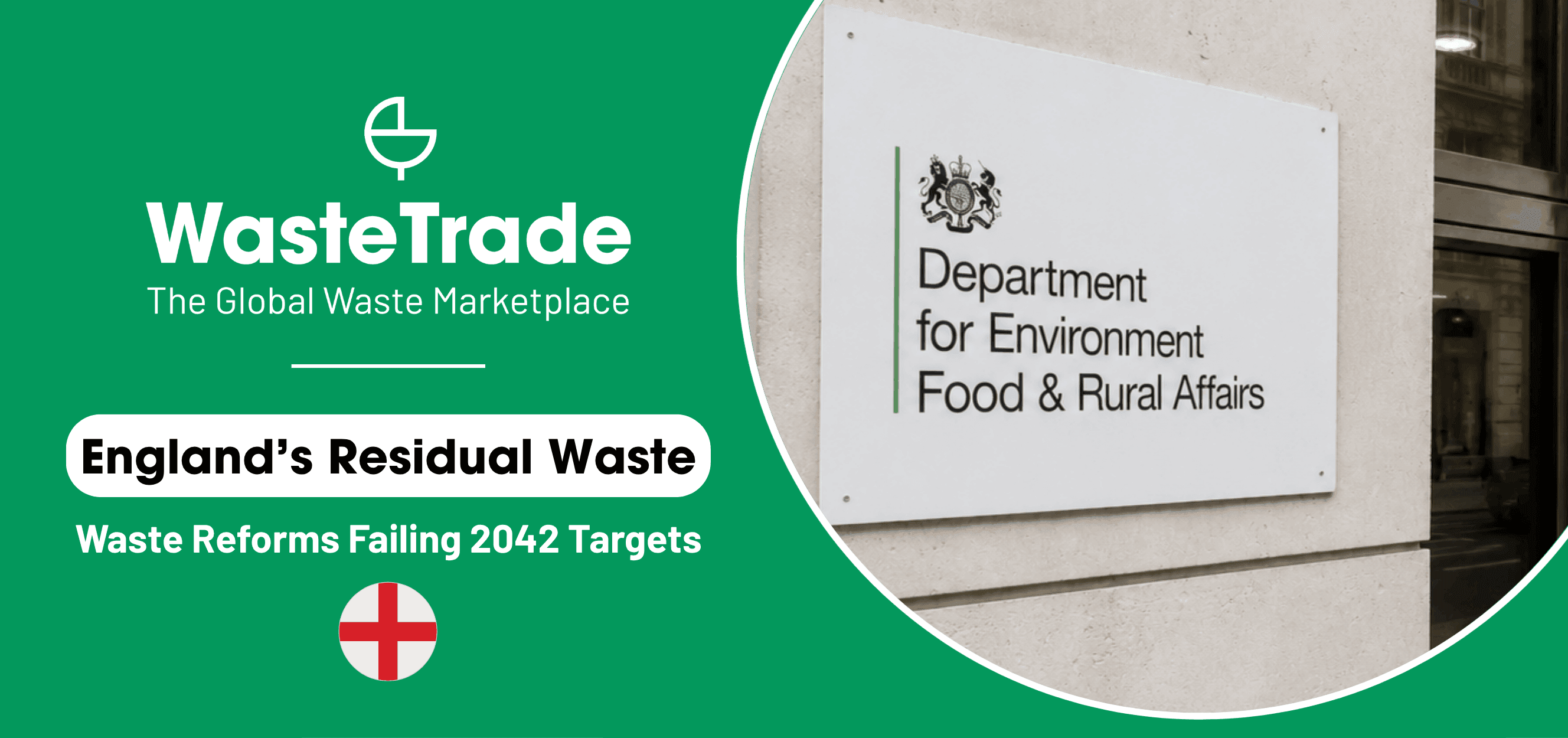
England’s residual waste target requires the country to reduce waste sent to landfill, incineration and other disposal routes to 287kg per person by 2042. The measure excludes major mineral wastes such as concrete, bricks and soil, but covers household and commercial materials left after reuse and recycling. Defra now estimates that its three flagship collection and packaging reforms will deliver only 31 per cent of the required reduction.
Simpler Recycling, packaging Extended Producer Responsibility and the Deposit Return Scheme should recover more material and improve several recycling streams. They do not provide a complete route to the statutory target.
The unresolved 69 per cent lies largely beyond collection. Material must still meet a usable specification, reach an authorised processor and find a buyer able to use it competitively in place of virgin resources.
England’s Residual Waste Target Remains Distant
England generated an estimated 31.4 million tonnes of residual waste, excluding major mineral wastes, in 2024. That equated to 535kg per person, down from 575kg in 2019.
The interim target limits residual waste to 437kg per person by 2030, while the statutory 2042 limit stands at 287kg. England must therefore remove a further 98kg per person from the residual stream to reach the nearer milestone.
Defra expects the main reforms to reduce residual waste per person to almost 24 per cent below 2019 levels by the end of 2029. Its modelling suggests they could deliver between 90 and 100 per cent of the reductions required for the interim targets, yet less than a third of the reduction needed for 2042.
Simpler Recycling Will Improve Material Capture
Simpler Recycling standardises the core materials that households and workplaces separate for collection. The household requirements took effect on 31 March 2026, subject to transitional arrangements for some councils, following the workplace rules introduced in 2025.
The reform should capture more paper, card, glass, metals, plastics and food waste before they enter residual bins.
That matters, but capture does not equal circularity. A tonne placed in a recycling container still needs sorting, grading, transport, processing and a dependable end market.
Packaging EPR and DRS Address Part of the Challenge
Packaging Extended Producer Responsibility shifts more of the cost of managing household packaging waste towards producers. Modulated fees should charge more for less recyclable packaging and give businesses a clearer reason to redesign what they place on the market.
The Deposit Return Scheme, scheduled to launch in October 2027, targets single-use PET, aluminium and steel drinks containers from 150ml to three litres. It should create cleaner, more consistent streams with strong commodity value.
Both policies can improve material quality and producer incentives. They cannot address the many non-packaging and lower-value materials that struggle to compete commercially.
Flexible Plastics Expose Weak Recycling End Markets
The decision to delay mandatory collections of plastic films and flexible packaging from March 2027 to April 2030 illustrates the tension.
Sorting systems, domestic reprocessing capacity and reliable end markets were not ready to absorb the expected material. The delay exposed a structural problem rather than a narrow scheduling issue.
Requiring councils to collect crisp packets, films and pouches does not make them economically recyclable. Low weight, variable composition, contamination and weak value make processing difficult. Virgin polymer prices can weaken the economics further.
Defra’s delivery plan still lists 2027, and the department has not published revised modelling for the delay. It remains unclear how much of the projected 2030 progress depends on collections that will now start later.
Secondary Materials Markets Will Shape the Outcome
England’s residual waste target ultimately depends on what happens after collection.
A recycler needs to know what a load contains, how much contamination it carries, whether the supply will recur and whether the material suits its equipment. A manufacturer needs confidence that recovered feedstock will perform consistently. Hauliers need workable collection arrangements. Regulators need accurate classifications, documents and destination information.
Price joins these questions together. A technically recyclable material may still fall outside the circular economy when transport, sorting and processing cost more than the recovered output can command.
For instance, a council may collect a difficult material without a viable processor nearby. A recycler may reject a load because its composition is unclear. A manufacturer may want recycled feedstock but struggle to secure consistent quality and volume. Material may also travel farther than expected because no suitable local end market exists.
WasteTrade operates at this commercial junction. It connects waste producers with verified recyclers, manufacturers and end users, while integrating logistics, documentation, classification support and payment controls into the transaction. The platform treats recovered material as a secondary raw material whose value depends on specification, provenance and suitability.
Waste Specifications and Traceability Reduce Friction
Broad labels such as “plastic waste” or “mixed paper” tell a serious buyer very little.
Commercial decisions often depend on grade, colour, source, form, moisture, contamination, packaging, volume, location and frequency of supply. Waste classifications, permits and import rules can determine whether a movement can proceed at all.
WasteTrade structures these details before material reaches the market. Sellers present the information buyers need to assess suitability, while verified counterparties, compliant haulage and transaction documentation sit within the same process.
Better information cannot create value where none exists. It can reduce unsuitable matches, rejected deliveries and unnecessary transport. It can also help processors identify feedstock that might otherwise enter a mixed residual stream.
Buyers participate more readily when they understand what they are buying, where it came from and whether it can enter their process without creating additional operational or regulatory risk.
Recycled Material Demand Must Grow
Collection reform will increase the supply of recovered material. Policy must also strengthen demand.
Manufacturers choose between recycled and virgin inputs on price, quality, availability and technical performance. Environmental benefit alone rarely settles the purchasing decision. A weak market for recyclate can therefore frustrate even a well-designed collection system.
Government can influence that calculation through recycled-content requirements, product standards, public procurement, ecodesign rules and fiscal measures. Product and material passports could also preserve information about composition, origin and previous use.
WasteTrade gives buyers and sellers a clearer view of where demand exists, which specifications attract interest and where viable outlets remain limited. That market visibility can direct material towards credible users and show where further processing capacity or policy support is needed. It complements physical infrastructure rather than replacing it.
Waste Reduction Must Move Beyond Packaging
England’s residual waste target covers far more than the packaging streams at the centre of current reform.
The next phase must keep products in use for longer and prevent waste before collection becomes necessary. Repairability, reuse, durability and better product design will matter alongside recycling. Further producer responsibility may also extend into textiles, electrical goods and furniture.
Food waste requires the same distinction. Separate collection can divert organic material from residual disposal, but prevention avoids wasting the land, water, energy and labour embedded in food that nobody eats.
The government expects its Circular Economy Growth Plan and wider programme to shape these policies. As of July 2026, the plan remained unpublished. Until those measures appear, most of the route to 2042 remains undefined.
Waste Data Delays Could Slow the Response
Defra’s latest figures cover 2024, before household Simpler Recycling and the main packaging reforms took effect. The department says 2025 data will not appear until spring 2027 because regulators need time to receive, clean and verify industry returns.
That lag makes early operational evidence especially important. Policymakers will need information from councils, processors, producers and material markets before national statistics reveal the full effect.
Transaction data can identify changes in material availability, buyer demand, specification and destination while policy still has time to respond. It cannot replace official measurement, but it can expose pressure points earlier.
Closing England’s Residual Waste Target Gap
The current reforms provide an important foundation. Consistent collections, producer funding and deposit returns should move useful material away from landfill and incineration while improving several recycling streams.
They cannot deliver England’s residual waste target alone. The remaining challenge lies in preventing waste, extending product life, expanding processing capacity and creating stable demand for secondary raw materials.
That requires a commercial system in which producers describe materials accurately, recyclers buy with confidence, hauliers move loads lawfully and manufacturers can rely on recovered feedstock. WasteTrade provides that connective infrastructure, helping materials move from available supply to verified demand.
Government must still establish the wider conditions through coherent regulation, infrastructure policy and demand-side incentives. The 31 per cent contribution does not diminish the flagship reforms. It clarifies how much work remains.