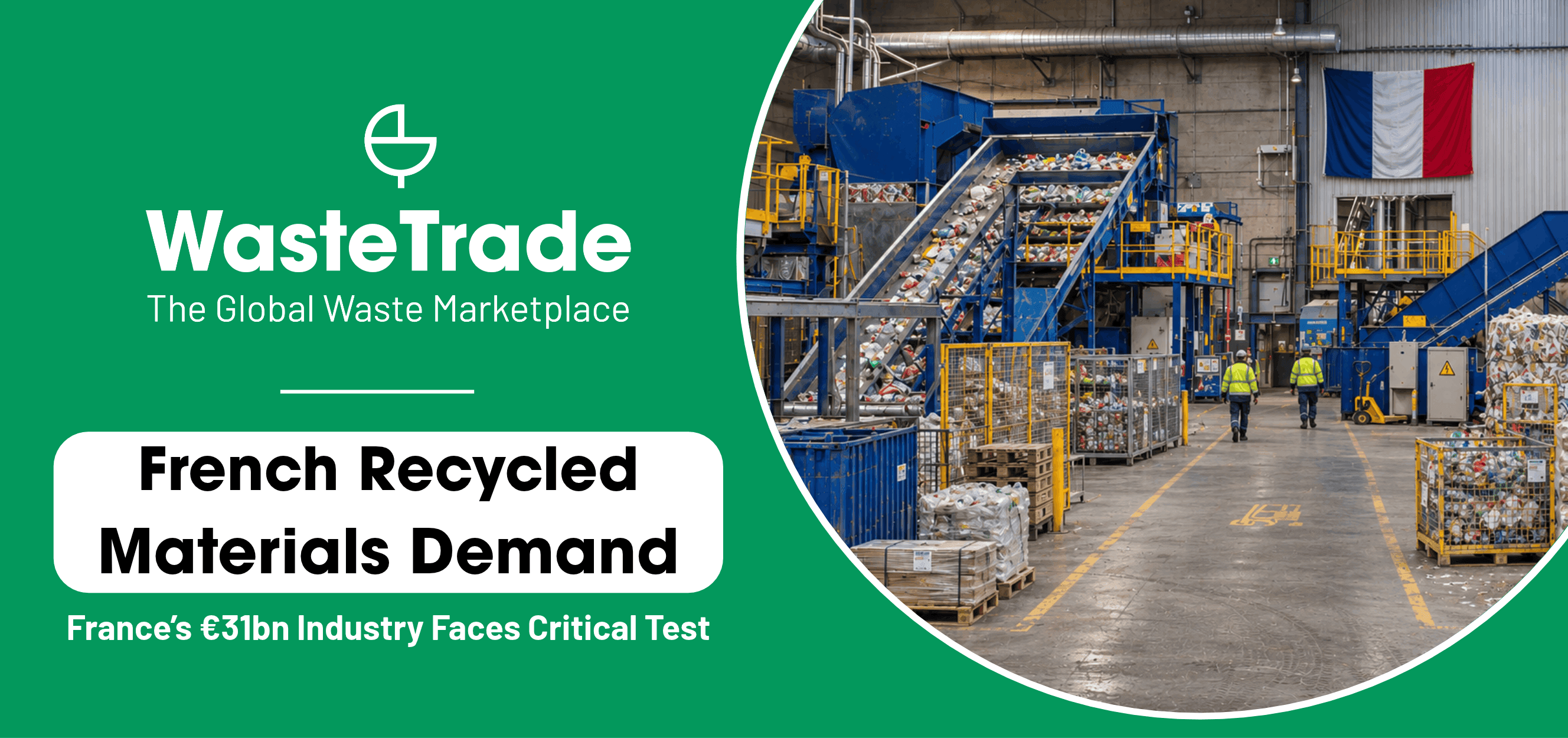
French recycled materials demand has become a central test for France’s €31 billion waste sector: can companies that collect and process discarded materials find enough industrial buyers to use them in new products? These recovered metals, plastics, paper fibres and glass are known as secondary raw materials. France’s agreement, signed on 15 October 2026, aims to connect their supply with factories that could use them.
French Recycled Materials Demand: Key Information
- France signed a 2026–2029 waste-sector agreement on 15 October 2026, covering ten strategic projects. [1][2]
- The sector comprises nearly 1,500 businesses, 90,000 jobs and €31 billion in annual turnover. That is existing sector revenue, not a new government investment pledge. [1]
- France wants stronger links between recyclers and industrial users of plastics, metals and rubber. Proposed partnerships do not yet amount to confirmed purchasing volumes. [3]
- Commercial success depends on repeat orders, reliable specifications, competitive delivered costs and documented material origins.
France’s Recycling Strategy Puts Industrial Buyers First
The agreement, which runs to 2029, marks a shift in emphasis from how waste is managed towards what industry can make with it. Securing markets for recovered materials is an explicit priority, alongside energy recovery from non-recyclable waste, lower landfill methane emissions, workplace safety and skills. [1][3]
That distinction matters. The ten projects are not ten recycling subsidies, and €31 billion is the industry’s annual turnover rather than money earmarked for new plants. The commercial promise lies in recycled materials demand supported by buyers, not merely added processing capacity.
Why Recycled Materials Demand Is Still Uncertain
Waste collection is not the same as material consumption. A sorting facility can produce a saleable grade without securing a manufacturer prepared to purchase it every month.
Recycled materials demand ultimately depends on manufacturers’ production schedules, technical approval and willingness to pay. If virgin inputs are cheaper or easier to qualify, buyers can defer switching. For recyclers carrying substantial energy, labour and equipment costs, that uncertainty reaches directly into margins and investment decisions.
Industrial Recycling Partnerships: Steel Offers a Model
France’s proposed alliances between recyclers and manufacturers have an instructive precedent. In September, recycling federation FEDERREC and metals industry association A3M signed a Green Steel Pact intended to improve scrap quality, secure supply to French steelmakers and support investment. [4]
Steel furnaces need particular scrap compositions, quantities and delivery schedules. The pact therefore addresses purchasing conditions as well as recycling ambition. It is not proof of additional steel orders, but it shows what a productive industrial relationship could look like. Plastics, rubber and other materials need similarly precise agreements, tailored to their own manufacturing requirements.
Recycled Plastic Prices Reveal the Weakness
Plastic recyclers face the sharpest illustration of the problem. The industry association Recycling Europe warned in June 2026 that rising virgin-polymer prices had brought temporary relief, without resolving structurally weak demand or pressure on operating costs. [5]
France has separately introduced a recycled-plastic incorporation premium for eligible products, subject to detailed conditions. WasteTrade has examined that incentive elsewhere. [6] PET flake and HDPE regrind have different end uses. [7][8] The new industrial agreement addresses a wider question: can demand remain dependable when raw-material prices move, subsidies apply only to certain streams and manufacturers retain alternatives?
Recycled Material Prices Depend on Usable Yield
For a buyer, the cheapest tonne of waste is not necessarily the cheapest tonne of usable material. Consider an illustrative comparison, not actual market prices. Material bought at €200 per tonne with an 80% recovery yield costs €250 per usable tonne before processing and transport. At €230 per tonne and 95% yield, the equivalent cost falls to about €242.
Moisture, contamination, colour, alloy composition and load consistency all affect that calculation. This is familiar territory forWasteTrade’s global recyclable-materials marketplace: an offer only becomes meaningful when it specifies what the buyer can actually recover, where the load sits and how regularly it is available. Its guide to commercial bottle recycling examines these variables in detail. [9]
What Waste Generators Can Gain From Better Sorting
For factories, warehouses and commercial waste producers, France’s strategy raises the value of knowing exactly what leaves a site. Separated metal offcuts, identifiable plastic grades, clean cardboard and colour-sorted glass can offer recyclers a more predictable input than mixed waste.
Better presentation is not automatically profitable. Sorting and storage carry costs, and the buyer’s specification must justify them. But reliable descriptions of grade, contamination, packaging and monthly tonnage can help sellers compete for repeat business rather than a succession of isolated collections.
Recyclers Need Contracts, Not Just Capacity
Investment in washing lines, optical sorting and quality control depends on confidence that someone will buy the resulting feedstock. That confidence improves when customers agree on acceptable specifications, expected volumes, rejection rules and reviewable pricing arrangements.
The most revealing question is therefore not how many tonnes France can process, but how many it can sell under workable commercial terms. Recycled materials demand becomes financially meaningful when manufacturers convert expressions of interest into qualified suppliers and sustained orders.
Manufacturers Must Qualify Secondary Raw Materials
Manufacturers also have work to do. Recycled inputs may require production trials, checks on performance and contamination, and assurance that each delivered batch matches the approved specification. For a business looking tobuy recyclable materials, the presence of an available load establishes a possible supply route, not automatic suitability.
Different industries face different obstacles. Papermills monitor fibre quality; glass manufacturers consider colour and impurities; metals producers need appropriate alloy or scrap grades. Plastics converters weigh mechanical properties, composition and, for sensitive uses, additional regulatory requirements. WasteTrade’s brass-recycling guide offers a useful example of why metal grades cannot simply be grouped together. [10]
EU Circular Economy Rules Could Strengthen Demand
France’s initiative sits within a wider European effort to establish functioning markets for secondary raw materials. The European Commission’s planned Circular Economy Act aims to improve their supply and stimulate demand across the single market, although its detailed measures are not yet a substitute for purchase orders. [11]
One rule is firmer: the EU Packaging and Packaging Waste Regulation began applying in August 2026, with mandatory recycled-content requirements for relevant plastic packaging due from 2030. [12] That strengthens longer-term recycled materials demand, but plants need viable supply chains well before the deadline. France is also advocating EU-made recycled inputs and equivalent standards for imports, although these ideas are not enacted requirements. [3]
Cross-Border Recycling Trade Is Part of the Answer
Manufacturing demand and waste generation rarely sit in the same place. Trading across borders can connect a recycler with the right factory, although transport, classification, import permissions and shipment paperwork can make an apparently attractive price unworkable.
EU waste-shipment requirements already changed in May 2026. A further ban on EU exports of plastic waste to non-OECD countries takes effect on 21 November 2026, making alternative lawful outlets more urgent for some streams. [13]
WasteTrade’s approved haulage networkunddigital product passportsillustrate two practical needs: a viable route for the load and verifiable records of what is moving. Neither replaces the receiving buyer’s technical or legal checks.
What Would Prove France’s Plan Is Working?
The measures worth watching are repeat contracts, specification approvals, capacity utilisation, rejection losses and recovered output sold to manufacturers at sustainable prices. None of those outcomes follows automatically from signing an agreement.
Recycled materials demand is the missing connection between waste policy and industrial production. France has identified it. The harder task, for manufacturers,Recyclingunternehmenand marketplaces such as WasteTrade, is to turn that recognition into dependable trade. A country’s recycling success will ultimately be measured not just by what it recovers, but by what its industry buys again.
References
[1] French Ministry for Ecological Transition. Signature du nouvel avenant au contrat stratégique de la filière transformation et valorisation des déchets (2026–2029). 14 October 2026.
[2] SNEFiD. Le SNEFiD co-signataire du Contrat Stratégique 2026–2029 de Filière « Transformation et valorisation des déchets ». 19 October 2026.
[3] Localtis, Banque des Territoires. Nouvel avenant au contrat stratégique de la filière Transformation et valorisation des déchets. 19 October 2026.
[4] A3M. A3M et FEDERREC signent le premier Pacte Acier Vert.
https://www.a3ms.fr/evenement/a3m-et-federrec-signent-le-premier-pacte-acier-vert
[5] Recycling Europe. War Is Not a Business Model: Europe’s Plastics Recycling Industry Needs Urgent Structural Solutions. 23 June 2026.
[6] WasteTrade. France Recycled Plastic Premium: Powerful New €1,000 Incentive. 28 May 2026.
https://www.wastetrade.com/news/france-recycled-plastic-premium
[7] WasteTrade. PET Recycling: Buy and Sell PET Plastic.
https://www.wastetrade.com/materials/pet-recycling
[8] WasteTrade. HDPE Recycling: HDPE Material for Sale.
https://www.wastetrade.com/materials/hdpe-recycling
[9] WasteTrade. Plastic Bottle Recycling: Processes, Facilities, and Business.
https://www.wastetrade.com/resources/plastics/plastic-bottle-recycling
[10] WasteTrade. Brass Recycling: Sell and Buy Brass Scrap on WasteTrade.
https://www.wastetrade.com/resources/metals/brass-recycling
[11] European Commission. Circular Economy.
https://environment.ec.europa.eu/strategy/circular-economy_en
[12] European Commission. New EU Packaging Rules Start to Apply, Including Restrictions on PFAS in Food-Contact Packaging. 11 August 2026.
https://environment.ec.europa.eu/news/new-eu-rules-packaging-enter-application-2026-08-11_en
[13] European Commission. Waste Shipments.
https://environment.ec.europa.eu/topics/waste-and-recycling/waste-shipments_en