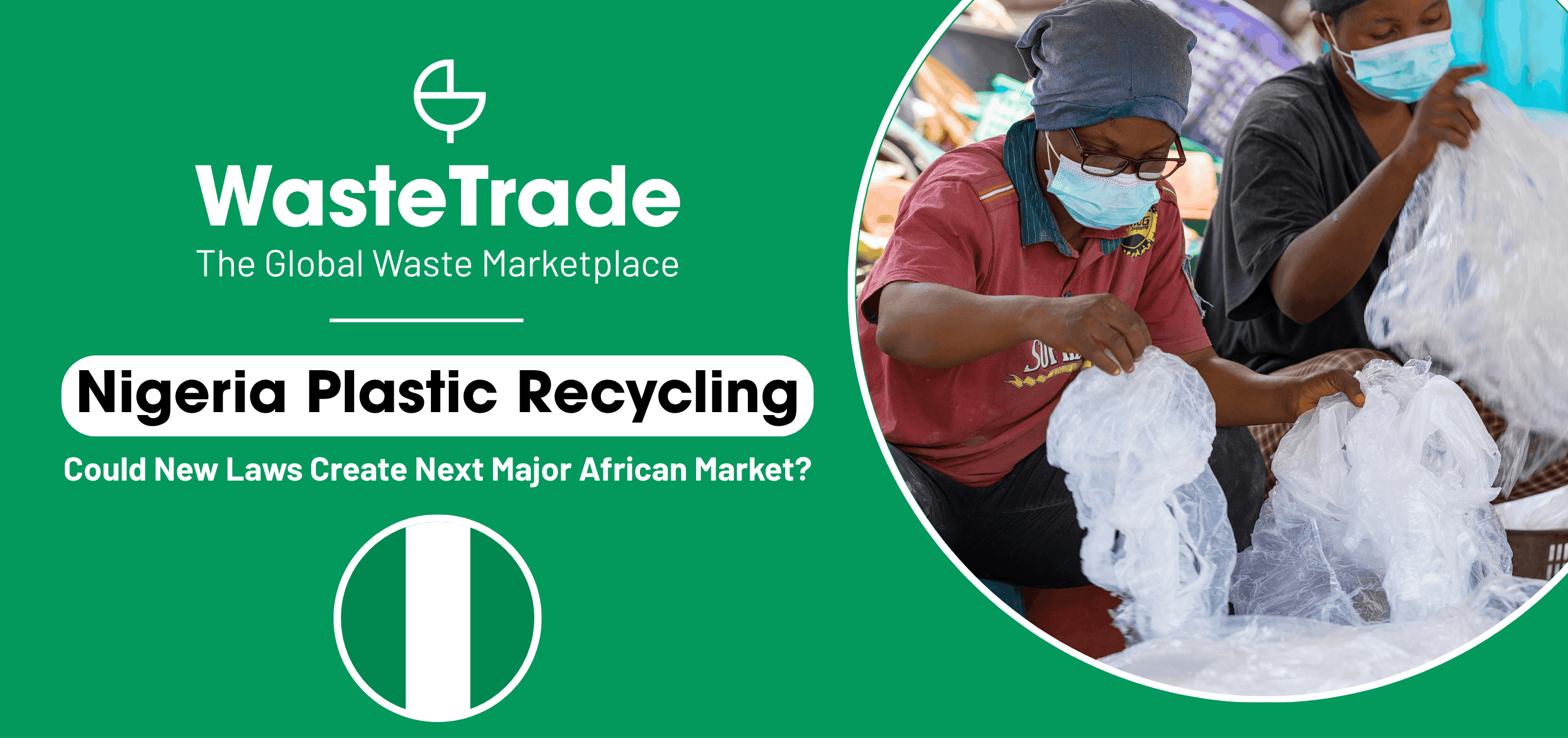
Nigeria’s plastics recycling industry is entering an important period of development. New environmental regulations, investment in recycled PET production and initiatives to improve waste collection are creating opportunities to build a more commercially developed recycling sector. The question is whether these developments can translate into a reliable supply of recycled materials for manufacturers in Nigeria and overseas.
Nigeria Plastic Recycling: Key Information
- Nigeria's National Environmental (Plastic Waste Control) Regulations, 2026, are listed on the official NESREA website, alongside the country's developing extended producer responsibility (EPR) framework.
- The IFC announced US$37 million in financing for Mohinani Group subsidiaries to establish PET recycling plants in Nigeria and Ghana, each with planned annual capacity of 15,000 tonnes of recycled PET resin.
- TechnoServe's Plastics Recycling Program is working to strengthen collection networks, support aggregators and improve connections between collectors and recycling businesses.
- Better collection, sorting, processing and quality assurance could help Nigerian businesses supply manufacturers with more consistent secondary raw materials.
- WasteTrade Ghana has established operations connecting verified recyclers with international buyers, demonstrating the importance of compliance, traceability and logistics in cross-border recyclable-material trading.
- More plastic collected does not automatically mean more commercially saleable recyclate. Quality, processing costs, material losses, transport and dependable demand all influence profitability.
Nigeria Plastic Recycling Regulations 2026: What Is Changing?
Nigeria has been developing its approach to plastic waste management through environmental policy, producer responsibility programmes and more specific regulatory measures.
The Federal Ministry of Environment published its National Policy on Plastic Waste in November 2025. NESREA, the National Environmental Standards and Regulations Enforcement Agency, also lists the National Environmental (Plastic Waste Control) Regulations, 2026, on its official register. These developments provide an important framework for the country's future approach to plastic recovery and recycling.
Extended producer responsibility is central to this approach. EPR places responsibility for aspects of a product's end-of-life management on the businesses that produce, import or place it on the market. Depending on the applicable requirements, this can include registration, reporting, financing collection schemes and supporting recycling.
In its reporting on Nigeria's developing EPR framework, the United Nations Environment Programme (UNEP) explained that producer responsibility organisations can help channel funding from packaging businesses into collection and recycling. Nigeria's Food and Beverage Recycling Alliance is one existing example of an industry initiative involving food and beverage companies and plastics-sector representatives.
The commercial significance is straightforward. If producer responsibility arrangements provide sustained funding for recovery, collectors and recyclers may have a more dependable basis for investing in equipment, collection networks and processing capacity.
However, the distinction between legislation and policy ambition matters. UNEP has reported a Nigerian target for PET bottles to contain 25% recycled material by 2029. This should not be interpreted as a blanket, legally enforceable recycled-content requirement without checking the applicable regulatory provisions, covered products and implementation dates. Businesses need to understand the precise obligations that apply to them rather than base investment decisions on targets alone.
Could Nigeria's Recycled PET Market Expand?
Polyethylene terephthalate (PET), commonly used in drinks bottles, is one of the most commercially significant materials in plastic recycling. When recovered and processed to the required specification, it can become a secondary raw material for manufacturing new products and packaging.
There is already evidence of investment in Nigeria's capacity to produce recycled PET.
In February 2025, the International Finance Corporation announced a US$37 million financing partnership with the Mohinani Group. Through its subsidiaries Polytank Ghana and Sonnex Packaging Nigeria, the group planned to establish PET recycling plants in Ghana and Nigeria, each with annual production capacity of 15,000 tonnes of recycled PET resin. The announcement stated that 90% of the raw materials would be sourced from local small businesses involved in plastic collection.
The proposed facilities are significant because they connect industrial-scale processing with the collection businesses supplying the feedstock. A recycling plant needs sufficient quantities of suitable plastic throughout the year, not simply access to large volumes of waste in principle.
Investment in processing capacity can therefore create opportunities for aggregators and collectors capable of supplying reliable volumes. It can also encourage the development of better sorting, storage and transport arrangements.
However, planned capacity is not the same as confirmed operational output. The commercial impact depends on commissioning, feedstock availability, production performance and demand for the finished material.
Food-contact applications present an additional challenge. Producing recycled PET for food and beverage packaging requires appropriate decontamination technology, quality assurance and compliance with the relevant food-contact requirements. Not every recycler can produce material suitable for these applications, and not every bottle collected will become food-grade recycled PET.
From Plastic Waste to a Saleable Commodity
The difference between collecting plastic waste and producing a marketable recycled material is fundamental to the economics of recycling.
Consider a hypothetical business that collects 100 tonnes of used PET bottles. The material may contain different colours, labels, caps, residual liquids and other contaminants. Before a manufacturer can use it, the bottles may need to be sorted, baled, shredded, washed and processed.
After sorting and processing, suppose the business produces 75 tonnes of saleable washed PET flakes. This is an illustrative example, not a Nigerian industry average.
The business has collected 100 tonnes, but it can sell only 75 tonnes of finished material. Its revenue must cover the cost of collecting the original load, removing unsuitable material, processing the feedstock, transporting the product and running the operation.
A higher selling price for washed flakes may justify the additional investment compared with selling sorted bottles. Equally, energy, labour, equipment, maintenance and material losses may consume the extra revenue.
The right decision depends on the difference between the selling price achieved and the full cost of producing and delivering the material.
This is why recycling businesses need to understand the requirements of potential buyers before investing in additional processing. The objective is not simply to carry out more processing. It is to produce a material that customers want, at a cost that makes commercial sense.
Why Material Quality Matters to Recyclable Plastic Buyers
Different buyers require different forms of recycled plastic. One may purchase sorted PET bottle bales, while another requires washed flakes or processed resin that meets a precise production specification.
Important characteristics can include polymer purity, colour, moisture content, contamination levels, PVC contamination, residual labels and adhesives, and flake size. Consistency between shipments also matters, particularly for manufacturers operating production lines that depend on predictable raw-material inputs.
A supplier that can demonstrate consistent quality may be able to approach a wider range of potential buyers. Documented specifications and appropriate testing can also reduce uncertainty during negotiations and help buyers assess whether a material is suitable for their processes.
Additional processing does not automatically create higher profits, however. A recycler must establish whether the additional value of its finished material outweighs the costs of equipment, energy, labour, testing and yield losses.
Reliable market information is therefore important at every stage. Knowing what buyers require can help a business decide whether to sell collected material, invest in sorting equipment or develop a more advanced processing operation.
Can Nigeria's Recycling Infrastructure Support Growth?
Nigeria's recycling industry still faces practical challenges, including fragmented collection networks, inconsistent feedstock quality, financing constraints, transport costs and the expense of operating processing equipment.
TechnoServe's Plastics Recycling Program provides an example of efforts to address these issues. Its approach includes supporting aggregators to formalise their operations, improving direct connections with recyclers, providing business development support and helping businesses access equipment such as balers, weighing scales and trucks.
These measures address a fundamental commercial problem: processors need dependable feedstock, while collectors need reliable outlets for the material they recover. Neither side can operate efficiently without effective connections across the supply chain.
There is also progress in collection infrastructure. In June 2026, the United Nations Industrial Development Organization (UNIDO) reported on a plastic collection centre in Abuja's Jabi district, developed with the Abuja Environmental Protection Board and Chanji Datti, with funding support from the Government of Japan. The centre is expected to collect up to 1,200 tonnes of plastic waste annually.
The same initiative has supported Ecobarter's locally developed reverse vending machines, which reward people for depositing recyclable materials. UNIDO reported that Ecobarter's annual waste collection had increased from approximately 23 tonnes before its involvement with the programme in 2022 to more than 240 tonnes at the time of its report.
These examples demonstrate how collection systems can develop through investment, incentives and better organisation. They do not, by themselves, establish that Nigeria has sufficient processing capacity to meet all future demand.
Manufacturers will still need consistent supplies of suitable material, while recyclers must manage electricity costs, equipment reliability, working capital and transport. Closing these gaps is essential if collection growth is to translate into commercially sustainable production.
Where Are the Commercial Opportunities?
Nigeria's developing plastics recycling industry offers potential opportunities at several stages of the value chain.
Collection and aggregation:Businesses can organise collection networks, consolidate material from multiple sources and supply processors with more predictable volumes. Better weighing, sorting and storage can help improve the commercial usefulness of collected plastics.
Sorting and processing:Investment in equipment can enable businesses to separate polymers, remove contamination and produce bales, flakes or other materials suited to specific buyers. The viability of each investment depends on achievable selling prices, operating costs and available feedstock.
Manufacturing partnerships:Recyclersmay be able to develop longer-term supply relationships with packaging producers and other manufacturers. Such arrangements can improve visibility of demand, although the terms, volumes and quality requirements must be commercially agreed.
International trading:Businesses producing consistent, appropriately documented recycled materials may be able to reach buyers outside Nigeria. International markets can provide additional potential outlets, but exporters must account for freight, customs procedures, applicable waste shipment rules, currency movements, payment terms and the reliability of counterparties.
A higher quoted export price is not necessarily the most attractive commercial option. A domestic buyer may offer lower transport costs, quicker payment or a more predictable collection arrangement. The relevant comparison is the net return after costs and risks, not the headline price alone.
What Does Nigeria's Development Mean for West African Recycling?
Nigeria's potential should also be considered within the wider West African market. Ghana provides a useful example of how collection, processing, compliance and international trading can be brought together to help recyclable materials reach suitable end users.
WasteTradeGhana launched following receipt of its EPA export permit in September 2025. Its operations in Accra and coordination around Tema Port support verified trading of recyclable plastics and rubber with international buyers. WasteTrade's published account describes a system combining supplier checks, site audits, material verification, export documentation andlogisticscoordination.
This experience is relevant to Nigeria because finding a buyer is only one part of a successful transaction. The material must meet the buyer's requirements, the shipment must comply with applicable regulations, and the economics must work once transport and other costs are included.
For Nigerian collectors, processors and traders, access to potential buyers can help inform decisions about which materials to recover, what quality to produce and where further processing may be worthwhile.
WasteTrade'smarketplaceprovides a way for businesses buying and selling recyclable commodities to identify potential trading partners across geographical markets. Its relevance lies in helping connect different parts of the supply chain, rather than assuming every material is suitable for every buyer or that an international sale will always be the best option.
As the region's recycling infrastructure develops, better visibility of material specifications, supplier credentials and potential demand could help businesses make more informed commercial decisions. Cross-border trading must still be assessed against the relevant permissions, documentation and shipment requirements.
For further regional context, see WasteTrade's articles onbuilding the circular trade gateway for West Africa, recycling investment in Ghanaandthe crossroads facing Ghana's recycling industry.
Turning Nigeria's Recycling Potential into Commercial Value
Nigeria has several of the ingredients needed to develop a more commercially valuable plastics recycling industry: a substantial consumer market, investment in recycled PET production, initiatives to improve collection and a developing regulatory framework.
The challenge is to bring these elements together. Producer responsibility must translate into effective implementation and dependable funding. Collectors need viable routes to market, processors need consistent feedstock, and manufacturers need recycled materials that meet their specifications at competitive prices.
The distinction between collected waste and saleable recyclate will remain central. Growth in collection volumes is valuable, but lasting commercial progress depends on the industry's ability to turn those volumes into consistent, marketable materials.
For WasteTrade and the wider recycling trade, the opportunity lies in connecting these different requirements. As Nigeria's industry develops, stronger relationships between collectors, processors, manufacturers and buyers could help more recovered plastic become a useful industrial resource, supporting a more connected circular economy across West Africa.