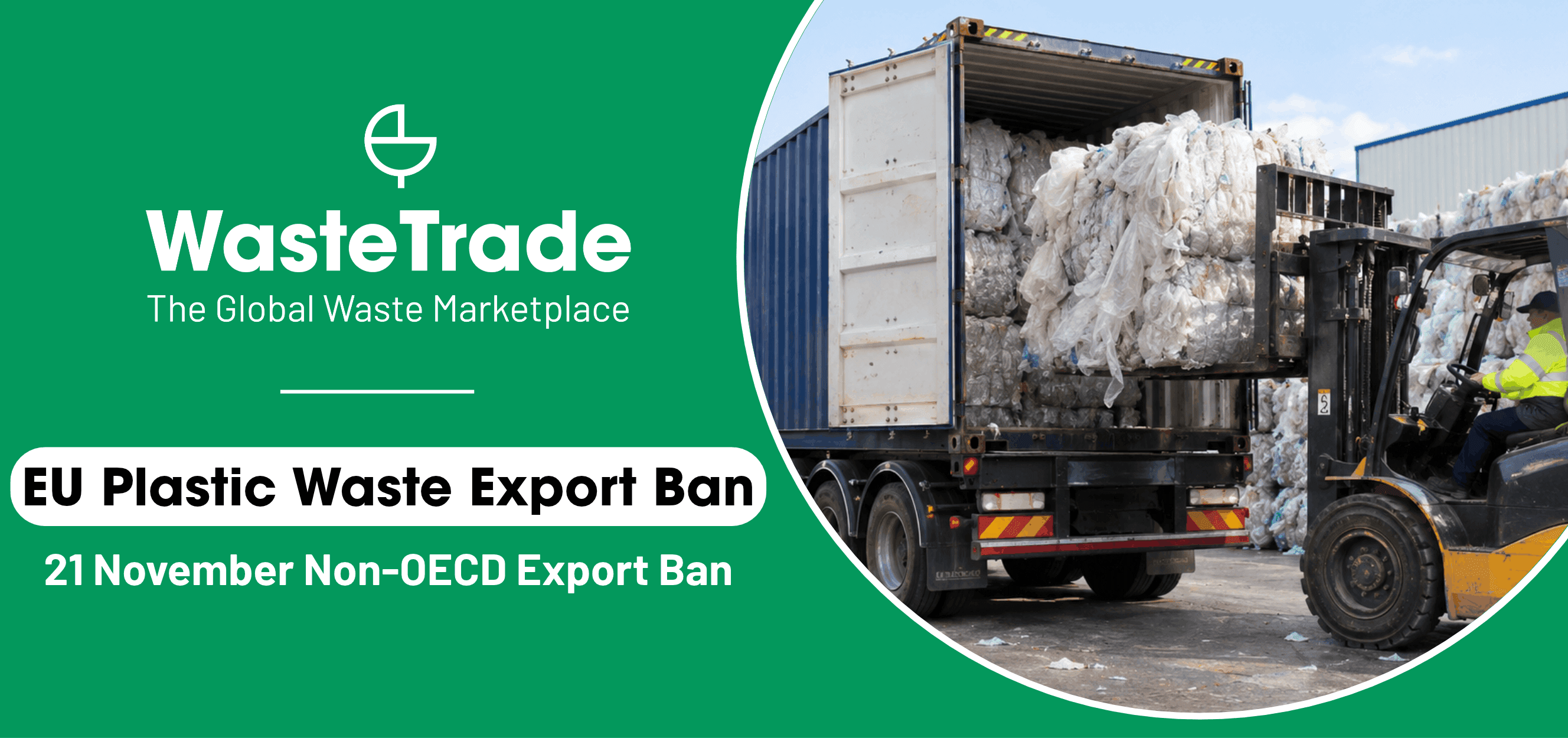
EU Non-OECD Plastic Waste Export Ban takes effect on Saturday 21 November 2026. From that date, businesses in the European Union can no longer export plastic waste to countries outside the Organisation for Economic Co-operation and Development (OECD), including clean, sorted material intended for recycling. The prohibition is not a ban on all waste exports. It removes established customers, with consequences for prices, processing capacity and individual loads.
EU Non-OECD Plastic Waste Export Ban: Key Information
- From 21 November 2026, EU plastic waste exports to non-OECD countries are prohibited until at least 21 May 2029. [1]
- Clean, non-hazardous plastic waste classified as B3011 is covered. Recyclability offers no exemption. [1]
- Roughly half of the EU's 1.4 million tonnes of plastic waste exports in 2025 went to non-OECD destinations. [2]
- EU exports to OECD countries, including the UK and Türkiye, can continue subject to notification, consent and import conditions. [1]
- Independent audits of relevant overseas recovery facilities become a requirement from 21 May 2027. Wider non-OECD waste export restrictions begin separately that month. [1][9]
- Businesses face lost buyers, weaker bids, storage costs and uneconomic freight.
What Changes on 21 November 2026?
Since 21 May, even EU exports of clean plastic waste to OECD countries have required prior written notification and consent. Saturday changes the status of non-OECD destinations from restricted to prohibited. Contracts and freight bookings do not override the ban. Operators handling loads close to the cut-off should check the relevant shipment rules and timing with their competent authorities. [1]
The EU Non-OECD Plastic Waste Export Ban also remains distinct from the Commission's draft list of non-OECD countries authorised to receive certain other wastes after May 2027. Inclusion on that list will not reopen the plastic waste trade. Any future resumption after May 2029 will require the prescribed assessment and authorisation. [1][2]
EU Plastic Waste Exports Are Already Falling
The scale is substantial. The Commission says Malaysia received 276,000 tonnes of EU plastic waste in 2025, Indonesia 215,000 tonnes and Vietnam 137,000 tonnes. Together, that was 628,000 tonnes. Türkiye, an OECD member, received another 510,000 tonnes. [2]
The adjustment has begun before the ban. Basel Action Network recorded EU exports to non-OECD countries of 22,643 tonnes in July 2026, compared with a monthly average of 61,700 tonnes in 2025. Other factors also affect trade, but the contraction is already evident. [3]
Plastic Scrap Prices Face a New Test
For some materials, the marginal overseas buyer was the reason a load had positive value at all. Remove that bid and the cost of collection, sorting and transport remains. Clean PET bottles may find several competing processors; mixed rigid plastics, heavily printed films and inconsistent bales face a narrower pool of buyers.
Nor is Europe equipped to absorb every displaced tonne at a profitable price. The Bureau of International Recycling reported in October that recyclers were contending with subdued demand, pressure on margins and continued capacity closures. Future recycled-content targets will not finance today's stock. [4]
The EU Non-OECD Plastic Waste Export Ban will therefore test the difference between technical recyclability and commercial value. More domestic feedstock means little to a plant without orders for its finished recyclate.
Where Can EU Plastic Waste Go Now?
For EU exporters, the remaining options include recovery within the single market and permitted routes to OECD countries. Neither is an automatic replacement. A buyer needs the right licences, processing equipment, capacity, material specification and price. A legally available destination may still leave an exporter facing higher freight or longer approval times.
Türkiye illustrates the constraint. It remains outside Saturday's prohibition, but the Commission's September assessment raised questions about oversight and transparency in its plastic waste management system. OECD status is not an assurance that every facility or shipment is acceptable. [2]
PreWasteTrade, the practical relevance lies in comparing verified potential buyers alongside the compliance and logistics needed to complete a trade. A high offer may not survive transport, delays and rejection costs.
B3011 and Y48: Why Plastic Grades Matter
B3011 covers specified clean, non-hazardous plastic waste, but it remains waste and falls within the non-OECD prohibition. Y48 covers other plastic waste requiring tighter controls, including certain mixed or contaminated streams. WasteTrade's Y48 analysis explains why these classifications have materially different routes and processing requirements. [5]
For PET, HDPE and LDPE, commercial descriptions also need more precision than a polymer name. Bottle colour, film composition, contamination, moisture, bale density, available tonnage and packaging determine which plants can actually process a load. WasteTrade's PET and LDPE guides outline the different material forms and recovery processes. [6][7]
Shredding or washing plastic does not, by itself, establish that it has legally ceased to be waste. Classification must follow the law, not a revised invoice description.
UK Plastic Waste Export Rules Are Different
Great Britain is outside the EU, although the UK belongs to the OECD. The EU prohibition does not itself impose an identical blanket ban on plastic waste exported directly from Great Britain to non-OECD countries. UK export controls and the importing country's rules still govern those shipments. Northern Ireland is different because the EU waste shipment regime applies under the Windsor Framework. [8]
EU plastic waste may still move to suitably authorised UK recipients under the applicable consent procedures. Yet UK recyclers and exporters could face indirect effects if displaced EU material increases competition for processing capacity, contracts or buyers. [8]
Non-OECD Recyclers Face a Feedstock Gap
Processors in Asia and Africa that relied on European PET, HDPE or LDPE bales must now replace an established source of raw material. Machinery and downstream manufacturing contracts do not disappear when a supplier's legal export route does. Local collection and other lawful sources become essential.
The EU Non-OECD Plastic Waste Export Ban does not prohibit every international movement involving these countries. It specifically closes the EU-origin plastic waste export route. WasteTrade's network across different markets can help buyers investigate alternative supplies, but true origin, classification and each jurisdiction's export and import conditions still require verification.
EU Waste Shipment Rules in 2027 and Beyond
From 21 May 2027, EU exporters must meet independent audit requirements for recovery facilities in third countries, including OECD destinations, subject to the applicable rules. Other non-hazardous waste faces separate non-OECD export restrictions, with conditional authorisations. Neither development cancels Saturday's plastic ban. [1][9]
There is a different uncertainty around DIWASS, the EU's digital shipment system. The Commission has proposed further flexibility beyond 1 January 2027 for electronic Annex VII documents, but had not confirmed a new binding date as of 19 November. DIWASS remains required for prior-notification shipments involving EU countries. The proposed Annex VII reprieve does not permit a prohibited export. [10]
Batch-level records of origin, classification and custody, including thedigital material passportsdeveloped by WasteTrade, can make due diligence more reliable. They cannot replace statutory consents or facility audits.
What Businesses Must Do Before Saturday
Exporters should identify affected contracts and stock, confirm the legal position of shipments near the deadline, and renegotiate delivery and cancellation terms where necessary. They should price each alternative against the full delivered cost, including sorting yield, permissions, storage, haulage and potential returns.
Recyclers need realistic intake specifications and confirmed capacity before promising to absorb displaced material. Overseas processors should diversify genuine supply origins rather than attempt to reroute EU waste through an intermediary country. Carriers should verify documents, consignee and route before booking.
The Real Test Begins After 21 November
The EU Non-OECD Plastic Waste Export Ban will make an uncomfortable truth more visible: removing an export destination does not create a viable recycling marketin its place. WasteTrade sits at the point where specified material, verified demand, documentation anddopravamust meet. The measure of success after Saturday will be how much plastic returns to manufacturing through lawful, economically sustainable trades, not simply how much Europe stops exporting.
References
[1] European Commission: Plastic Waste Shipments
[2] European Commission: Draft Importer List and Türkiye Assessment, 18 September 2026
[3] Basel Action Network: EU Plastic Waste Export Data
[4] BIR: World Mirror on Plastics, October 2026
[5] WasteTrade: Y48 Plastic Waste Explained
[6] WasteTrade: Polyethylene Terephthalate (PET)
[7] WasteTrade: Low Density Polyethylene (LDPE)
[8] ERP UK: EU Plastic Waste Export Ban and UK Producers