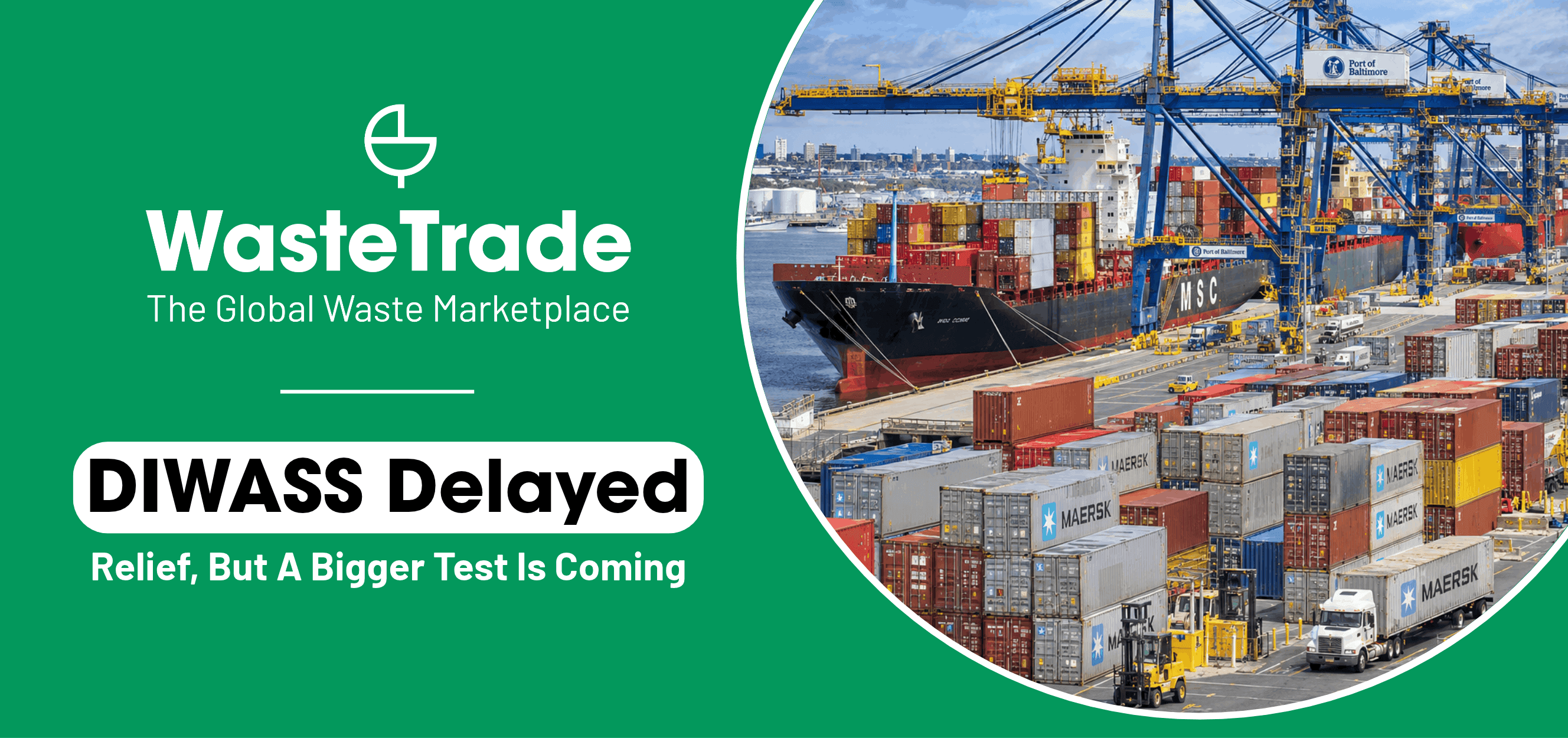
DIWASS delay has moved from an industry demand towards a European policy response, with Brussels signalling that mandatory electronic Annex VII reporting for many non-hazardous waste shipments should move beyond 1 January 2027. DIWASS is the EU's online system for tracking cross-border waste movements; Annex VII is the document that accompanies many shipments of recyclable materials. For traders in recovered paper, metals and plastics, the possible reprieve matters. Yet it will not, by itself, make every shipment legally or commercially viable.
DIWASS Delay: Key Information
- As of 17 November 2026, the Commission has signalled an extension beyond 1 January 2027, but has not confirmed a new binding EU deadline.
- EU Member States are reportedly due to discuss the next steps on 25 November 2026. Recycling Europe favours July 2027; FEAD has called for January 2028.
- DIWASS has remained mandatory since 21 May 2026 for shipments requiring prior notification and consent where an EU country is involved.
- Overseas buyers and recovery facilities must appear on the DIWASS register, although they need not always use the system themselves.
- A separate EU ban on plastic waste exports to non-OECD countries takes effect on 21 November 2026. The DIWASS delay does not change it.
What Has the EU Actually Delayed?
The proposed DIWASS delay concerns the electronic exchange of Annex VII documents, not the entire waste shipment regime. The Commission'sDIWASSguidance [1] originally recommended retaining established, mainly paper-based arrangements through December 2026 while technical connections were completed.
French waste-shipment authorities now state that the Commission intends to extend that transition beyond January [2]. In a statement reported by letsrecycle [13], the Commission said the Annex VII module should remain voluntary, with digital documents available for real shipments. Industry reporting says Member States will examine the mechanism and timing on 25 November [3]. Until authorities establish a definitive framework, businesses should distinguish an announced direction of travel from a legally settled deadline, and check the position in each jurisdiction involved.
New DIWASS Deadline: July 2027 or January 2028?
There is no confirmed replacement date. Recycling Europe is seeking at least 1 July 2027 [12], while the European Waste Management Association, FEAD, has proposed 1 January 2028 [3]. The gap reflects a disagreement about how much operational testing the platform still needs.
The Commission scheduled voluntary Annex VII use from 15 November. That leaves little time for live testing, system integration and training before the previous year-end cut-off. Another DIWASS delay may provide breathing space, but postponement without clear rules for fallback paperwork would merely relocate uncertainty.
Why the DIWASS Rollout Is Still Disrupting Trade
The problem extends beyond an unfinished Annex VII module. Recycling Europe has reported interruptions to already-notified shipments caused by technical failures, with storage, haulage and administrative costs falling on operators [4]. Those movements already depend onDIWASS, regardless of the Annex VII discussion.
For a recycler, a delayed electronic movement document can mean a missed vessel, additional yard space or a buyer waiting for feedstock. The administrative problem becomes a working-capital problem. A later Annex VII date does not resolve faults affecting the consignments that are already inside the digital system.
Recovered Paper Exports Face a Buyer Registration Gap
The stakes are especially high for recovered paper. At the Bureau of International Recycling's October convention, paper division president Francisco Donoso estimated that only a few dozen of more than 1,000 Asian paper mills had registered, while Europe depends on overseas outlets for roughly six to eight million tonnes of surplus recovered paper annually [5]. These are industry estimates, not an official registration census.
There is an important distinction. The Commission says overseas operators involved in EU-linked shipments must be registered and selectable in DIWASS, but they do not necessarily have to submit documents themselves [1]. An EU participant may be able to handle relevant entries on their behalf. That makes the immediate commercial question more precise: is the intended mill correctly registered, authorised to receive the material and operationally ready to complete the transaction?
The Two-Working-Day Annex VII Rule Still Matters
Under Article 18 of the revised EU Waste Shipment Regulation [6], the person arranging an Annex VII shipment must complete the available information, as far as possible, at least two working days before departure. Operators can supply the actual waste quantity, carriers and container identification shortly before the shipment starts.
This distinction matters when bales are weighed late, lorries change or vessels are rescheduled. The DIWASS delay concerns how information is exchanged; it should not be read as removing substantive obligations. FEAD wants the advance-information rule reconsidered, but lawmakers have not amended it [3].
Plastic Waste Exports Have a Different November Deadline
For plastics traders, the more immediate date is 21 November 2026. From that day, the EU prohibits plastic waste exports to non-OECD countries, under separate provisions of the Waste Shipment Regulation [7]. The restriction covers EU-origin exports even where the material is clean and recyclable.
Other routes require their own analysis. Since May, exports of plastic waste from the EU to OECD destinations have generally required prior notification and consent, including clean B3011 material. By contrast, qualifying EU3011 plastic shipments within the EU follow general information requirements [7]. A DIWASS delay cannot make a prohibited destination permissible. For PET bottles, flakes and trays [11], a commercial specification is not permission to export. Overseas facility audits due in May 2027 remain a separate requirement.
What Does the DIWASS Delay Mean for UK Traders?
UK operators should distinguish Great Britain from Northern Ireland. The revised EU rules apply in Northern Ireland under the Windsor Framework, and Northern Irish operators use DIWASS. For movements linking Great Britain with EU territory, applicable EU documentation and counterparty requirements can still affect whether a load moves [1].
The UK's domestic digital waste tracking programme is a separate policy, not a substitute for EU waste-shipment procedures [8]. Traders serving both markets need to manage these requirements independently rather than assuming a postponement in Brussels changes British reporting obligations.
When a Shipment Delay Becomes a Pricing Problem
WasteTradeのwork connecting material suppliers, buyers and logistics providers highlights a distinction that regulation alone cannot solve: a material may have a willing buyer without having an executable route to that buyer. Price, contamination specification, destination permissions, counterparty registration and freight availability must all align.
If an overseas outlet becomes uncertain, sellers may compete more aggressively for domestic capacity. Storage and demurrage can erode an apparently attractive offer. Access to verified buyer and seller networks and alternative buyers matters commercially, but it cannot override export restrictions. The strongest contract is not simply the one with the highest quoted price; it is the one that can be completed.
How Recycling Businesses Should Use the Extra Time
The next stage should be operational, not merely administrative. Confirm waste codes, destination eligibility and Annex VII documentation requirements [10] before negotiating price. Check that every relevant producer, carrier, consignee and recovery facility appears correctly in DIWASS. Test the available DIWASS route with the responsible authority, and agree who will enter information for non-EU partners.
Then examine haulage and delivery windows, changes to vehicle details, document retention and the allocation of delays or demurrage under the contract.WasteTrade's logistics networkaddresses the transport side of that coordination. Itsデジタル製品パスポートapproach also illustrates the value of batch-level traceability, linking material specification and custody evidence. Such records can support preparation, but they do not replace a statutory DIWASS submission [9].
The Real Test Is Whether Materials Keep Moving
The DIWASS delay may spare recyclers an abrupt switch to an untested process. It does not remove the need to verify buyers, document routes and protect margins against interrupted shipments.
For WasteTrade and the widersecondary-materials market, the decisive measure of progress is not the date Brussels eventually chooses. It is whether legitimate recovered materials can move predictably to the facilities capable of recycling them. A digital system should make that trade more dependable, not decide which otherwise lawful transactions survive.
References
[1] European Commission, Digital Waste Shipment System (DIWASS)
[2] French Environmental Ministry, Annex VII Transition Guidance
[3] Ricicla News, Member State Talks and Proposed Deadlines, 17 November 2026
[4] Recycling Europe, Letter on DIWASS Operational Failures
[5] Bureau of International Recycling, Paper Sector Warning, 2 November 2026
[6] Regulation (EU) 2024/1157, Article 18
[7] European Commission, Plastic Waste Shipment Rules
[8] WasteTrade, Digital Waste Tracking in the UK
[9] WasteTrade, Digital Product Passport Updates
[10] WasteTrade, DIWASS Requirements and Annex VII Compliance
[11] WasteTrade, PET Recycling and Trading Specifications
[12] Recycling International, DIWASS Digital Deadline to Be Delayed, 13 November 2026
[13] letsrecycle, Commission Statement on Annex VII Postponement, 11 November 2026