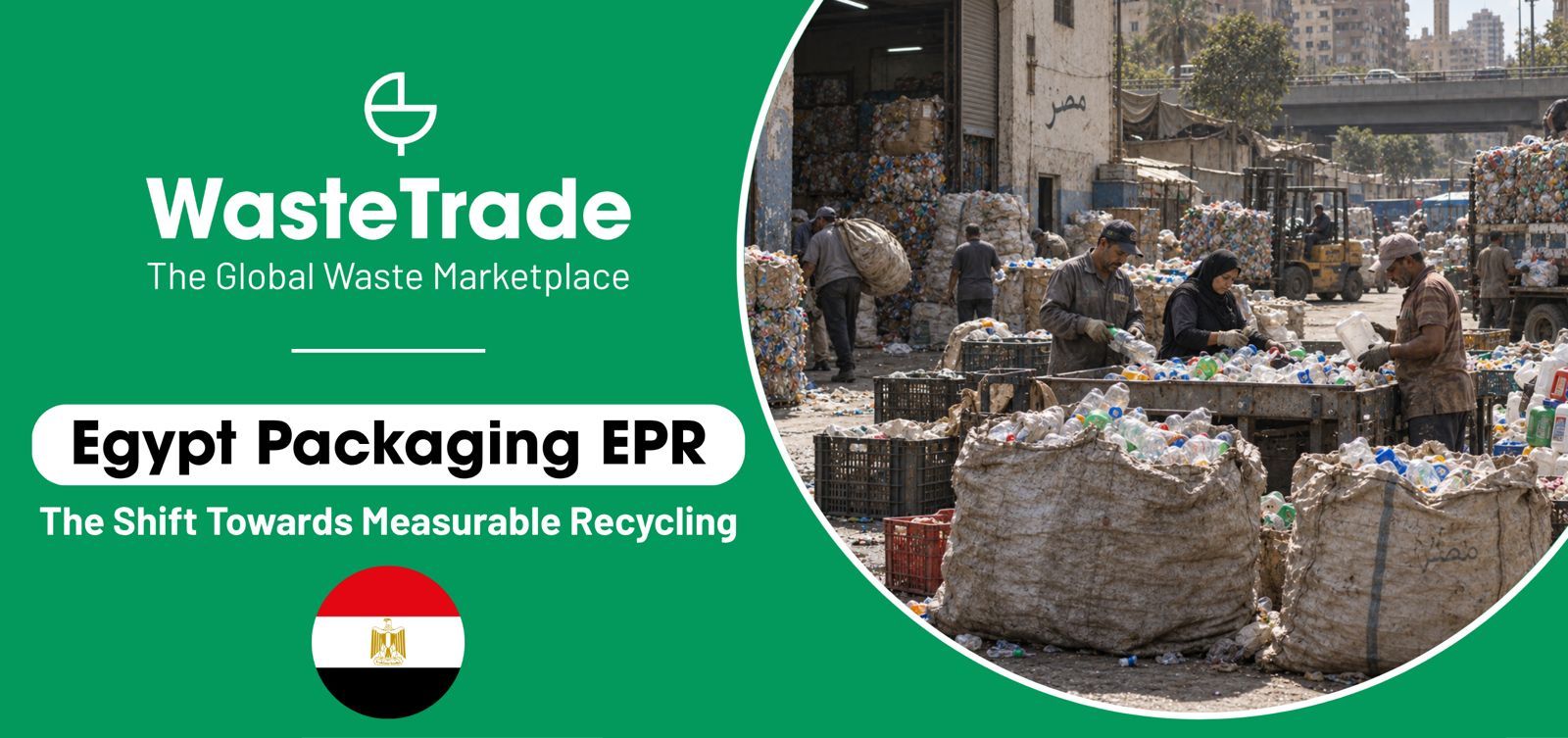
Egypt Packaging EPR is moving from consultation into practical infrastructure. Producers and importers are expected to register and disclose how much packaging they place on the Egyptian market through the national Waste Information Management System, or WIMS. Extended Producer Responsibility, or EPR, makes companies carry more of the environmental and financial responsibility for products after use. In Egypt, its importance may lie as much in measurement as in compliance.
The country already has collectors, processors and established end uses for materials such as PET. Better information could change how that material is collected, financed, specified and sold.
Egypt Packaging EPR Moves Towards Implementation
Egypt has spent several years building the basis for producer responsibility. Waste Management Law No. 202 of 2020 established the framework, while later consultations focused on packaging. Article 17 allows priority products to enter EPR arrangements and provides for producers to bear waste-management costs.
The latest step came in August 2026. Egyptian officials said the electronic EPR platform was ready through WIMS and had been designed to register producers and importers and record the quantities of packaging they place on the market. They also said materials for the first phase had been identified following consultation with the private sector and other stakeholders, although the public announcement did not name them.
Important commercial details remain outside the public record. Officials said a Prime Ministerial decision would define covered products, producer obligations, fees and the roles of relevant authorities.
Packaging Volumes Could Change What Egypt Can Measure
The central value of Egypt Packaging EPR may begin with a simple number: how much packaging enters the market.
Recycling rates are difficult to interpret without a credible figure for material placed on the market. Producer declarations could give regulators a firmer denominator for assessing collection and recycling.
That is not the same as full traceability. WIMS can record producer information, while Egypt already licenses collection, transport and treatment activities through its waste-management system. Connecting those records closely enough to follow physical material through the chain is a more demanding task.
If Egypt can do it, regulators can see where recovery falls short, reprocessors can gain a clearer view of feedstock and producers can understand their post-consumer exposure more precisely.
Plastic Bag EPR Sets a Precedent
Egypt does not have to design every administrative mechanism from scratch.
Prime Ministerial Decree No. 662 of 2025 brought specified plastic shopping bags within EPR. Producers and importers covered by the decree must register, submit quarterly sales data and pay EGP 37.50 for each kilogram sold on the domestic market, with the funds directed towards waste management.
That system offers a useful precedent for registration, reporting and producer financing. It does not tell us what the broader packaging regime will look like.
The public material has not yet set out an equivalent packaging fee schedule, reporting timetable, producer threshold or recycling target. Those choices will decide whether the scheme changes material flows or mainly administration.
Producer Funding Could Change Collection Economics
Collection follows value.
PET bottles attract attention because processors can turn them into flake, fibre or recycled resin and sell those outputs into established markets. Other packaging may be lightweight, contaminated, dispersed or simply worth too little to recover economically.
Producer funding can change that boundary. If Egypt Packaging EPR directs money towards collection, sorting, transport and treatment, material that currently falls below the commercial threshold may become worth recovering. Earlier government consultations linked EPR with higher collection and recycling rates and closing the waste-management financing gap.
Fee design will matter. A charge can raise money without improving recycling. A better-designed system can direct funding towards the formats, locations and stages of recovery where the economics are weakest.
Egypt Packaging EPR Meets Existing Recycling Capacity
Egypt is not waiting for a recycling industry to appear.
Collectors, aggregators, wash plants, reprocessors and manufacturers already move recoverable material through the economy.WasteTradehas previously examined Egypt's recycled polyester fibre market, where post-consumer PET moves from bottles into flake and then fibre for textiles, bedding, furniture and industrial applications.
That existing capacity changes the EPR question. The immediate challenge is not simply to build more plants. It is to give processors more predictable feedstock and to make recovered material easier to identify, qualify and buy repeatedly.
Higher collection volumes would help. Consistency will determine how much value those volumes create.
PET and HDPE Still Depend on Quality
For streams such as PET and HDPE, more collection does not automatically mean more high-value recycling.
Processors buy against specifications. Colour, polymer separation, contamination, moisture, labels, closures and consistency all affect whether recovered packaging suits a given production line and what a buyer will pay for it.
If Egypt Packaging EPR sends more material into formal recovery channels, quality control becomes more important. Reprocessors need confidence before allocating capacity. Manufacturers using recycled content need stable inputs. International buyers need documentation that stands up to commercial and regulatory scrutiny.
A recovery system should therefore measure more than tonnes collected. It should also become better at identifying which tonnes can return to productive use.
The Zabbaleen Will Test Formalisation
Egypt's informal recovery networks make this unusually sensitive.
Cairo's Zabbaleen and other informal collectors already recover, sort and trade valuable material through networks that formal systems would struggle to reproduce quickly. Earlier technical work on packaging EPR in Egypt recognised this reality and argued for integrating informal operators into collection and treatment structures.
Formalisation can improve the system if it means clearer contracts, safer equipment, reliable weighing, registration and traceable transfers. It can weaken it if formal status becomes a barrier that displaces experienced collectors without replacing their knowledge or efficiency.
Egypt does not need to prove that informal collection works. It needs to decide how a more accountable system can recognise, pay and document the people already doing much of the recovery.
Traceability Will Matter as Much as Tonnage
A producer register can show how much packaging entered the market. It cannot tell a buyer whether a bale of PET meets specification or whether its stated origin can be supported.
Commercial recycling relies oninformation attached to physical material: source, weight, polymer, contamination, processing history, custody and documentation. As reporting becomes more structured, those records gain economic as well as regulatory value.
This is whereWasteTradefits naturally into the developing market. The platform connects verified counterparties around defined material listings and supports classification, documentation,logisticsand cross-border recyclable-material transactions. It does not replace regulation, inspection or certification. Its value lies in helping a material retain a clearer commercial identity as it moves between seller and buyer.
For Egyptian suppliers seeking repeat business, that distinction matters.
A Recycling Market Still Needs Buyers
EPRcan improve the economics of recovery, but recovered packaging still needs an end market.
If collection grows faster than processing or demand, the bottleneck simply moves downstream. Reprocessors need customers for flake, pellets, fibre and other secondary materials. Those customers need repeatable quality, workable pricing and confidence that supply will continue beyond a first shipment.
Egypt has useful geography. Europe sits across the Mediterranean, Gulf markets are close and the Suez corridor connects the country with major trading routes. Yet proximity has limited value when material cannot meet specification consistently.
The strongest recycling markets connect policy, collection, processing and demand. Leaving out the final element merely produces better-documented material with nowhere attractive to go.
Egypt Packaging EPR Still Has Critical Gaps
Several decisions will determine how consequential the new system becomes.
The public material has not yet named the first-phase packaging categories or set out the final fee structure, producer thresholds, recycling targets or reporting frequency. It also leaves open the model for collective producer responsibility, the role of informal collectors and how much resulting data will become public.
These are structural questions. They determine who pays, which materials gain a collection incentive, how free riders are treated and whether formal reporting corresponds with physical recovery.
The registration platform is therefore an important beginning, not a verdict on the system.
The Test Is Whether Packaging Becomes More Visible
Egypt already has recovered material, collection knowledge and industrial recycling capacity. What remains fragmented is the information connecting packaging placed on the market with the material that collectors recover, processors convert and buyers ultimately use.
Egypt Packaging EPR could narrow that gap.
If producer declarations can be reconciled with credible collection, processing and trade records, Egypt will gain something more useful than a larger compliance database.Recyclerswill see feedstock more clearly, producers will face a more tangible connection to post-consumer material, and buyers will have stronger evidence behind the secondary raw materials offered to them.
That will not resolve Egypt's packaging waste challenge in a single regulatory step. It could, however, give the market a firmer basis for deciding what exists, what is recoverable and what is worth bringing back into circulation.