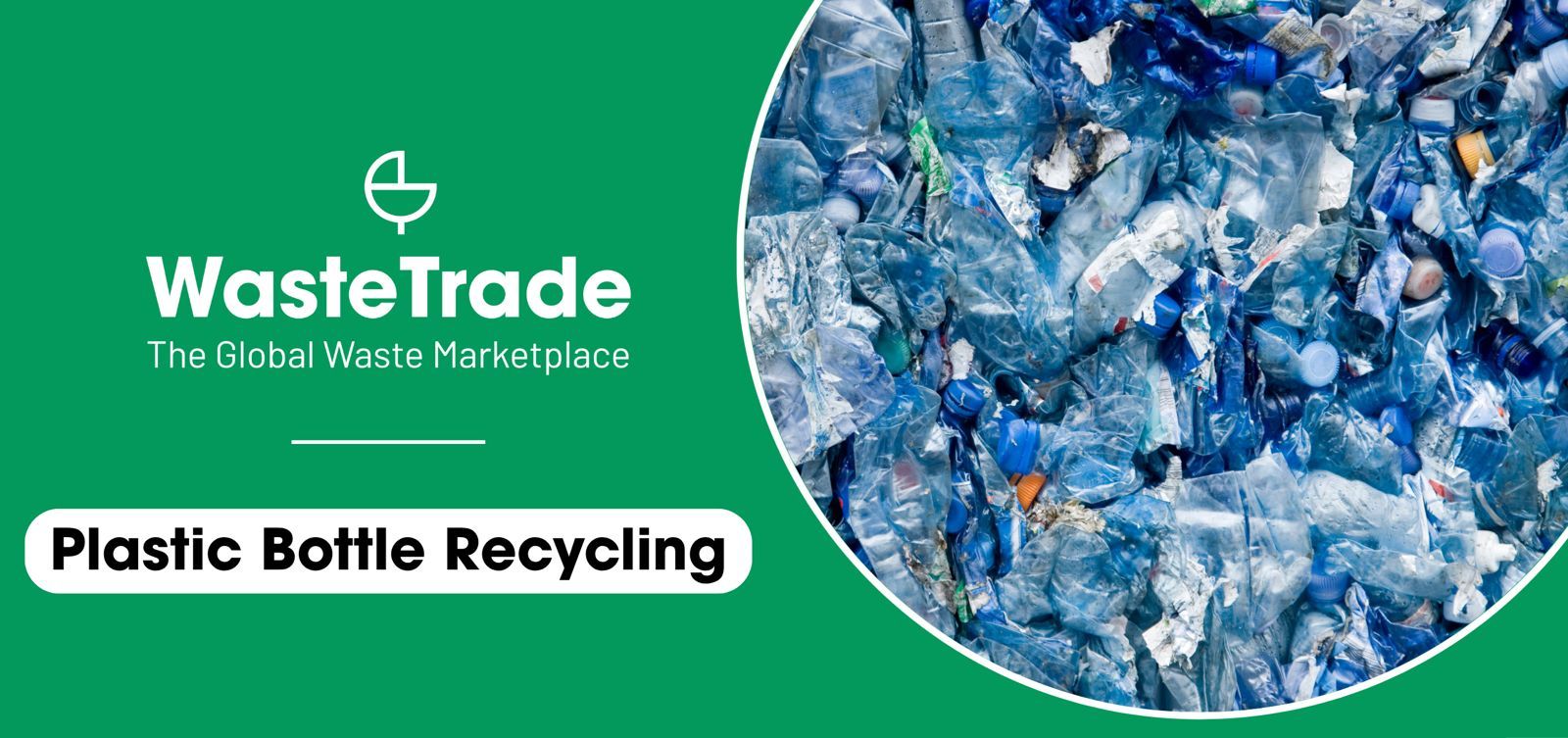
Plastic Bottle Recycling: Key Information
- Plastic bottle recycling covers the collection, sorting, preparation and reprocessing of PET, HDPE and other bottle plastics.
- Commercial recycling depends on material grade, contamination, volume, packaging, location and buyer requirements.
- Larger quantities may require dedicated collection, sorting, baling and specialist recycling routes.
- WasteTrade connects sellers of plastic bottle waste with verified buyers and reprocessors, supporting competitive offers, logistics, compliance and secure payment.
Plastic Bottle Recycling
Plastic bottle recycling gives businesses a route to move used PET and HDPE bottles out of residual waste and back into productive manufacturing. At commercial scale, however, recycling involves far more than placing bottles in the correct container. Material has to be collected effectively, prepared to an appropriate specification, consolidated into viable quantities and matched with a recycler or buyer whose process can actually use it.
That distinction matters for WasteTrade customers.
A household needs to know whether a bottle belongs in its local recycling collection. A manufacturer, waste contractor, materials recovery facility or large waste-producing business may need to find an outlet for tonnes of PET or HDPE, understand what buyers require, compare commercial offers and arrange an efficient movement of material.
WasteTrade provides the marketplace for that commercial stage of plastic bottle recycling. Sellers can offer defined recyclable materials to verified buyers and reprocessors. Buyers can source feedstock that meets their plant requirements. Offers are made against actual loads, allowing price to reflect specification, volume, location and trading terms rather than an unrealistic universal value for "plastic bottles".
Once a trade is agreed, logistics, compliance and secure payment still have to work. WasteTrade supports those parts of the transaction so that a commercially recyclable bottle stream can move from the business producing it to a customer capable of using it.
This guide covers how to recycle plastic bottles, preparing bottle waste at commercial scale, what plastic bottle buyers and reprocessors need to know, where to find recycling routes in the UK and USA, plastic bottle disposal, commercial value and how bottle material is bought and sold through WasteTrade.
How to Recycle Plastic Bottles
How to recycle plastic bottles depends on the polymer, previous contents, condition of the material, collection system and the specification required by the recycler receiving it.
At commercial scale, the objective is to preserve as much usable polymer as possible without introducing unnecessary handling cost.
Identify and Separate the Bottle Material
PET and HDPE are the two bottle polymers most businesses are likely to encounter in significant recycling streams.
PET commonly appears in drinks bottles. HDPE is widely used for milk, cleaning products, toiletries and other rigid containers.
They should not be treated as interchangeable feedstocks.
A recycler processing PET wants to maximise PET yield and minimise incompatible materials. A recycler processing HDPE has the same objective for polyethylene. Other polymers, glass, metal, film and unrelated waste increase sorting requirements and can reduce usable output.
Where practical, businesses should identify the dominant bottle polymer before the material enters a large mixed-waste stream.
Empty and Prepare Plastic Bottles for Recycling
Bottles should be sufficiently empty for the collection and recycling process receiving them.
Residual liquids create avoidable weight, leakage and contamination. Food products, oils, detergents and chemicals may create additional problems depending on what the bottle previously contained.
Commercial preparation should always be proportionate.
A business should not automatically invest labour and water in washing thousands of bottles unless the target specification requires it. Equally, material that reaches a recycler heavily contaminated can create avoidable rejection or processing costs.
The most efficient standard is the standard the receiving recycler actually needs.
Manage Caps, Labels and Sleeves
Caps, labels and sleeves can introduce other polymers into a bottle stream.
Many modern bottle-recycling systems can separate certain closure materials during processing, so removing every cap manually is not automatically necessary.
Large sleeves, unusual labels or excessive non-target packaging can be more problematic.
For a commercial seller, the right question is not "should all caps always be removed?" It is "what does the intended recycler accept within this grade?"
Once that requirement is known, preparation can be designed around it.
Control Contamination Before It Enters the Stream
The cheapest place to remove contamination is often before it gets mixed into the material.
Collection containers should be placed where bottles actually arise and labelled clearly enough that users can distinguish them from food waste, glass and general rubbish.
For industrial or controlled streams, staff responsible for waste handling should understand what belongs in the grade.
Once contamination has been compressed into a bale, removing it becomes somebody else's sorting cost and may affect whether the load is accepted at all.
If your business generates regular bottle tonnage, define the recycling specification first and build the collection process around it. Correcting a poor stream after baling is usually harder and more expensive.
Plastic Bottle Recycling at Commercial Scale
Plastic bottle recycling at commercial scale is a materials-management and supply-chain problem. The recycler needs predictable feedstock, while the waste producer needs a route that is operationally practical and commercially viable.
The strongest recycling systems are designed from the receiving specification backwards.
Waste-Producing Businesses
Manufacturers, retailers, warehouses, hospitality businesses, event operators, universities, facilities managers and construction companies can all generate significant bottle volumes.
The best collection model depends on where the bottles arise and how concentrated the stream is.
A drinks manufacturer may be able to isolate PET production rejects directly at the line. A hotel may generate bottles across hundreds of rooms and food-service areas. A construction company may capture PET drinks bottles through welfare facilities while keeping chemical containers in separate waste routes.
The more dispersed the waste generation point, the more important collection design becomes.
For large businesses, bottle recycling should be treated as an operational system rather than a collection-bin decision.
Waste Contractors and Materials Recovery Facilities
Waste contractors and materials recovery facilities play a different role.
They may receive mixed dry recyclables from many customers and then separate those materials into commercial grades. Bottle recovery can involve automated sorting equipment, manual quality control, baling and regular sampling.
Their product is not simply "recycled waste". It is a defined secondary raw material supplied to a downstream reprocessor.
That means yield, bale composition and end-market requirements matter directly.
WasteTrade can be useful where waste companies want access to a wider pool of bottle buyers, need additional outlets for recurring grades or want to reduce reliance on one existing destination.
Storage and Compaction
Loose bottles are inefficient to transport because a large proportion of the volume is air.
Commercial operators therefore often compact or bale bottle material before shipment.
The correct approach depends on the site, available equipment and buyer requirement. Baling improves payload, storage efficiency and handling, but poorly formed bales create their own problems.
Material should also be protected from unnecessary contamination during storage. A carefully sorted PET stream can lose value quickly if it is stored where glass, general waste, soil or excessive water enters the load.
Bale Quality and Load Consistency
Bale quality includes more than density.
A buyer may care about bale composition, moisture, wire condition, contamination, average bale weight and how consistently one load resembles the next.
Reliable supply matters particularly to reprocessors operating continuous production.
A plant does not simply need twenty tonnes today. It may need twenty tonnes every week within an agreed input tolerance.
For sellers hoping to build a recurring outlet, consistency can therefore be more commercially important than achieving an exceptional result on one isolated load.
Quality Control Before Dispatch
Commercial bottle sellers should have some method of checking whether material still matches the agreed specification before dispatch.
That can be as simple as regular visual inspection for a controlled production stream or more structured sampling where material comes from mixed collection.
Quality control protects both sides.
The seller reduces the risk of rejection or deductions. The buyer has greater confidence that the load will perform as expected through the recycling plant.
Where problems are found repeatedly, the solution should normally be pushed upstream into collection and sorting rather than accepted as a permanent downstream cost.
Plastic Bottle Buyers and Reprocessors
Plastic bottle buyers and reprocessors are ultimately buying usable feedstock rather than taking bottles simply because they are recyclable. Their questions therefore focus on specification, yield, consistency, processing compatibility and supply reliability.
Understanding that buyer perspective makes it much easier for a WasteTrade seller to present material effectively.
What Buyers Need to Know Before Making an Offer
Before making an offer, a serious buyer will usually want enough information to judge whether the load belongs in its process.
That can include polymer, grade, colour, source, contamination, moisture, packaging format, approximate load weight, total quantity, location and whether the material is available once or on a recurring basis.
Photographs can help, but photographs alone do not replace a usable specification.
A buyer assessing clear PET bottles, for example, may want to know how much coloured PET, trays, HDPE, PVC or other non-target material is typically present.
The more uncertainty there is, the more risk the buyer has to price into the offer.
How Reprocessors Assess a Bottle Load
Reprocessors think in terms of usable yield.
If twenty tonnes arrive at the plant but a substantial proportion has to be removed as contamination, the commercial value of the load is not the same as twenty tonnes of usable polymer.
Input quality also affects throughput. Excess contamination can slow sorting, increase wash losses, interfere with equipment and reduce output quality.
This is why a reprocessor may prefer a slightly more expensive but more consistent grade. Feedstock is part of a production process, and production stability has value.
One-Off Loads Versus Recurring Supply
One-off bottle loads can be commercially useful, particularly where a business is clearing accumulated stock or dealing with a specific project.
Recurring supply is often more valuable strategically.
A buyer that knows a supplier can provide an agreed grade every month can plan procurement and plant capacity with greater confidence.
For the seller, a repeat outlet can reduce the uncertainty and administrative effort associated with finding a new destination for each load.
WasteTrade can support both one-off and recurring opportunities, but sellers with repeat material should make the frequency and expected tonnage clear.
Why Buyer Fit Matters
Not every recycler is the right buyer for every bottle grade.
A plant producing high-quality recycled PET may have tighter input requirements than one serving a broader polyester market. A natural HDPE processor may not want heavily mixed coloured HDPE. Another buyer may be specifically set up to handle the grade.
Finding the right buyer is therefore more useful than simply finding any recycler.
WasteTrade gives sellers the opportunity to expose a material to customers whose process is a genuine fit, while buyers can focus on listings that match their feedstock requirements.
Water Bottle Recycling
Water bottle recycling is primarily associated with PET because most conventional single-use water and soft-drink bottles are made from polyethylene terephthalate.
For commercial operators, the objective is to recover that PET in a form that gives the downstream recycler a good usable yield.
Recycling Plastic Water Bottles
Recycling plastic water bottles typically begins with collection and sorting.
Bottles may pass through materials recovery facilities where optical sorters, mechanical separation and manual quality control identify PET and remove other materials.
Once the target PET stream has been produced, bottles can be baled for transport to a specialist recycler.
At the reprocessing stage, material is reduced in size, washed and separated from labels, closures, dirt and other contaminants. The resulting PET can then be processed into recycled feedstock for manufacturing.
The precise plant configuration varies, but the commercial principle remains the same: each stage is trying to increase the concentration and quality of the target polymer.
Clear and Coloured PET
Clear PET can be commercially distinct from green or mixed-colour bottle grades.
A recycler producing light-coloured or clear recycled material needs suitable feedstock. Strong pigmentation in the input cannot simply be removed during ordinary mechanical recycling.
This makes colour sorting important where the scale and end market justify it.
Businesses should avoid mixing separate PET colour grades merely to increase tonnage unless the intended buyer accepts the combined material.
What Happens After PET Bottles Are Recycled?
Recovered PET can return to packaging or move into other polyester applications depending on quality.
From a commercial perspective, this means the bottle recycler is part of a wider manufacturing supply chain.
The buyer of baled bottles needs to produce a recycled output that somebody further downstream wants to purchase. Its input specification is therefore shaped by the quality requirements of that eventual market.
This is why the initial bottle grade matters so much.
Where to Recycle Plastic Bottles
Where to recycle plastic bottles depends on whether the material is household waste, small-scale commercial recycling or a bulk commodity load.
For WasteTrade users, the most relevant question is usually where substantial quantities can be sent repeatedly and economically.
Where to Recycle Plastic Bottles in the UK
Businesses in the UK should use an appropriate commercial waste or recycling route for workplace bottle waste.
For small quantities, that may mean collection through an existing dry-recycling contract.
As volumes increase, businesses may have access to more specialised routes through waste contractors, materials recovery facilities or direct recycling outlets.
PET and HDPE bottle grades can also become commercially tradable where quantity and quality justify it.
At that point, the business is no longer simply looking for somewhere to dispose of bottles. It is looking for a customer whose feedstock requirements match the material available.
WasteTrade gives UK sellers access to verified buyers seeking recyclable plastics and allows those buyers to assess actual listings against their own plant requirements.
Where to Recycle Plastic Bottles in the USA
Plastic bottle recycling in the USA varies significantly by location, collection system and state or municipal arrangements.
Businesses should therefore avoid assuming that one local consumer rule describes the commercial recycling market across the entire country.
Commercial operators with bulk quantities can access collectors, sorting facilities and specialist PET or HDPE reprocessors.
The size of the USA makes location particularly important. Transport distance can have a substantial effect on the net value of low-density material, which is why baling, load weight and the location of suitable buyers matter.
WasteTrade gives US sellers a way to reach beyond the immediate local market where a more suitable recycler may exist elsewhere.
Where to Recycle Plastic Bottles in Europe
Plastic bottle recycling across Europe varies by country, regional collection system and the infrastructure available to commercial waste producers.
Businesses should therefore avoid treating Europe as a single recycling market. Collection requirements, deposit-return systems and local recycling arrangements differ between countries, while commercial material may move through a much wider network of waste contractors, sorting facilities and specialist reprocessors.
Businesses generating bulk quantities of PET or HDPE bottles may have access to specialist recycling outlets beyond their immediate local area, particularly where the material is consistently graded, baled and available in commercially viable volumes.
For larger loads, transport distance, load weight, material quality and cross-border movement requirements can all affect the practicality and net value of a recycling route.
At commercial scale, the objective is therefore not simply to locate the nearest recycler. It is to find a suitable buyer or reprocessor whose feedstock requirements match the bottle grade being produced.
WasteTrade gives European sellers access to verified buyers across a wider market, helping businesses identify suitable outlets for recyclable plastic bottle material beyond their existing local network.
Where to Recycle Plastic Bottles in Africa
Plastic bottle recycling in Africa is shaped heavily by local infrastructure. In major cities and industrial centres, businesses may have access to established collectors, aggregators and recycling plants. In other areas, bottle recovery can depend much more on informal collection networks and smaller-scale sorting operations.
For commercial waste producers, that makes material preparation especially important. PET and HDPE bottles that are kept separate, clean and sufficiently consolidated are easier to move into organised recycling channels than mixed plastic waste with uncertain composition.
The right outlet may not always be the closest one. An African business generating regular bottle tonnage may need to work with an aggregator, a regional processor or a recycler operating in another commercial centre if local capacity is limited.
Transport reliability, bale density and access to loading infrastructure can all influence whether that route works economically.
WasteTrade Ghana helps businesses in African markets present defined plastic bottle grades to verified buyers beyond their immediate area, giving sellers a wider route to market where local recycling options are limited or inconsistent.
Where to Recycle Plastic Bottles in Asia
Asia contains some of the world’s largest plastics manufacturing and reprocessing markets, but access to those markets varies greatly between countries and regions.
For businesses producing PET or HDPE bottle waste, the key issue is often not whether recycling capacity exists, but whether the material can meet the specification required by a particular processor.
Large reprocessors may buy tightly controlled grades and place particular importance on colour, contamination, bale composition and continuity of supply. Businesses with regular volumes can therefore benefit from separating bottle streams carefully before they enter a broader mixed-plastics system.
Geography can also work in very different ways across the region. A seller located close to a major industrial cluster or port may have access to a large number of potential outlets, while an inland producer may need to weigh transport cost against the value of reaching a more suitable buyer.
WasteTrade gives Asian sellers access to verified recyclers and reprocessors across a wider commercial market, helping businesses place bottle material with buyers whose feedstock requirements genuinely match the grade available.
Where to Recycle Plastic Bottles in South America
Commercial plastic bottle recycling in South America is often concentrated around major cities, manufacturing regions and established waste-processing hubs.
For businesses outside those areas, the challenge can be aggregation. A relatively small quantity generated at one site may not justify direct movement to a specialist recycler, while material collected across several sites or consolidated by a waste operator can become much more commercially viable.
PET beverage bottles are a particularly visible waste stream across the region, but the value of any load still depends on how well the material has been sorted and prepared. Consistent grades are easier for processors to assess and easier for buyers to price.
Road distance can also have a significant effect on the economics of the trade. Bottles are bulky until compacted, so baling and achieving sensible load weights can be important when material needs to travel between regions.
WasteTrade allows South American businesses to expose commercial bottle loads to verified buyers beyond their existing local contacts, creating more options for well-specified PET and HDPE material where the nearest recycling outlet is not necessarily the best commercial destination.
Where to Send Bulk Plastic Bottle Loads
Bulk plastic bottle loads should be sent to a facility or buyer that can use the actual material grade.
A business with several tonnes of PET bottles is dealing with a different problem from a consumer carrying bottles to a local recycling point.
The relevant questions become:
What grade is the material?
How many tonnes are available?
How is it packed?
What contamination does it contain?
Where is the load?
What buyer can actually process it?
WasteTrade is built around those commercial questions.
Have a bulk bottle load ready for recycling? Describe the grade accurately and let suitable WasteTrade buyers assess the material against their own processing requirements.
Plastic Bottle Disposal
Plastic bottle disposal should use a recycling route where the material is suitable and a legitimate recycling outlet exists.
For businesses, disposal decisions must also account for contamination, previous contents, waste classification and whether the container can safely enter a standard bottle stream.
Recycling Versus Disposal
A PET or HDPE bottle placed in residual waste loses the opportunity to become recycling feedstock.
Where substantial quantities arise, keeping those bottles in a controlled recycling stream can reduce disposal and potentially create a material with commercial value.
That does not mean every plastic container should be forced into conventional bottle recycling.
Packaging containing problematic residues, heavily contaminated material and unusual multi-material formats may need another treatment route.
Responsible commercial recycling means recognising those limitations rather than treating the word "plastic" as sufficient evidence of suitability.
Disposal of Plastic Water Bottles
Disposal of plastic water bottles is usually straightforward because conventional water bottles are commonly made from PET.
At workplaces, venues and sites, the main challenge is often collection rather than material identification.
Recycling containers should be easy to find and positioned near the places where bottles are actually consumed.
Poor placement leads to PET bottles entering general waste or food-contaminated bins even where a recycling system technically exists.
For large sites, reviewing where contamination enters the stream can improve material quality more effectively than adding further sorting after collection.
Bottles With Chemical or Hazardous Residues
Containers that held chemicals, solvents, oils or other potentially hazardous products require greater care.
The fact that the bottle body is HDPE or another recyclable polymer does not override the significance of its previous contents.
Businesses should understand whether residues change the handling, transport or treatment requirements for the container.
Where specialist recycling is available, the receiving operator must be able to handle the material safely. Where it is not, an alternative compliant treatment route may be necessary.
Ordinary beverage bottles and contaminated industrial containers should never be treated as equivalent simply because both are rigid plastics.
Recycling Plastic Bottles for Money in the UK
Recycling plastic bottles for money in the UK is commercially possible where a business has enough suitable material to attract a buyer and the value of the recovered polymer supports the cost of preparation and logistics.
For WasteTrade customers, this is a commodity transaction rather than a consumer bottle-return question.
When Plastic Bottle Waste Has Commercial Value
Bottle waste is more likely to have positive commercial value where the material is well defined, relatively clean and available in economic quantities.
A consistent PET bottle bale is useful to a PET recycler because it contains feedstock the plant can process.
Natural HDPE may attract different demand from mixed-colour HDPE because the resulting recycled polymer has different manufacturing possibilities.
There is no single point at which plastic bottles automatically become valuable. The economics depend on what is being offered and who can use it.
What Affects WasteTrade Prices for Plastic Bottles?
WasteTrade prices for plastic bottles are driven by the material and terms of the actual trade.
Polymer, grade, colour, contamination, moisture, volume, packaging, location and current buyer demand can all influence what somebody is prepared to offer.
Transport also matters.
A strong gross price from a distant buyer may produce a weaker net result once haulage is considered. A buyer closer to the material may be commercially preferable even if the initial price per tonne is lower.
This is why static online figures for "plastic bottle prices" are of limited use.
A price only becomes meaningful when it refers to a defined grade, quantity, location and set of trading terms.
How Buyer Competition Affects Price
When multiple suitable buyers are interested in the same material, the seller has a better opportunity to compare the real market.
One buyer may value a grade more highly because it fits its process particularly well. Another may have a logistical advantage because the plant is closer. A third may need additional tonnage at that moment.
WasteTrade gives verified buyers the opportunity to bid against listings, allowing the seller to see what the actual material can attract rather than relying on an assumed benchmark.
Price Versus Net Commercial Value
The highest price per tonne is not always the best trade.
Transport costs, loading requirements, contamination deductions, rejected material, payment security and reliability of the outlet all contribute to the final result.
The relevant number for a business is therefore net commercial value.
A dependable repeat buyer offering workable collection terms can sometimes be more valuable than an unusually high one-off price attached to difficult logistics or an unrealistic specification.
This is particularly important for regular waste producers who need an outlet every month, not just once.
Plastic Bottle Recycling Through WasteTrade
Plastic bottle recycling through WasteTrade brings the commercial elements together: sellers with material, buyers seeking feedstock, agreed specifications, competitive offers, logistics, compliance and secure payment.
The purpose of the marketplace is to make recyclable material easier to trade between businesses that are equipped to produce it and businesses that are equipped to use it.
Selling Plastic Bottle Waste on WasteTrade
A seller should begin with an accurate listing.
The description should identify the polymer and grade rather than relying on "plastic bottles" where more precise information is available.
Useful information can include colour, source, whether the material is post-consumer or post-industrial, typical contamination, packaging format, location, total quantity and expected frequency.
Photographs should represent the actual load.
If the material is recurring, the seller should make that clear. A recycler may be more interested in a stable monthly supply than in an isolated load, even where the initial tonnage is similar.
What WasteTrade Buyers Look For
WasteTrade buyers are looking for material they can process or place into a dependable downstream market.
That means listings should make it easy to determine whether the load fits their specification.
A PET recycler may be looking for a particular bottle colour grade. An HDPE processor may distinguish natural from coloured feedstock. Another buyer may accept broader contamination tolerances because it has a different sorting or end-use capability.
The marketplace works best when buyers can reject unsuitable material quickly and focus their attention on loads that genuinely match their process.
Making and Assessing Offers
WasteTrade buyers can make offers against suitable material.
The seller can assess those offers based on the price and the wider trading terms.
Where more than one buyer is interested, the seller gains a clearer view of demand for the actual grade available.
There is no benefit in accepting an offer that depends on a specification the material cannot meet. Commercial discipline matters on both sides.
A successful transaction starts with both buyer and seller having the same understanding of what is being traded.
Logistics and Collection
Once an offer is agreed, the bottle material still has to move.
Vehicle type, payload, loading equipment, bale size, site access, collection date and destination can all affect the practicality of the trade.
For international movements, additional compliance and documentation requirements may apply.
Transport should therefore be considered alongside price from the beginning rather than treated as an afterthought once the commercial terms have already been accepted.
WasteTrade supports the logistics required to move traded material between the parties.
Compliance
Waste movements have to satisfy the relevant regulatory and documentation requirements.
The exact requirements depend on origin, destination, material and whether the movement crosses borders.
Businesses should not select an outlet solely because the buyer offers an attractive price. The movement itself must also be legitimate and properly documented.
WasteTrade supports the compliance side of transactions so that commercial recycling can take place within an appropriate trading framework.
Secure Payment
Payment risk is an important consideration in material trading.
A load has value only if the seller receives the agreed payment and the buyer receives material that meets the agreed terms.
WasteTrade's secure payment process adds structure to that exchange and reduces the need for businesses to treat every new counterparty as an unmanaged credit risk.
For sellers expanding beyond their historic buyer network, this can be particularly important.
Building a Repeat Recycling Outlet
The strongest WasteTrade relationship can be a repeat one.
A seller produces the same bottle grade reliably. A buyer knows the material suits its process. Logistics become familiar. Quality expectations are understood. Future loads are easier for both parties to plan.
This is where careful collection and quality control begin to produce commercial benefits.
A reliable PET or HDPE bottle stream is more than waste waiting to be removed. It is recurring feedstock for another business.
Generating regular PET or HDPE bottle loads? List the material accurately on WasteTrade so verified buyers can compete for a grade they understand and can genuinely use.
Plastic Bottle Recycling FAQs
Plastic bottle recycling FAQs cover the practical questions that arise once a business moves from general recycling awareness into managing a real commercial material stream.
How do I recycle plastic bottles?
Identify the polymer, keep avoidable contaminants out of the collection and follow the preparation requirements of the recycler receiving the material. Businesses with substantial quantities should establish the intended grade and outlet before investing in additional processing.
How can businesses recycle plastic bottles at work?
Start by identifying where bottles arise and how much material is generated. Place clearly labelled collection containers at those points, prevent obvious contamination and decide whether the resulting volume justifies a separate PET or HDPE stream.
Where can businesses recycle plastic bottles?
Small volumes can often move through an existing commercial dry-recycling service. Bulk PET and HDPE bottle streams may be suitable for specialist recyclers, materials recovery facilities or direct commercial buyers. WasteTrade can connect sellers with verified buyers looking for appropriate bottle feedstock.
How do you recycle water bottles?
Most conventional water bottles are PET. They are collected, sorted, commonly separated by colour, reduced in size and washed. Non-PET components and contamination are separated before the recovered PET is processed into recycled manufacturing feedstock.
How should a business dispose of plastic bottles?
Suitable PET and HDPE bottles should use an appropriate recycling route rather than residual disposal where practical. Containers with hazardous or unusual residues need separate assessment and should not automatically enter ordinary bottle recycling.
Can businesses get paid for plastic bottle waste?
Yes, where the material has sufficient quantity, quality and buyer demand. Commercial value depends on the specific grade, contamination, location, packaging and logistics rather than simply on the fact that the material consists of bottles.
What information do plastic bottle buyers need?
Buyers commonly need to know polymer, grade, colour, source, contamination, packaging format, quantity, location and whether supply is one-off or recurring. Clear information helps the buyer decide whether the material fits its process and what it is prepared to offer.
Why do plastic bottle buyers care about contamination?
Contamination reduces usable polymer yield and can increase sorting, washing and disposal costs. Some contaminants can also affect product quality or interfere with the recycling process itself.
Does a business need to separate PET and HDPE?
Where a commercial grade requires one polymer, yes. PET and HDPE are processed separately. Some mixed collection systems sort them downstream, but businesses with sufficient volume may be able to create a more useful feedstock by separating them earlier.
Should plastic bottles be baled before recycling?
Baling is common for commercial quantities because it reduces the amount of air being transported and creates more efficient loads. Whether it is necessary depends on volume, available equipment and buyer requirements.
How are WasteTrade prices for plastic bottle waste determined?
WasteTrade prices arise from buyer offers against real material listings. The price can reflect polymer, grade, quality, tonnage, location, logistics and current demand. There is no single WasteTrade price that accurately represents every bottle stream.
Can WasteTrade handle recurring plastic bottle loads?
Yes. Recurring supply can be attractive to reprocessors that need dependable feedstock. Sellers should describe the expected quantity and frequency accurately so interested buyers understand the scale of the opportunity.
Why use WasteTrade for plastic bottle recycling?
WasteTrade brings together verified sellers and buyers of recyclable material and supports the commercial transaction with bidding, logistics, compliance and secure payment. For businesses with suitable quantities, this creates a route from bottle waste to a customer that can use the material as feedstock.


