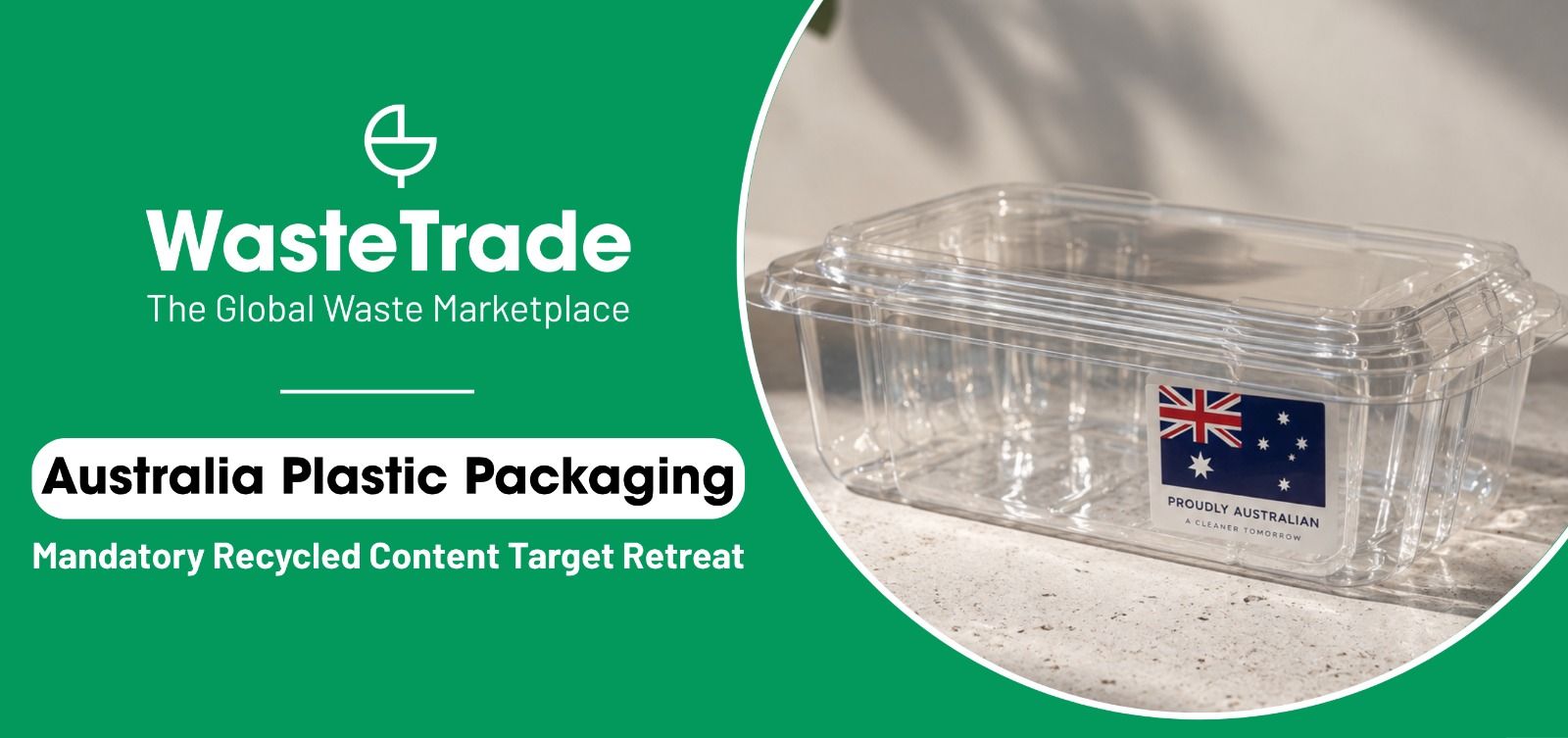
Australia’s mandatory recycled content plans for packaging will not proceed this parliamentary term, after the federal government stepped back from a 2023 commitment to introduce national rules requiring packaging producers to use minimum levels of recycled material.
The proposed rules would have guaranteed a baseline of demand for recycled material in new packaging. The government has cited cost-of-living pressures as a central reason for postponement and will instead work with states and territories on existing packaging regulation.
Australia has not abandoned packaging regulation altogether. The current co-regulatory system remains, and businesses must continue working towards the National Packaging Targets. What has changed is the prospect of a Commonwealth scheme that would have turned key voluntary ambitions into mandatory requirements.
What Happened to Australia’s Packaging Reform?
Australia’s environment ministers agreed in 2023 that voluntary targets and design guidelines were not delivering fast enough. The proposed reforms included minimum recycled-content requirements, stronger packaging-design rules and restrictions on harmful chemicals.
The decision follows years of consultation. In 2024, consultation found strong support for national action. The government now says it wants to balance environmental outcomes with wider economic pressures.
For producers, recyclers and packaging businesses, the immediate consequence is uncertainty. National rules promised a common baseline. Without them, Australia risks a slower, more fragmented path across jurisdictions.
Why Mandatory Recycled Content Matters
Mandatory recycled content does something that recycling targets alone cannot: it creates demand for what recyclers produce.
Australia’s latest packaging data shows the weakness of the current system. In 2023–24, only 20% of plastic packaging was recycled or composted. Just 28% of rigid plastic packaging was recovered, despite 73% having good recycling potential. Australia’s national target called for 70% of plastic packaging to be recycled or composted.
The gap is not simply about whether households use the right bin. Recycling works as an economic system only when recovered material returns to manufacturing at sufficient scale.
A plant can sort, wash and reprocess plastic. But if manufacturers can buy virgin polymer more cheaply and face no obligation to use recyclate, the loop remains commercially fragile.
Australia Has Recycling Capacity, but Not Enough Demand
The Australian Government has committed more than $200 million through the Recycling Modernisation Fund. Together with state, territory and private investment, the programme represents about $1 billion in recycling infrastructure, with announced projects expected to add more than one million tonnes of annual processing capacity.
Yet industry analysis commissioned by the Australian Council of Recycling and the Australian Packaging Covenant Organisation estimated plastic recycling facilities were operating at around 53% utilisation. Without stronger demand-side intervention, the modelling suggested that figure could fall to about 32% by 2030.
Australia has helped finance more recycling capacity while the resulting recyclate still competes with cheaper virgin and imported alternatives.
Recycling Plastics Australia Shows the Stakes
The pressure is no longer theoretical.
Recycling Plastics Australia entered voluntary administration in early September, putting about 60 jobs at risk. In 2024, the federal government announced a $20 million investment in technology at its South Australian operation, intended to divert more than 14,000 tonnes of soft plastics from landfill each year.
One company cannot represent an entire sector. Its administration still illustrates the gap between installing recycling capacity and sustaining a viable recycling business.
Infrastructure needs throughput. Recyclers need dependable buyers. Without both, public investment can create technical capacity without creating a durable market.
The Cost-of-Living Argument Needs Scrutiny
The government’s concern about household budgets deserves serious treatment. Australian consumers have faced sustained pressure from housing, food and energy costs. Regulation that materially raises everyday prices should face proper scrutiny.
The difficulty is that the scale of the claimed packaging cost remains unclear.
The ABC reported that the government had not completed a regulatory impact statement and did not provide its own modelling showing how mandatory standards would affect living costs.
Industry modelling points to a relatively modest direct effect. MRA Consulting estimated mandatory recycling standards could add about 0.3 Australian cents to each packaged item, or roughly 20 cents to a hypothetical weekly shop containing 60 packaged products. Separate APCO-backed modelling estimated broader national packaging reform could add around 0.1% to product costs.
These are industry-commissioned estimates, not settled government figures. They still strengthen the case for comparing the cost of reform with the cost of delay.
The Costs Do Not Disappear
Keeping packaging cheaper at the point of sale does not make waste free.
Councils still collect it. Ratepayers support waste services. Governments fund recycling infrastructure. Landfill carries long-term costs, while escaped plastic creates damage that never appears on a supermarket receipt.
ACOR and APCO-commissioned modelling estimated that the cumulative environmental cost associated with Australia’s present plastics system could exceed $32 billion by 2050. That figure remains a modelled estimate, but it identifies a genuine policy problem: visible costs today can crowd out larger, dispersed costs tomorrow.
Cost-of-living policy and circular-economy policy are not opposites. Both concern how costs move through households and the wider economy.
Australians Still Want Stronger Plastic Packaging Laws
Public opinion also complicates the idea that packaging reform and household interests necessarily pull in different directions.
A YouGov poll of 1,501 Australian voters, commissioned by the Australian Marine Conservation Society in May 2026, found that 63% supported mandatory packaging laws replacing voluntary targets. Some 89% thought Australia should act to limit its reliance on imported single-use plastic packaging, while 62% supported making companies responsible for the collection and disposal costs associated with their packaging.
The commissioning organisation has an environmental interest, but the results indicate substantial public appetite for stronger action.
Australians can worry about grocery bills and still want less plastic waste. Serious policy has to accommodate both concerns.
Recycled Plastic Is a Specification, Not a Category
Broad policy debates often miss a practical constraint: recycled material is not interchangeable.
A packaging manufacturer may need a particular polymer, grade, contamination threshold, food-contact status, volume and delivery schedule, plus evidence of origin and recycled content.
WasteTrade’s work across secondary-material markets makes this commercial reality visible. Recycling capacity is measured in tonnes, but demand is measured in specifications.
A country can have unused recycling capacity while manufacturers struggle to source compliant material. Better market connectivity cannot replace policy, but it can reduce friction between recyclate and viable end users.
WasteTrade’s Digital Product Passport model follows the same logic. By linking a material batch with information on origin, custody, composition, processing and recycled content, traceability becomes part of the material’s commercial value rather than an administrative afterthought.
Mandatory Recycled Content Creates a Market Signal
This is the strongest economic case for mandatory recycled content.
It does not guarantee that every recycling plant becomes profitable, nor does it solve collection, contamination, packaging design or food-safety constraints. It does give manufacturers a structural reason to procure recycled material when virgin polymer is cheaper.
Other major markets are moving in that direction. European packaging rules increasingly set recycled-content requirements, while the UK Plastic Packaging Tax encourages packaging with at least 30% recycled plastic.
Australia now faces a different trajectory, at least for this parliamentary term. Recycling businesses, packaging manufacturers and financiers make long-term commitments. Uncertain future demand makes those commitments harder to justify.
What Happens to Australia’s Packaging Rules Now?
The existing system continues. The Department of Climate Change, Energy, the Environment and Water says businesses must still meet co-regulatory obligations and keep working towards the National Packaging Targets.
Political pressure will continue too. The Greens have pledged to campaign for stronger packaging laws. Separately, a Senate inquiry into an Extended Producer Responsibility bill found broad support for reform but recommended that the specific bill should not pass because of concerns about design and implementation.
The distinction matters. The debate is increasingly less about whether Australia’s packaging system needs reform than about what form that reform should take.
Australia Still Needs a Market for Recycled Plastic
The central problem survives the government’s decision.
Australia can improve collection, build plants and ask households to separate waste more carefully. None of those measures closes the loop unless manufacturers have a commercial reason to buy the material that comes back out.
Marketplaces such as WasteTrade can connect verified suppliers with suitable end users and preserve the provenance that increasingly matters to buyers. They cannot manufacture demand where the economics consistently favour virgin material.
That is why shelving mandatory recycled content matters beyond environmental politics. It affects the demand signal on which recycling investment depends.
Protecting households from unnecessary costs is a legitimate objective. So is preventing today’s affordability pressures from becoming tomorrow’s larger waste, infrastructure and resource costs.
Australia has already invested heavily in its capacity to recycle plastic. The harder task is making sure somebody wants to buy what that capacity produces.