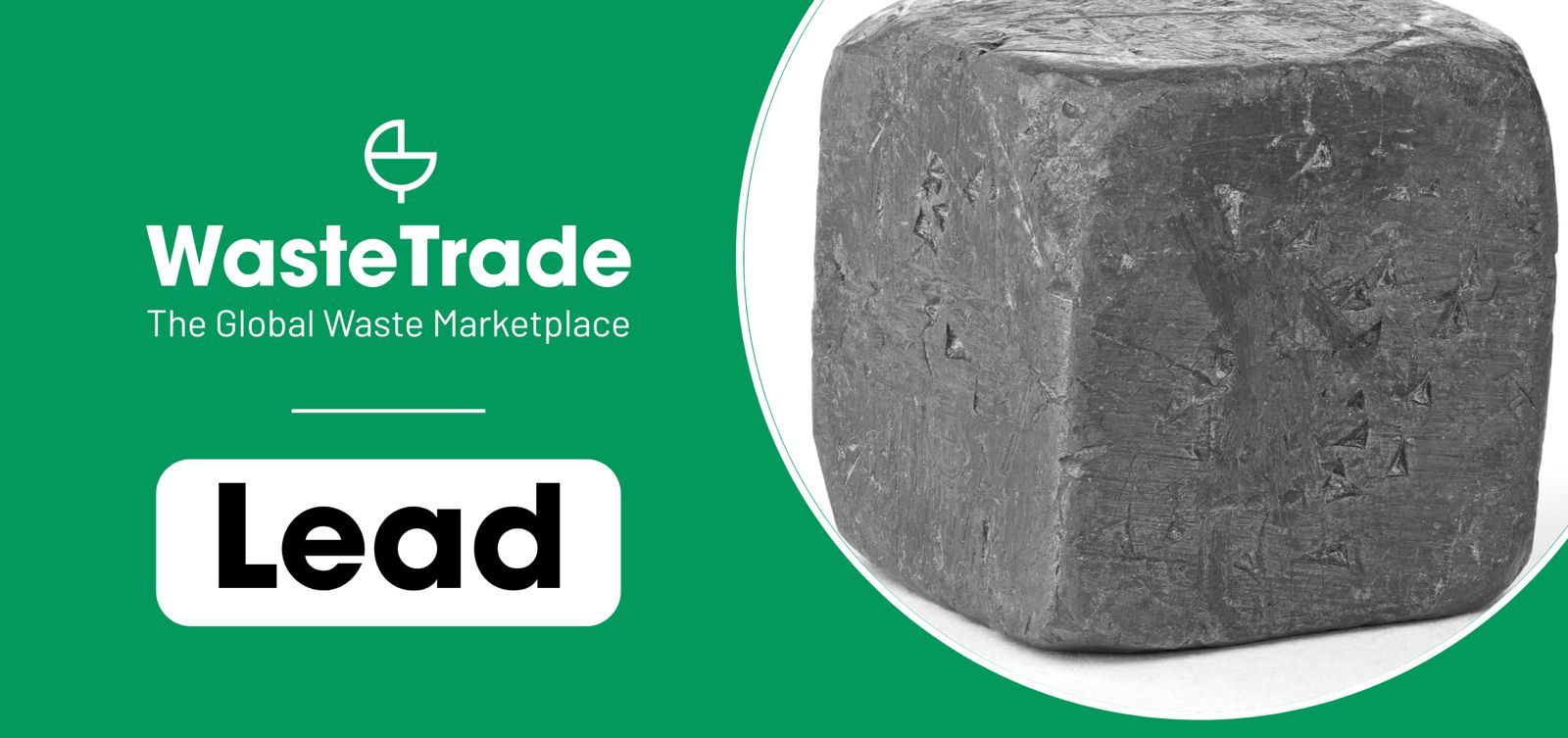
Lead Metal: Key Information
- Lead is a dense, soft, non-ferrous metal with the chemical symbol Pb and atomic number 82.
- Lead metal is used extensively in batteries, radiation shielding, roofing, cable protection, weights and specialist industrial applications.
- Key properties covered include lead density, melting point, hardness, magnetism, colour and corrosion behaviour.
- Pure lead, lead alloys, lead oxides and lead ore are different forms or sources of lead and have different commercial and processing considerations.
- Lead alloys can contain metals such as antimony, calcium or tin, which alter properties and influence buyer requirements.
- Lead is highly recyclable, with secondary lead representing a significant part of global lead supply.
- Material form, composition, contamination, quantity and location can influence how commercial lead is bought, sold and recycled.
- WasteTrade enables businesses to list, source, buy and sell lead, lead scrap and recycled lead materials with verified commercial counterparties.
Lead Metal
Lead Metal is one of the most established industrial metals in use today, valued for its high density, low melting point, softness, corrosion resistance and ability to be recovered and used again. The chemical element has the symbol Pb and atomic number 82, but commercially the more important question is usually not simply what lead is. It is what form the lead is in, what specification it meets, where it is located and whether it is a usable raw material, a recyclable waste stream or a secondary commodity ready to return to manufacturing.
For businesses, Lead Metal can represent both a cost and an asset. Manufacturers may generate lead offcuts, rejected components or other lead-bearing material. Demolition and recovery businesses may encounter lead sheet, pipe, cable or other products. Battery recyclers and secondary smelters handle far larger lead-bearing streams. Manufacturers and processors, meanwhile, require reliable sources of metal and secondary raw material.
WasteTrade brings the commercial sides of that market together. Businesses with recyclable material can present it to verified buyers and processors, while buyers can search for suitable waste and recycled commodities. WasteTrade supports the transaction with counterparty verification, logistics, compliance and secure payment, helping businesses trade material beyond the limits of an established local contact book.
Lead Metal also has an unusually strong relationship with the circular economy. More than 60% of global lead production originates from end-of-life products, according to the International Lead Association, while more than 85% of global lead use goes into automotive and industrial batteries. That combination makes the market for recovered lead commercially significant rather than peripheral to the primary metal industry.
If you have Lead Metal or lead-bearing material to sell, the quality of the commercial information matters. Material type, grade, quantity, location, photographs, availability and any known specification all help buyers understand what is being offered. WasteTrade listings are structured around exactly this kind of information, allowing commercial interest to form around the actual material rather than a vague description of “scrap lead”.
Lead Metal Buying, Selling and Recycling on WasteTrade
Lead Metal buying and selling is most effective when both parties can see what material is being traded and understand the conditions surrounding the load. A piece of clean lead sheet, an alloyed manufacturing offcut and a lead-bearing battery stream may all contain valuable lead, but they are not commercially interchangeable.
For sellers, this means describing the material accurately rather than relying on the word “lead” alone. Useful listing information can include the physical form, estimated or confirmed grade, total tonnage, number of loads, location, packaging, availability and whether the supply is a one-off lot or a recurring stream. Representative photographs of the actual material can answer basic questions before a buyer places a bid.
For buyers, WasteTrade provides access to verified counterparties and material listings that can be assessed against purchasing requirements. Once a transaction is agreed, the platform can support the movement of the material through logistics, compliance and secure payment.
Lead Metal therefore sits within a wider commercial chain. This page explains the material itself. For end-of-life recovery and processing, see Lead Recycling. For valuation and the factors behind an offer, see Lead Scrap Price.
What Is Lead Used For?
What Is Lead Used For is a question with a very commercial answer because modern demand is heavily concentrated in applications that eventually create recyclable material streams. The largest use by far is in lead batteries, including automotive starting batteries, motive-power batteries and industrial standby systems. More than 85% of global lead is used in automotive and industrial battery production.
Outside batteries, lead is used where its particular physical properties are valuable. Its density makes it effective for radiation shielding and counterweights. Its corrosion resistance and workability have supported applications in roofing, architecture and cable protection. Lead and lead alloys also have specialist industrial uses where a particular combination of weight, softness, chemical resistance or metallurgical behaviour is required. The Royal Society of Chemistry lists current uses including car batteries, cable sheathing, weights, radiation protection, roofing and certain solders.
For the recycling market, the important point is that these uses create different kinds of secondary material. A battery stream needs a different recovery route from clean fabrication offcuts. Lead-covered cable is different from clean lead solids. The original use is often therefore a useful clue to the material's composition and appropriate downstream buyer.
Is Lead A Metal?
Is Lead A Metal can be answered simply: yes, lead is an elemental metal. It is a non-ferrous metal, meaning it does not contain iron as its defining base metal, and pure lead consists of the chemical element Pb.
Commercially, however, it is useful to separate three related ideas. Pure or refined lead is metallic lead meeting a particular chemical specification. Lead alloy is metallic lead combined with controlled quantities of other elements to alter its performance. Lead compounds, such as lead oxides, contain lead chemically bonded with other elements and are not the same material as metallic lead.
That distinction matters when Lead Metal is bought, sold or recycled. A buyer looking for a known lead alloy may have a very different specification from a processor taking mixed lead-bearing feedstock. A seller who can identify the actual material rather than describing everything as “lead” gives the market a better basis on which to price it.
Where chemistry is known, include it. Where it is not, avoid making unsupported claims about purity or alloy grade. Accurate descriptions reduce the risk of rejected, repriced or disputed material.
Lead Properties
Lead Properties explain much of the metal's continuing industrial value. Lead is very dense, relatively soft, easy to work, corrosion resistant and low-melting compared with many common engineering metals. Pure lead has a density of about 11.3 g/cm³ and a melting point of 327.462°C. It normally appears dull silvery-grey and is solid at room temperature.
These properties should not be viewed as a checklist detached from commercial use. Density affects transport and load planning. Softness makes lead easy to form but also means visual shape is a poor indication of grade. Its melting behaviour is relevant to casting and secondary processing. Corrosion resistance explains why lead has been used in long-lived building and industrial applications.
The properties of Lead Metal also change when it is alloyed. A battery grid, for example, is not simply a piece of chemically pure lead. Small additions of other elements can alter strength, hardness and casting behaviour.
For buyers and recyclers, this is why specification matters. Identifying the material's origin, physical form and known composition is more commercially useful than simply knowing that an object looks and feels like lead.
Lead Density
Lead Density is approximately 11.3 g/cm³ at room temperature, which is why a relatively small volume of lead feels exceptionally heavy in the hand.
In bulk trade, Lead Density has a practical consequence: tonnes accumulate quickly without occupying much physical space. A load that looks modest by volume can still be very heavy. Transport economics therefore need to be considered by weight, vehicle limits, packaging and collection location rather than visual volume alone.
Density can also provide a useful clue when identifying an unknown material, but it should not be treated as a commercial grade test. Several metals and alloys are dense, and coatings, voids, attached materials or mixed construction can make simple volume-to-weight assumptions unreliable.
For sellers, the better approach is to provide an accurate weight and material description. For buyers, confirmed tonnage and loading conditions allow freight to be assessed properly. On WasteTrade, location and quantity are therefore central pieces of a listing because the commercial value of a dense material such as lead cannot be separated entirely from the cost and practicality of moving it.
Lead Melting Point
Lead Melting Point is 327.462°C, or 621.432°F, for pure lead.
That comparatively low melting point is one reason lead has historically been easy to cast and form. It is also relevant to secondary processing, where recovered metallic lead can ultimately be melted, refined as required and cast back into usable forms.
Melting should not, however, be confused with smelting. Melting is a physical change in which metallic lead becomes liquid. Smelting is a metallurgical process used to recover metal from lead-bearing compounds or materials through chemical and thermal treatment. A clean piece of metallic lead and a battery-derived lead-bearing material therefore do not require the same processing route.
For businesses selling Lead Metal scrap, there is rarely a commercial reason to melt material simply to make it saleable. Buyers are generally more interested in what the material is, how much there is, how clean it is and whether its chemistry is known. Unnecessary processing can even make material harder to verify if distinct grades are combined.
Lead Melting Temperature
Lead Melting Temperature describes the temperature at which pure metallic lead changes from solid to liquid, but real commercial scrap is not always chemically pure lead. This matters when people expect every lead-bearing material to behave exactly like a laboratory sample at 327.462°C.
Lead alloys may have different melting behaviour depending on their composition. Contaminants, attachments and non-metallic material can also change how a scrap stream behaves during industrial processing. Battery-derived feedstock is more complicated again because it can contain metallic lead, lead compounds and other battery components before separation and treatment.
Lead Melting Temperature is therefore useful material science, but it should not be used as a crude test of commercial grade. Recyclers and secondary processors control furnace conditions according to their process and feedstock, not according to a single internet melting-point number.
For sellers, identifying and segregating known grades is more useful than trying to process them. For buyers, a clear material specification allows the appropriate recovery or refining route to be assessed before the load is purchased.
Is Lead Magnetic
Is Lead Magnetic has a straightforward answer: lead is not attracted to an ordinary magnet in the way iron or carbon steel is. Lead is diamagnetic.
That makes magnet testing useful in one limited commercial sense. If a supposed lead scrap stream contains obvious magnetic steel attachments, a magnet can help reveal that ferrous contamination. It cannot prove that a non-magnetic grey metal is lead.
This distinction matters during sorting. Aluminium, copper, zinc, many stainless steels and numerous other metals may also fail to respond to a simple magnet in the way mild steel does. A magnet is therefore a sorting aid, not an identification certificate.
Where the source of Lead Metal is known, that provenance can provide useful information. Where it is not, professional analysis may be appropriate, particularly if chemistry will affect a buyer's process or the commercial value of the load.
A good WasteTrade listing should describe what is actually known about the material. Buyers can then judge whether the origin, photographs, grade information and any available analysis meet their purchasing requirements.
Lead Hardness
Lead Hardness is low. Lead is a notably soft metal that can be cut, marked and deformed much more easily than many common engineering metals.
Softness is sometimes confused with low weight or poor value, neither of which follows. Lead is both soft and extremely dense. Its softness gives it useful forming and fabrication characteristics, while its density gives it very different handling and transport characteristics.
Hardness also varies with composition. Lead alloys can be designed to be harder or mechanically stronger than high-purity lead, which is one reason alloy identity can matter commercially. An unknown hard lead item should not automatically be assumed to be pure lead simply because lead is the dominant metal.
For scrap sellers, physical softness can be a clue but not a specification. For buyers, known origin and chemistry carry more weight than a scratch test. If a manufacturing business has segregated production scrap from a known lead alloy, preserving that segregation can be considerably more useful than mixing it into a general lead scrap pile.
What Colour Is Lead?
What Colour Is Lead is best answered by distinguishing a fresh metallic surface from one that has been exposed to normal conditions. Freshly cut lead can look silvery or bluish-grey, while exposed Lead Metal usually develops the familiar dull grey appearance. The Royal Society of Chemistry describes lead as a dull, silvery-grey metal.
Colour can help with a first visual assessment, but it is weak evidence of grade. Surface oxidation, dirt, paint, coatings and previous use can all change the appearance. Different lead alloys can also look very similar to one another.
This is why representative photographs are commercially useful but should not be treated as chemical analysis. WasteTrade asks sellers to use images of the actual material being offered rather than generic pictures, helping buyers understand its physical condition before bidding.
If material is painted, coated, attached to another substrate or heavily contaminated, that information should be stated. A clear description of condition is more useful to a serious buyer than trying to make old lead look cosmetically attractive.
Does Lead Rust
Does Lead Rust has a technically simple answer: no, because rust specifically refers to the corrosion products associated with iron and steel. Lead can corrode and tarnish, but it does not form iron rust.
Lead is relatively resistant to corrosion in many environments, one reason it has historically been used in roofing, cable sheathing and other applications where long service life is useful. A weathered lead surface can become dull and oxidised while the underlying metal remains recoverable.
For scrap trading, surface appearance should therefore not be confused with material identity or automatically treated as a loss of all commercial value. What matters more is the actual composition of the load, the degree of contamination, attached materials and the downstream process required.
Severe contamination, chemical residues or mixed material can change the commercial position, but ordinary dulling is not unusual for old lead.
When selling recovered Lead Metal, describe where it came from and its physical condition. This gives potential buyers more meaningful information than a simple statement that the material is “old” or “corroded”.
Lead Alloy
Lead Alloy is metallic lead deliberately combined with other elements to produce a composition suited to a particular application. Alloying can change hardness, strength, casting characteristics, corrosion behaviour and other properties.
Lead battery grids provide an important example. Battery manufacturing uses lead alloys containing small percentages of other metals, rather than treating every component as chemically identical pure lead.
Commercially, Lead Alloy material should be treated as a specification question. A processor may value a known alloy because it fits a particular production requirement, while unknown mixed alloy scrap may require testing or refining before it can be used. The same principle applies to manufacturing offcuts. Material from a controlled production process can carry useful information that may be lost if it is mixed indiscriminately with other scrap.
If a certificate, assay or production specification is available, it can help qualified buyers assess suitability. If no chemistry is known, the listing should say so.
WasteTrade customers selling material benefit from presenting the strongest accurate specification they possess. Better information makes it easier for suitable buyers to distinguish a useful feedstock from an uncertain mixed stream.
Lead Oxide
Lead Oxide is a broad term covering several lead and oxygen compounds rather than one single commercial material. Important examples include lead monoxide, PbO, and lead dioxide, PbO₂. Lead oxides have particular relevance to lead-acid battery chemistry.
In battery manufacture, lead oxide is used in the active material applied to battery grids, while the charged positive plate involves lead dioxide. Battery Council International describes lead oxide, sulphuric acid, lead-alloy grids and other components as part of lead-battery manufacture.
The commercial distinction is important because Lead Oxide is not the same thing as clean metallic Lead Metal. A waste stream containing lead compounds can require a different controlled recovery process from a clean metallic offcut.
Businesses should therefore avoid describing all lead-bearing material as “lead metal”. If the material is battery-derived, a process residue or another lead compound, that provenance may determine which recycler can accept it and how it must be handled.
For the recovery route used for lead-acid batteries and other lead-bearing streams, see the Lead Recycling guide.
Lead Ore
Lead Ore is the primary geological source from which newly mined lead is produced. The principal lead mineral is galena, lead sulphide, PbS, which is processed through mineral concentration and metallurgical operations before refined primary lead is produced.
For WasteTrade customers, the more relevant distinction is between primary and secondary lead. Primary lead originates from mined mineral resources. Secondary lead is produced from recycled lead-bearing material.
That secondary market is unusually important. More than 60% of current lead production comes from end-of-life products according to the International Lead Association.
Lead Ore therefore explains only one side of the supply chain. A large part of the metal used by modern industry has already had a previous life.
This is where recycling becomes commercially significant. End-of-life batteries, fabrication scrap and suitable lead-bearing waste can become feedstock for secondary processors rather than being treated simply as disposal material. WasteTrade exists to make those circular transactions easier by connecting businesses with material to verified businesses able to use or process it.
FAQs
Lead Metal FAQs
What is the melting point of lead?
Pure lead melts at 327.462°C, equivalent to 621.432°F.
Is lead toxic?
Yes. Lead is a toxic metal, and the World Health Organization states that there is no level of lead exposure known to be without harmful effects.
Is lead a heavy metal?
Yes. Lead is commonly classed as a heavy metal and has a density of approximately 11.3 g/cm³.
What is lead made of?
Pure lead consists of the chemical element Pb; commercial lead products may instead be alloys or lead-containing compounds.
What lead is used for?
Most global lead use is in automotive and industrial batteries, with other uses including shielding, roofing, cable protection, weights and specialist industrial applications.
Uses of lead metal?
Lead metal is used where properties such as high density, workability and corrosion resistance are valuable, particularly in batteries, shielding and selected building and industrial products.
Properties of lead metal?
Lead metal is dense, soft, malleable, relatively corrosion resistant, non-ferrous and low-melting compared with many common engineering metals.
Is lead soft?
Yes. Pure lead is a very soft, easily worked metal, although lead alloys can be made harder.
Is lead heavier than steel?
Yes. Lead is considerably denser than typical steels, so an equal volume of lead weighs substantially more.
How much does lead weigh?
Solid pure lead has a density of about 11.3 g/cm³, meaning one litre of solid lead weighs approximately 11.3 kg.
Does lead corrode?
Yes. Lead can corrode and oxidise, although it is relatively corrosion resistant and does not form the iron oxide commonly described as rust.
What is lead metal used for?
Lead metal is used primarily in lead batteries, with further applications in shielding, roofing, cable protection, weights and specialist alloys.
Is lead expensive?
Lead has a globally traded commodity value, but the value of an individual load depends on its form, specification, quantity, location and current market conditions.
How heavy is lead?
Lead is very heavy for its volume, with a density of approximately 11.3 g/cm³.
For businesses holding recyclable Lead Metal, the next question is normally commercial rather than scientific. If you need an appropriate recovery route, continue to Lead Recycling. If the priority is establishing what your material may be worth, continue to Lead Scrap Price and present the actual load to WasteTrade buyers.


